
Dar es Salaam – The treason trial of opposition leader Tundu Lissu has formally resumed at the High Court, Dar es Salaam Sub-Registry, following a lengthy suspension that ended when the Court of Appeal recently dismissed the prosecution’s revision application.
On August 10, 2026, Assistant Commissioner of Police (ACP) Amin Mahamba, the chief investigator in the case, took the stand as a prosecution witness before a three-judge panel led by Judge Dunstan Ndunguru.
The trial’s resumption comes after a prolonged legal battle over the prosecution’s attempt to introduce additional evidence, which was finally resolved on July 30 when the Court of Appeal ruled in Mr Lissu’s favour.
ACP Mahamba, an officer with 26 years of experience currently attached to the Directorate of Criminal Investigations (DCI) cybercrime and national security unit, detailed how the police built their case.
In his examination-in-chief led by Principal State Attorney Nassoro Katuga, ACP Mahamba testified that on April 8, 2025, he was assigned to coordinate the investigation into a treason file already opened at the Dar es Salaam Special Police Zone. He explained that he was informed about the task by his supervisor DCP Ramadhan Ng’azi.
He went to the Police Central station and met with the deputy ZCO George Bagyemu where he was handed a case file for treason with file number CDS/IR/727/2025. He went on to explain that he formed three teams: first team for operation that had the mandate to arrest and confiscate, led by one- Assistant Inspector Michael, with other team members including Corporal Ibrahim and Corporal Ramadhani.
The second team for intelligence which included Assistant Inspector Nunu as well Senior Superintendent Reuben Mwakaboka and the third team for legal advice.
The investigation centred on a video published on the Jambo TV YouTube channel. ACP Mahamba told the court that his team spent approximately two hours analysing the video, which showed Mr Lissu wearing a CHADEMA combat uniform, speaking in Swahili with national and party flags in the background.
READ MORE: Court of Appeal Deals Blow to Prosecution, Dismisses Revision Bid in Lissu Treason Trial
“According to what he said, my team and I observed that the defendant, Tundu Antiphas Lissu, intended to intimidate the government to act according to his wishes.”
“The act of intimidating the government by obstructing the election and inciting a rebellion is itself treason.”
[Laughter in the courtroom]
He continued to cite Section 39(2) of the Penal Code.
Interpreting kukinukisha
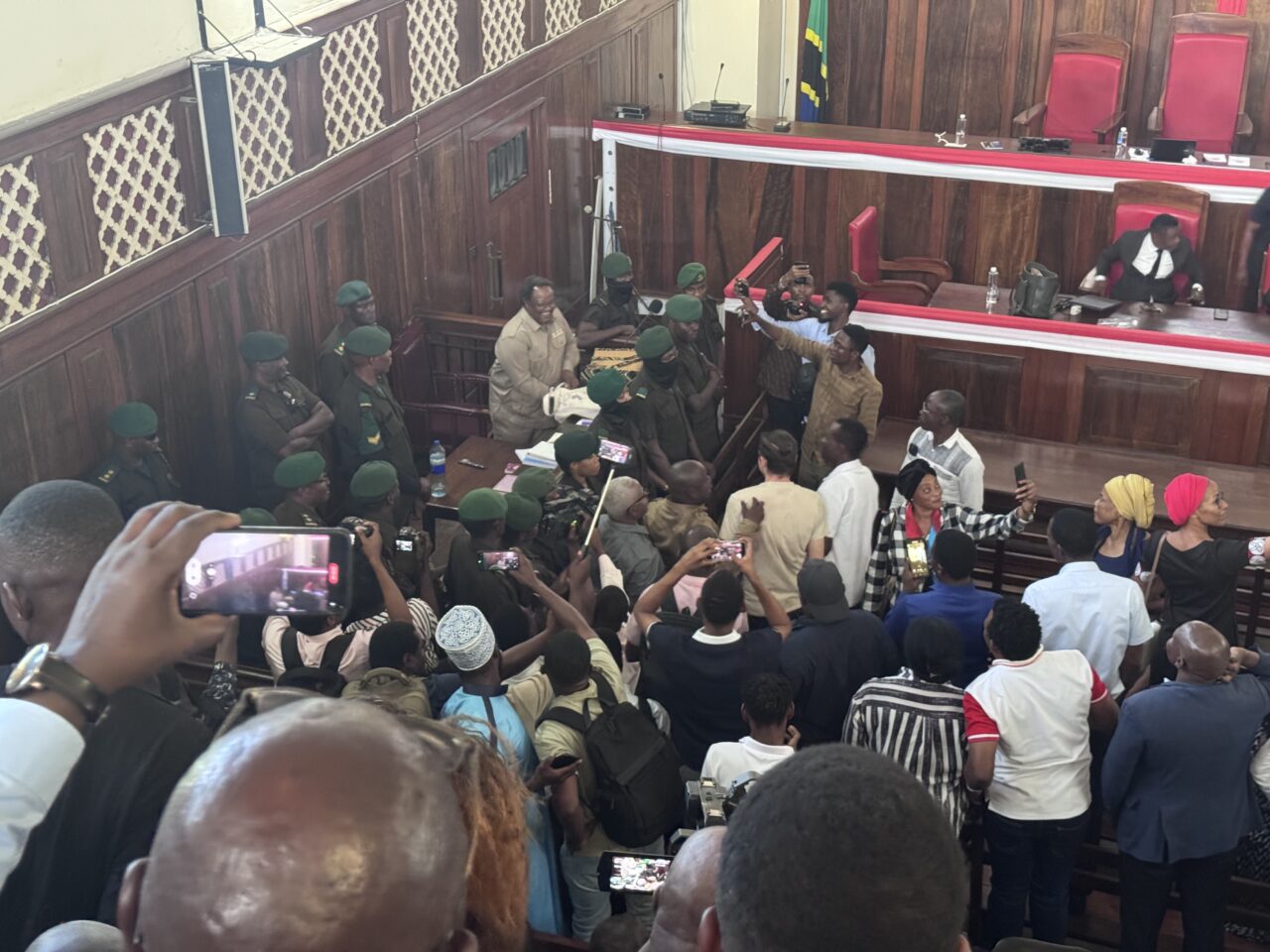
In the course of cross examination the State Attorney asked the witness to explain the results of their investigation, this caused a fierce exchange as Tundu Lissu raised an objection to the line of questioning.
Witness: The defendant, Tundu Antiphas Lissu, is a citizen of Tanzania. As a Tanzanian citizen, he owes a duty of allegiance both within and outside Tanzania.
Principal State Attorney Nassoro Katuga: Who is that allegiance owed to?
Witness: To the United Republic of Tanzania.
State Attorney: What did you find out in your investigation
“In the course of our investigation, those remarks kukinukisha [to make it smell] were found to be aimed at carrying out acts that could obstruct the election from taking place, acts such as causing chaos and tearing up ballot papers.”
Lissu: I object to this line of questioning. I have not been charged with inciting people to tear up ballots, so I fail to see the relevance of these statements, this is a fishing expedition. If they had intended to charge me over torn ballots, they should have brought that charge directly, not smuggled it in through the back door. This is not right.
Prosecution: The witness has every right to state what he observed during the investigation. Preventing him from testifying is highly unfair.
The judges confer among themselves, with Lissu watching the prosecution bench, one hand resting on his chin. The lead Judge Dunstan Ndunguru went on and offered further opportunity for the two sides to speak before them deciding. The prosecution maintained that it was unfair for the witness testimony to be discarded at that point, whereas Lissu went on to increase the intensity of his argument.
Lissu: The witness does not have the right to give evidence on just anything. Under Section 156(b) of the Evidence Act, examination-in-chief must relay relevant facts. Whatever he says must be relevant. A great deal has been said in the charge sheet, but nothing about tearing or beating anyone. If you allow this in, you are opening Pandora’s box. Do not allow the prosecution to introduce matters that they have not charged the accused with. They are required to provide evidence on the allegations contained in the charge.
The danger is that if you admit evidence that is not relevant and it becomes litigated, you will be obliged to rule on it, and in doing so, you will have shifted from a treason trial to a trial about torn ballot papers.
Justice Ndunguru: We had already reviewed this matter. The Court rejected the notice of additional substance, and it appears that is exactly where this is heading. That notice concerned the investigation into the events of 29 October. What is being raised now, regarding the conduct of the investigation, the reference to tearing up ballots, refers to something that had not yet occurred at that time.
READ MORE: Lissu Treason Trial Halted as Prosecution Flees to Appeals Court After Defeat
Prosecution: We consider this totally unfair; this is something the witness obtained directly from the investigation. We refer the Court to the evidence of PW3, who testified that those who went out to vote would see what the woodcutter sees— [a Swahili warning implying they would face harsh consequences].
The judge asks to review the relevant documents. After roughly ten minutes of review, he addresses the court. The witness is to be guided to avoid matters the Court has already ruled on.
Witness protection claims
The witness explained that he had received reports from various regions that people had been arrested in connection with that speech, and that he had accordingly called for the case files in order to review the evidence.
The investigation file for Kilimanjaro region was KR/CID/PE/182025; another, for Arusha, was ARS/CID/PE/402025; another arose in Mbeya, MBE/CID/PE/542025; another in Ruvuma, SOG/987/2025, concerning conspiracy to hold demonstrations; and another in Dar es Salaam, DSMZ/CID/PE/1012025.
“Essentially, after reviewing these files, we established that many of the individuals involved had been incited, and we found that most of them were CHADEMA supporters, with others being sympathizers. We directed that officers return to the regions to trace these individuals, and we issued instructions for them to be located and for written directives to be prepared,” Witness said.
The testimony also shed light on the prosecution’s earlier controversial request to conceal the identities of certain witnesses.
ACP Mahamba testified that after Mr Lissu was arrested in Mbinga on April 9, 2025, and charged the following day, the police received complaints from some witnesses who feared for their safety.
READ MORE: Tundu Lissu Warns of ‘Pandora’s Box’ in Fiery Clash Over New Evidence
The investigator claimed these threats were made on social media platforms like Instagram, Facebook, and TikTok, primarily by CHADEMA supporters.
This perceived threat led the National Prosecutions Office to file a special application for witness protection, resulting in the concealed witness booth that became a major point of contention earlier in the trial.
Cross-examination begins
Lissu was given the opportunity to cross-examine the witness at around 4:00 p.m., opening with a series of provocative questions that appeared designed to set the witness up for the strategy that would follow.
Lissu: If I said you rose through the ranks by fabricating false cases against people, what would you say?
Witness:That is not true.
Lissu: And if I told you that you rose through the ranks by torturing suspects in police custody, what would you say?
Witness: That is not true.
Lissu:And if I said you lack integrity and are, in fact, unfit to wear a police uniform, what would you say?
Witness: That is not true.
Lissu then showed the witness a document containing a statement written by ACP Mhamba and asked him what it was; the witness clarified that it was his own statement.
Lissu: A statement prepared for what purpose, for sentencing, or for giving evidence?
Witness: For giving evidence.
Lissu explained that he intended to use the witness’s statement to demonstrate that the witness lacked credibility, and requested that he be provided with the original copy. The state attorneys handed the witness the original, at which point he was seen removing the glasses he had been wearing since that morning.
Lissu then asked the witness to confirm that it was indeed the original copy, dated 30 April 2025, and to confirm whether it bore his signature, which the witness confirmed.
Lissu then identified 54 separate points that he described as contradictions, beginning with the very first details of the witness’s identification and continuing through to the end of the statement, an approach that appeared designed to prevent the prosecution from identifying which specific points carried weight for the defence’s strategy. Lissu subsequently asked the witness to agree that the exhibit be admitted by the Court so proceedings could continue; the witness appeared to hesitate.
At that point, the state attorney rose and explained that procedure required the substance of the alleged contradictions to be disclosed before the Court could proceed to admit the exhibit. The state attorneys cited the case of Lilian Jesus Fortes v. Republic.
Lissu responded with his own arguments, stating that the matter had already been resolved back when he was cross-examining the second prosecution witness, and cited Section 163 of the Evidence Act, maintaining that the prosecution’s position reflected their own preferred practice rather than any actual legal requirement.
After extended argument from both sides, the judges took time to deliberate. Lissu appeared in good spirits; as the courtroom fell silent, Lissu kept making a gesture with his hand near his neck, to depict he is winning the argument and prosecution is drowning, a gesture which made many of his supporters break into smiles, visibly lifted.
After roughly half an hour, the judges announced their decision, explaining that there are three recognised steps for using a witness’s statement to demonstrate contradictions: first, the statement must be read; second, the areas of contradiction must be read out; and third, the statement must be formally tendered, steps which the judges confirmed had indeed been followed.
Following the Judge’s clarification, Lissu went back to the witness and asked him to confirm the admission of his written statement; the witness appeared to be hesitant, until state lawyers guided him to say yes.
By then it was already a quarter past five in the evening, and the Court considered adjourning for the day. However, it granted Lissu’s request for a further fifteen minutes to continue on the relevant points, as Lissu cautioned that the case has been delayed for approximately 165 days.
Lissu proceeded to question the witness on several further points, to which the witness responded, in large part, “it is not there”, meaning that statements he had made in his oral testimony before the Court did not appear in his written witness statement.
The trial is scheduled to continue on August 11, 2026, at 9:00 a.m., when Mr Lissu will proceed with his detailed cross-examination of the witness.

One Response
Congratulations The Chanzo, you have stood valiantly to defend one of the fundamental rights of freedom- access to information (and knowledge).