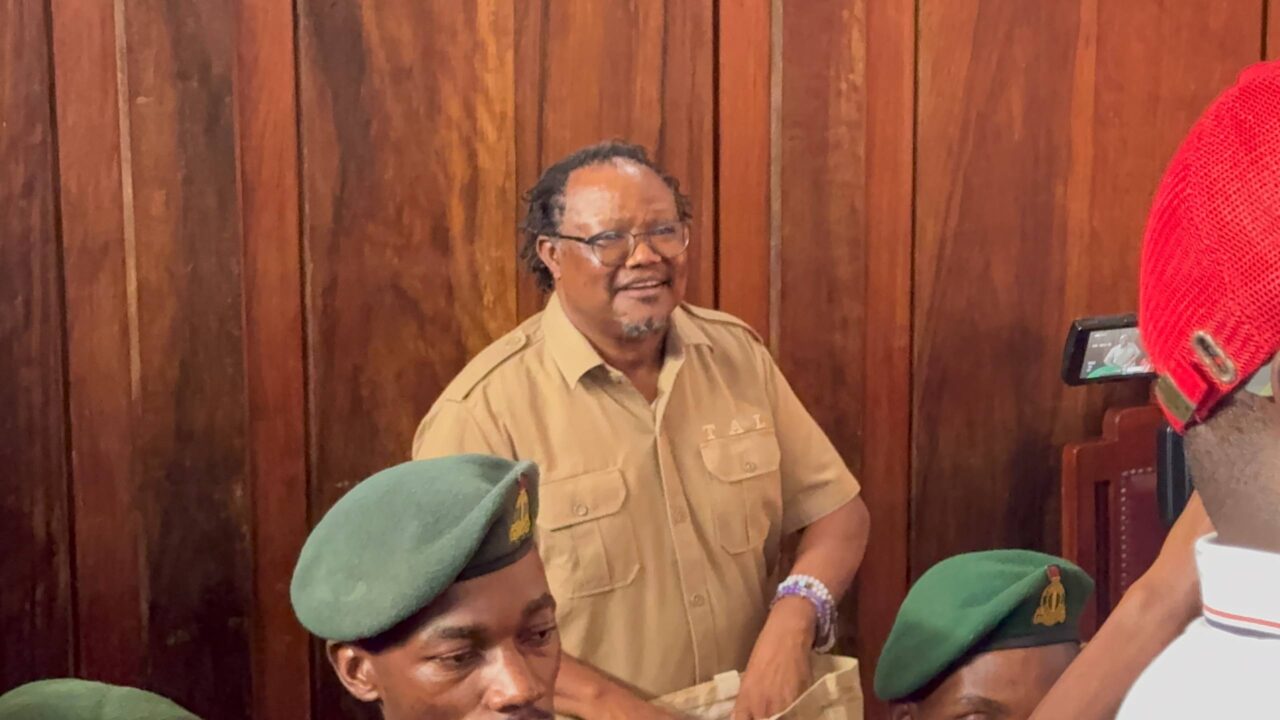

Dar es Salaam — Tundu Lissu on Friday, September 25, 2026, challenged the prosecution’s allegation that he personally published the words at the centre of his treason charge on Jambo TV’s YouTube channel, arguing that its own witnesses identified a Jambo TV journalist as the person who recorded and livestreamed the April 3, 2025 meeting.
Lissu told the three-judge High Court panel that publication is a decisive issue because the information alleges that he manifested a treasonous intention by publishing the disputed words live on the broadcaster’s online channel. He said the prosecution was required to prove that he, rather than media personnel, carried out that publication.
“They did not allege that I published through another person,” Lissu told the court. “They alleged that I published it myself.”
The court did not rule on the submission. Lissu’s closing argument was adjourned to Monday, September 28, at 9 a.m., after he began a separate argument that the prosecution had failed to prove the alleged intimidation of the government.
‘Law does not make words alone treason’
At the start of Friday’s hearing, Lissu returned to his argument that speech alone cannot constitute treason under Section 39(2)(d) of the Penal Code. He cited the Court of Appeal decision in Khatibu Gandi, which he said held that “mere words” do not amount to treason under that provision.
READ MORE: Lissu Says Treason Case Rests on Police Inference as Final Submission Continues
Lissu gave the panel a historical account of the provision, arguing that the Penal Code’s treason sections were derived from British law. He said an earlier English statute had briefly included speaking among the ways an intention could be manifested, but that provision ceased to operate in 1850 and was later repealed.
He argued that the Tanzanian provision did not create an offence of treason by words alone.
“The prosecution are trying to introduce into this country’s law something that England, which brought us the law, abandoned 176 years ago,” Lissu cautioned.
He submitted that the High Court was bound by the Court of Appeal’s ruling in Khatibu Gandi. The prosecution has yet to answer Lissu’s final submissions, and the court made no finding on his interpretation of the authorities.
Prosecution evidence on publication
Lissu argued that, under the Court of Appeal decisions he cited, publication for the purpose of Section 39 means sending out or sharing a writing or printing with a third party.
He said a video or television image may fall within definitions in the Cybercrimes Act or the Media Services Act, but maintained that he was not charged under either law.
READ MORE: Lissu Challenges Treason Charge Wording as His Final Submission Runs Into Second Day
He then reviewed the testimony of prosecution witnesses on the recording and distribution of the Jambo TV video.
Lissu said George Bagyemu, the first prosecution witness, testified that he contacted Jambo TV and was told that an employee had recorded the clip. He said Bagyemu also knew the journalist who recorded it was on duty in Dodoma.
Lissu said the journalist, identified in the proceedings as PW17, testified that he and other Jambo TV staff were directed by their editor to cover the meeting, brought cameras, and livestreamed the proceedings to the outlet’s YouTube channel and other social-media platforms.
“They knew who had recorded and published the video before they arrested me,” Lissu noted.
Lissu also pointed to what he described as conflicting prosecution testimony. He said John Kaaya, the second prosecution witness, initially said he did not know who uploaded the video, while a technical witness, PW3, said he had not established who uploaded it to the channel.
He said ACP Amin Mahamba first attributed the publication, transmission and circulation of the video to Lissu, but accepted in cross-examination that he was not sure whether Lissu was a Jambo TV employee, cameraman, presenter or had the channel’s password.
READ MORE: Tundu Lissu Closes Defence After Saying DCI Kingai Will Not Testify
According to Lissu, Mahamba also accepted that PW17 had said he recorded, livestreamed and uploaded the footage.
Lissu argued that the shifts in the prosecution account, including its reliance on what he called “constructive publication,” went to the root of the case and made the evidence unreliable.
He said all five defence witnesses had consistently testified that Jambo TV employees, not Lissu, broadcast the meeting, and that PW17’s prosecution evidence supported that account. Lissu said: “The answer to the question whether I published on Jambo TV is no. I did not publish.”
‘Intimidation of government’
Lissu then began addressing what he called the seventh issue in his final submission: whether the alleged words intimidated the Government of the United Republic of Tanzania.
He argued that Section 10 of the Penal Code required the prosecution to plead and prove the result of the alleged intention, including whether the executive had actually been intimidated. Lissu said the information did not allege that result and the prosecution had brought no witness from any government institution to establish it.
Lissu referred to his earlier requests to summon President Samia Suluhu Hassan, Vice-President Philip Mpango and Prime Minister Kassim Majaliwa, among others, to give evidence on the issue.
READ MORE: Court Blocks Bid to Re-question Heche as Lissu Eyes DCI Testimony Friday
The court had previously declined to summon the three political office holders. He said he had later been permitted to call certain security officials, but that Commissioner of Police Ramadhani Kingai had declined to testify for the defence.
“There is no evidence that the government was intimidated,” Lissu observed.
He invited the court to draw an adverse inference from the prosecution’s failure to call what he described as “necessary witnesses.” The court adjourned before he completed the seventh issue, and he is expected to continue on Monday.
The case remains at the final-submissions stage. Lissu began his final argument on September 23, after the defence case was formally closed the previous week.