

Kigoma. Jafari Kilanoza and his father have been running a small-scale oil and soap manufacturing business using palm oil in Kigoma for six years. One of the main challenges for their business has been managing the waste generated during production.
“We were discharging about 20,000 liters of wastewater per day, but we were concerned that it would end up contaminating water sources,” Kilanoza told The Chanzo during an interview.
Being self-taught producers, Kilanoza began researching alternative uses for the wastewater produced during oil and soap production.
“We took some of this wastewater one day and put it in a bottle. After putting it in the bottle, the bottle started to swell. Day by day, it kept swelling,” Kilanoza explained to The Chanzo.
“Later, we discovered that there was gas. So we conducted research and found that it ignites. And this gas requires that we add lime to it. The lime’s role is to kill the fats because there are insects that are found in them. So when the insects come into contact with the fats, what must happen? They die, and those dead insects are what produce the gas,” he added.
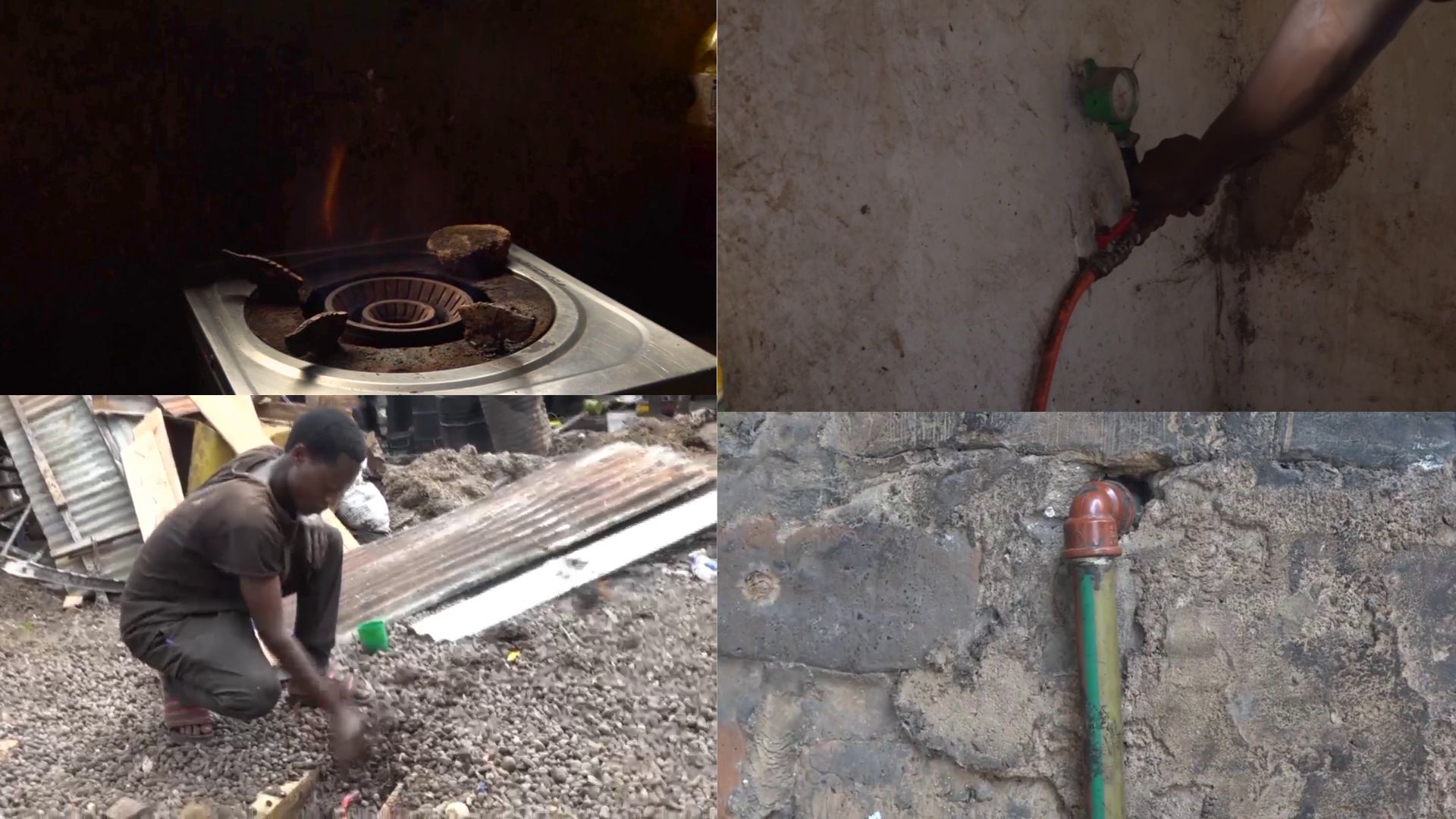
After their research, Kilanoza began using the produced gas at their factory. He admitted that it had been a game changer, as it had reduced waste discharge and lowered their fuel costs. The Chanzo also visited the factory to observe how the gas works and test its uses.
The process Kilanoza described is the generation of biogas through palm oil mill effluent (POME). POME is a brownish, viscous liquid composed of about 90-95% water, along with residual oil, fatty acids, and suspended solids.
When POME is placed in an oxygen-free environment, such as a biodigester or anaerobic pond, bacteria break down the organic residues through a process called anaerobic digestion. This process produces gases, primarily methane (CH₄) and carbon dioxide (CO₂). The mixture of these gases is called biogas.
Methane from biogas can be used for cooking, generating electricity through a generator, or providing industrial heat. Utilizing POME in this way not only manages waste efficiently but also creates a valuable source of renewable energy.
In his own words, Kilanoza explained the process of generating biogas at his factory: “After we press the oil palm fruit bunches, some wastewater remains, which we call ‘mnyemwe’—this is the dirty water that comes out after pressing. We collect this water and take it to a pit, where we add a small amount of lime and mix it. Once the lime is mixed, we pour it into another pit. It is in this second pit that biogas is produced,” he told The Chanzo.
Currently, Kilanoza explained that they have yet to fully commercialize their biogas operation as they lack a distribution and storage mechanism. However, they believe that with the proper tools, they could supply biogas to many more people in Kigoma.
Adela Madyane is a journalist based in Kigoma. She can be reached at vek3cutes@gmail.com.