

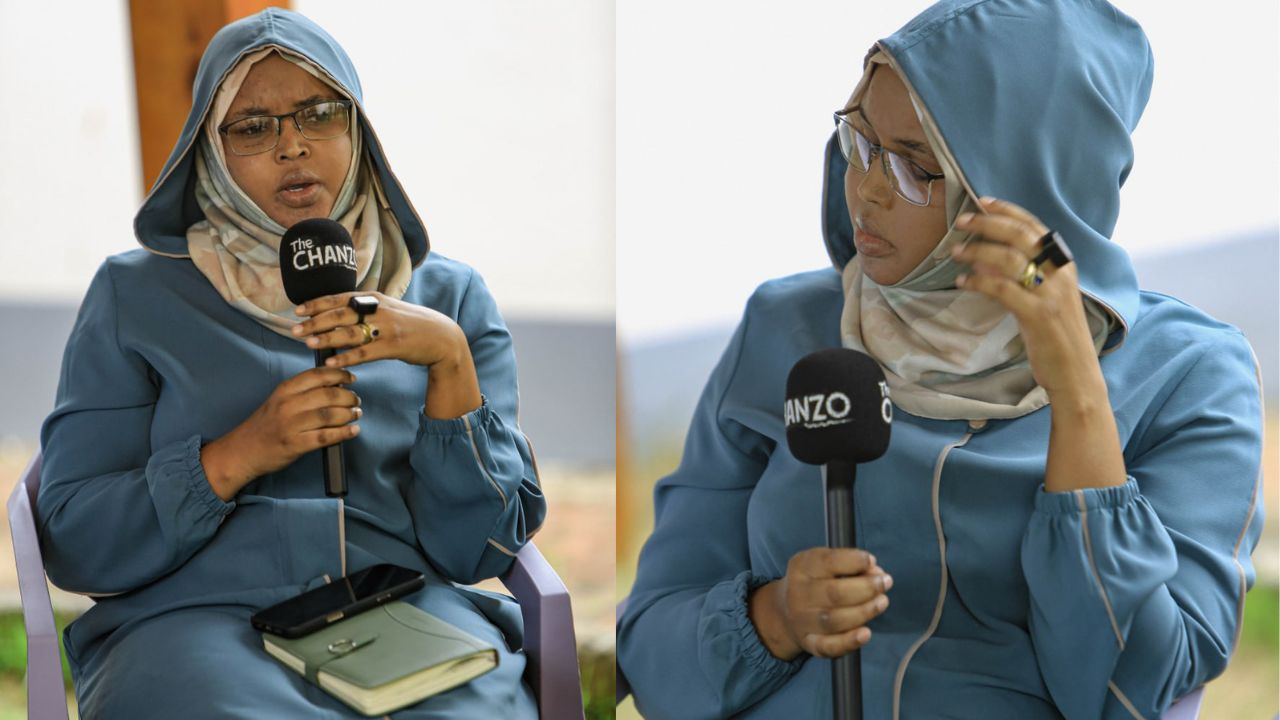
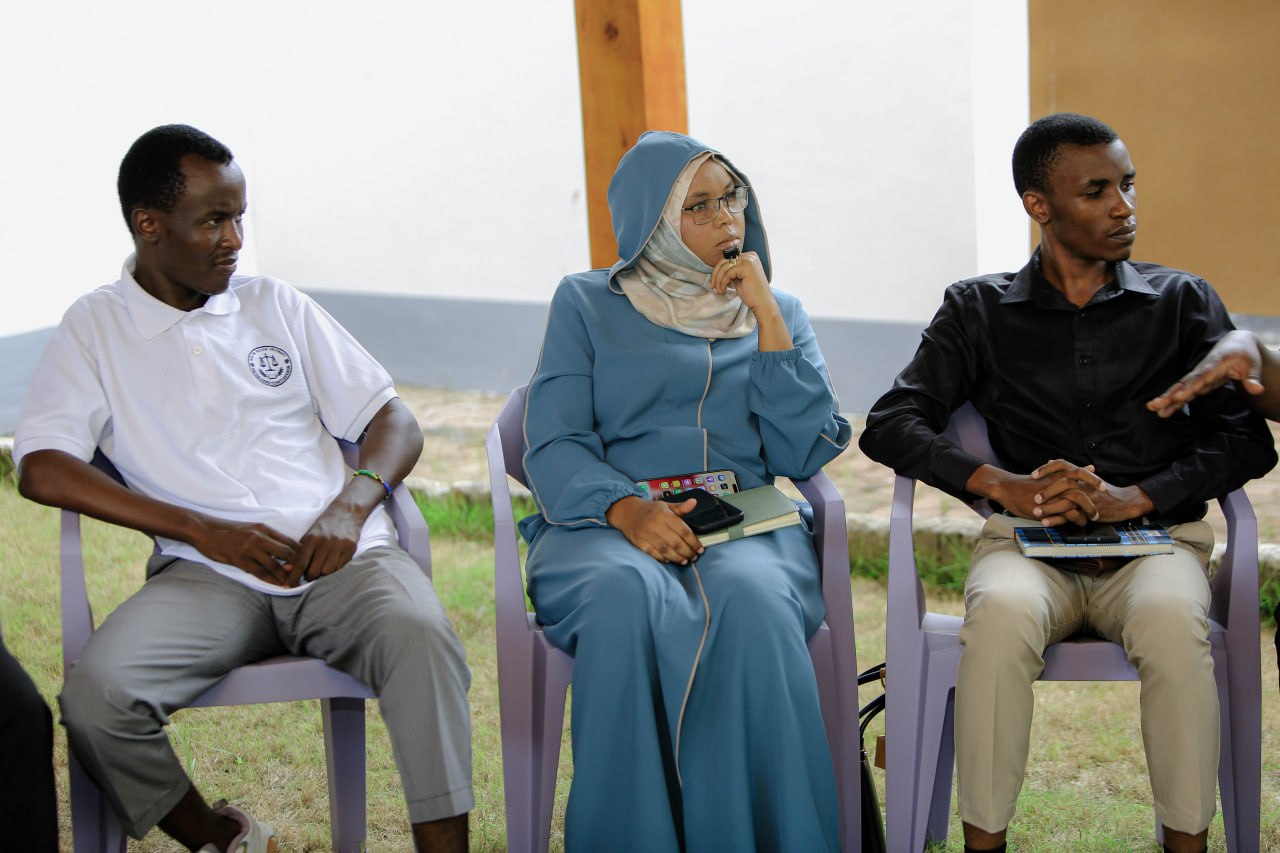
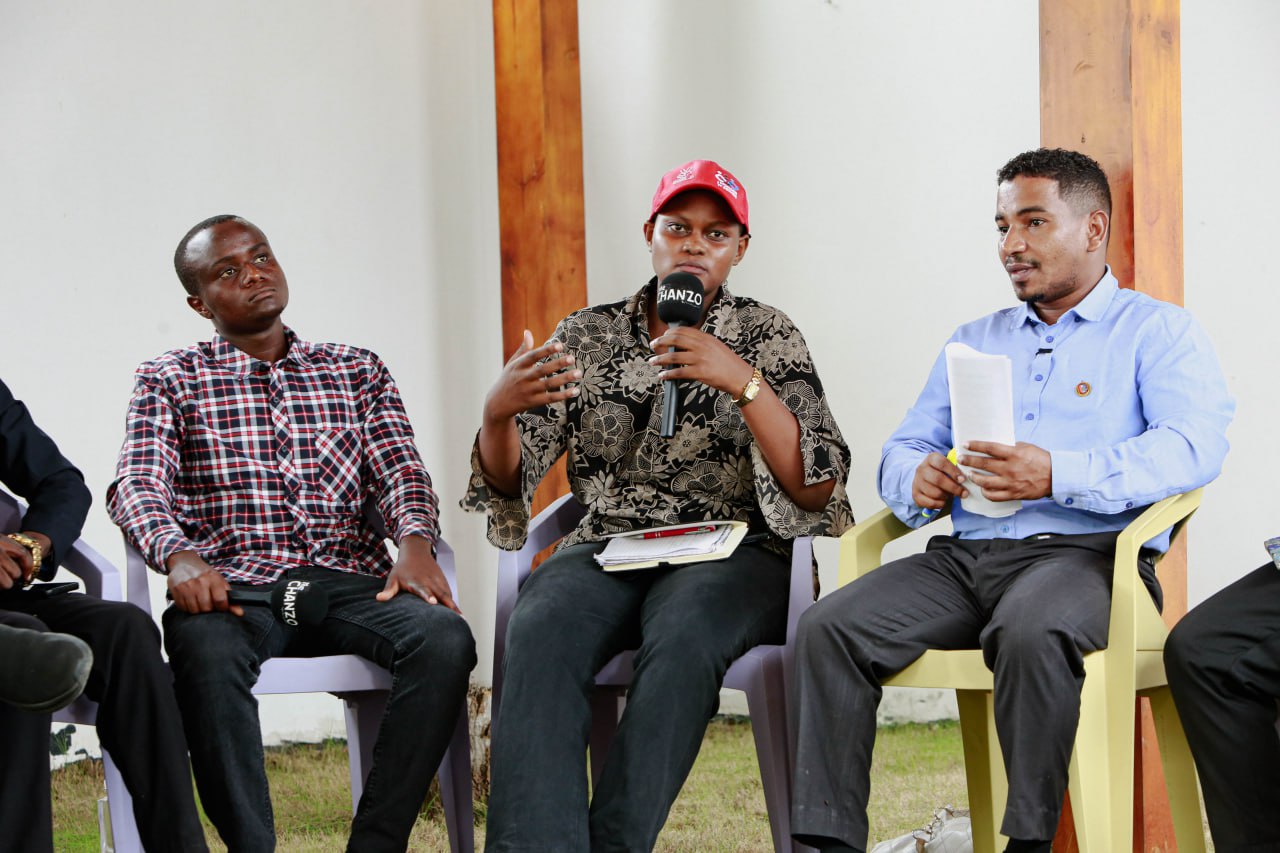
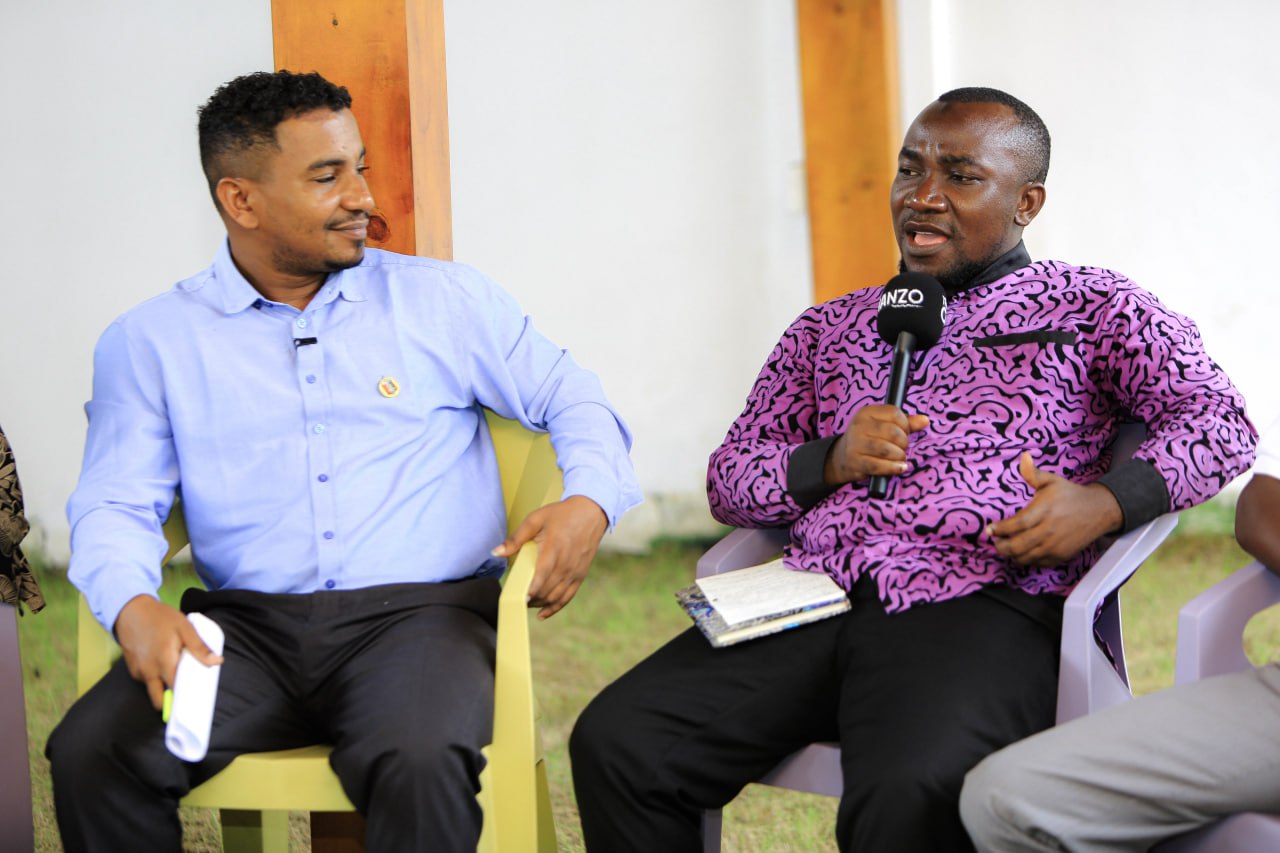
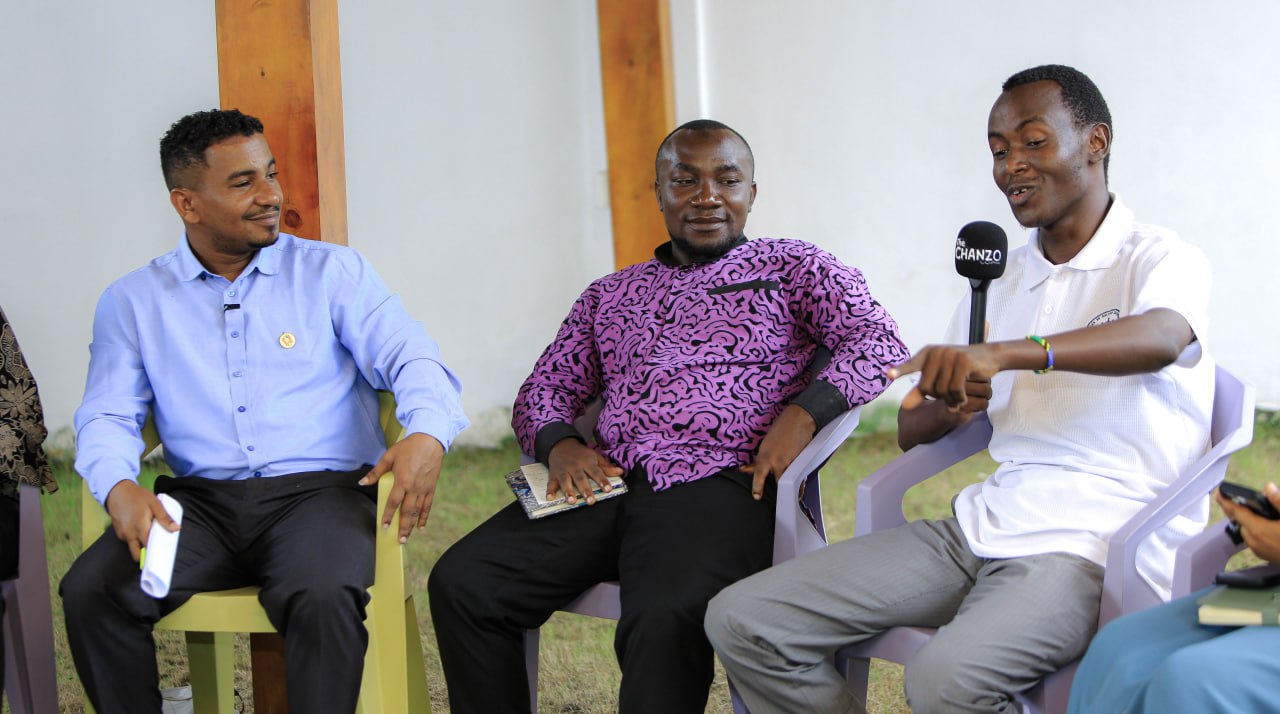
In this episode of Kivulini Talks, the discussion focused on the state of multiparty democracy in the country. The panel included representatives from various political parties: Idrisa Kwaweta, Chief Secretary of the ACT Wazalendo shadow cabinet; Nasra Mohamed, Youth Wing Leader for the CCM in the Dar es Salaam region; and Nice Sumari, Secretary of the CHADEMA Youth Wing.
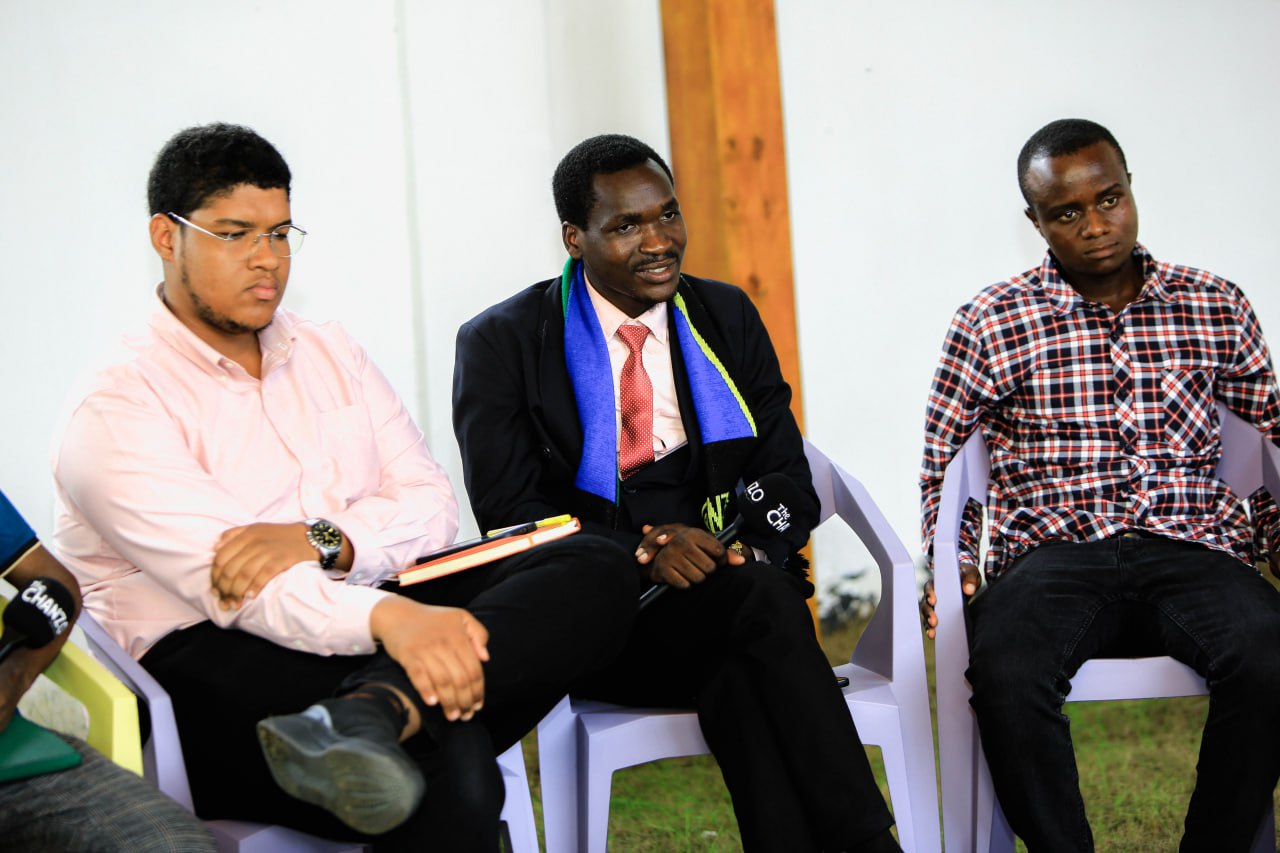
Other participants included Bakran Awadh, a political analyst based in Zanzibar; Antipas Pamba, an analyst and CCM member; and Aleki Nswila, a psychologist based in Dar es Salaam. Also participating were Leonard Humphrey, one of The Chanzo’s audience members selected randomly; Antony Severine, Chairperson of the Political Science Student Organization at the University of Dar es Salaam; and Ally Ibrahim Sadick, a second-year student at the University of Dar es Salaam. The discussion was joined by two of The Chanzo’s analysts, Tony Alfred K and Joel Ntile.
Watch the full episode below, or continue to read the transcript of the discussion here:
Khalifa Said (moderator): How are you. Welcome again to another episode of our Kivulini Talks series. Today we will be discussing the whole issue of multiparty democracy and asking whether we have achieved the goal of establishing again, or restoring, this democratic system here in our country.
As you may know, right now it has been approximately three decades since Tanzania restored the system of multiparty politics back in the year 1992, following the recommendations of the Nyalali Commission. I will have representatives from some political parties here in the country, but also other participants who closely follow the politics and development of our country.
From the Chama cha Demokrasia na Maendeleo, I have here Nice Sumari, who will introduce herself further when given the chance. From the ACT Wazalendo party, we have Mr. Idrisa Kwaweta, who will also introduce himself. And from Chama Cha Mapinduzi, the ruling party, we have Nasra Mohamed Ramadhani, together, as I mentioned earlier, with other participants.
My name is Khalifa Said, and I will be moderating this discussion. We welcome you very much—you are all very welcome. Welcome to The Chanzo.
Participants: Thank you.
Khalifa Said (moderator): So, perhaps just to begin, I would like all participants to reflect on this: three decades of multiparty politics—the multiparty system here in Tanzania. Have we achieved the objective of restoring this system, or have we not succeeded? So this is a question of yes or no, perhaps with a brief explanation. We will start there—introduce yourself very briefly, then go straight to answering the question.
Bakran Awadh: For me, saying that we have succeeded is a broad term, and it is bigger than simply saying we have succeeded in restoring multiparty politics—sorry, restoring multiparty politics. In my view, no, we have not yet reached the goal as it was envisioned at that time. Thank you.
Aleki Nswila: From my perspective, I think we have not yet reached it.
Leonard Humphrey: In my view as well, I say no, because we have had elections where every time they take place there are many complaints. There has never been an election that ends with all parties agreeing that they are satisfied with the results. So I think we are not there yet.
Nice Sumari: Personally, I say no—we have not reached the goal.
Idris Kweweta: The way the multiparty system was established, I think no, the goal has not yet been achieved.
Antony Severine: In short, the return of multiparty politics has been achieved, but it has not been achieved to the extent people expected.
Nasra Mohamed: My name is Nasra Mohammed Ramadhani. In short, the journey or the goal and main intention of restoring the multiparty system—from the way I have reflected on it—the goal has largely been achieved. We will get a chance later to explain more on this.
Khalifa Said (moderator): Nasra, you represent the ruling party, Chama Cha Mapinduzi, and I wanted to ask you: what have we been able to achieve within the multiparty political system that we could not have achieved under the one-party system? From the perspective of Chama Cha Mapinduzi, how do you measure the success of political pluralism?
Nasra Mohamed: Thank you very much, my brother Khalifa. Perhaps I should begin where I started sharing my thoughts—that when you talk about the issue of the multiparty system, each one of us as young people must recognize what the main goal was. In my view, the goal of restoring the multiparty system was to provide a broader opportunity for people to participate in various democratic processes.
READ: Kivulini Talks: Tanzania After October 29—Where Do We Go From Here?
We all know different democratic processes, such as issues of being elected or elections, the freedom to express opinions through voting on different issues with a national focus, but also various matters related to democracy. But you cannot say that the journey of the multiparty system has an end.
The journey of the multiparty system has no point that says this is where we have reached the end. Rather, the journey of the multiparty system has areas where we must make progress, and if you look back, it is true that we have made progress through the multiparty system.
Today, when you talk about what steps we have taken as a nation, as I speak now, we have approximately nineteen parties that have been registered through the Registrar of Political Parties. All these parties have had the opportunity to engage in politics in accordance with the guidelines and as guided by their constitutions.
Secondly, when you look at how successful we have been, today as I speak here, the major achievements that we can say have a positive perspective for the nation are in the way we have been able to listen to each other as a nation on various issues without considering who is raising these issues. Let me give an example.
We have major matters that have been discussed and were being complained about by Tanzanians in various groups. The first issue—let us refer to the system of free education—which was a complaint from our brothers who are now late, our brother Agostino Mrema. It was one of his key arguments, but Professor Lipumba also was part of giving his ideas or arguments on how people could access free education, along with various groups.
Let me conclude by saying that these issues were being discussed when the country’s economic situation was not very good, but when it reached the year 2015, and seeing that the economic situation had continued to improve well, the government—Chama Cha Mapinduzi under the late Doctor John Pombe Magufuli, with the Vice President being Doctor Samia Suluhu Hassan—officially launched free education. Up to now, under this seventh phase, Dr. Samia Suluhu Hassan has continued to strengthen the system accordingly.
There are many things, and if given the opportunity, I will explain where we have succeeded. Thank you very much, Nasra. Please give the microphone to Idrisa.
Khalifa Said (Moderator): Idrisa, the ACT Wazalendo party has been at the forefront in encouraging or stimulating the importance of carrying out fundamental reforms of politics in Tanzania and deciding to participate in elections despite the environment being very difficult. From your experience, you in ACT Wazalendo, do you think it is—what kind of failure—is it structural, that is, structural weaknesses in our attempt as a country to restore the multiparty political system in Tanzania?
Idrisa Kweweta: Thank you very much. First, as I said earlier, we still see that the journey of multiparty democracy has faced many obstacles. First, being clear, when we look at this 34-year journey, you can divide it into two major groups: during the period when we said there was a process of building multiparty democracy from 1995 to 2015, and from 2015 to now, as we speak, there is a project aimed at weakening the multiparty democratic system in the country.
Now here is where you find there was a shift in intention, which was translated into systems, into structure. For example, the electoral management bodies system—in the way they are—you find that they do not have independence in their ability to operate so that the multiparty democratic system can be strengthened.
For example, there are institutions that oversee the democratic system. There is an institution called the Office of the Registrar of Political Parties. This Office of the Registrar of Political Parties is the first obstacle that goes on to be used as a barrier to the growth of political parties, especially opposition parties.
The Office of the Registrar of Political Parties has been given great powers. It has been given the authority to punish political parties. Today, you may find that various parties are unable to carry out their activities. In 2025, our candidate was removed by the statement of the Office of the Registrar of Political Parties—not legally or anything—but only he has the authority to say that this candidate is removed.
Today, Chama cha Demokrasia na Maendeleo is not allowed to carry out its political activities. Recently, you witnessed the conflict of the Civic United Front (CUF). What was the source? The Office of the Registrar of Political Parties. So that is the first issue—a structural problem.
There are institutions that are working to control the growth of multiparty democracy, especially opposition parties. Likewise, in the structure of the Electoral Commission—in the past, complaints were raised, and it was during the process of building our multiparty democracy—those complaints were improving at least the performance of institutions.
But from 2015 onwards until now, you find that this body, the Independent Electoral Commission, apart from changing its name, is a commission whose structure, how it is formed, and how it operates, receives instructions from the ruling party.
Khalifa Said (Moderator): Thank you very much, Idrisa. I come to you, Nice. CHADEMA—some of the issues have already been discussed here by Idrisa—but when we look at the 2025 election, CHADEMA boycotted the election under its campaign of “no reform, no election,” and it has been consistent in saying that we cannot hold elections in an environment like the current one.
I wanted to ask you: when you look at it, our system of multiparty politics as it is now, as it appears right now, is it a system designed to strengthen democracy in Tanzania, or is it a system well designed to legitimize a one-party political system?
Nice Sumari: Okay, thank you very much. First, let me correct you, moderator—CHADEMA, we have not boycotted the election. I think it is also a matter of misunderstanding. When we say “no reform, no election,” what do we mean? We did not say we are boycotting; we were speaking in the sense that we cannot go to an election where we know what will happen in advance and we know what the results will be—and this has been happening for more than twenty years as we undertake these elections.
But let me go to the main question. Personally, I will speak in the sense that right now the multiparty system that exists in Tanzania is different from other places. It is as if we have taken it as legitimizing the fact that now we also have multiparty politics in Tanzania, but when you look at reality, in terms of the truth of the matter, it does not reflect that it is truly multiparty.
That is why, if you follow since 1995, elections were held—seven. 1995 was the first election, which was an opportunity for political parties to learn multiparty politics. Then came 2000, but in 2005 elections cooled down. In 2010 elections came again, now multiparty politics and opposition parties became ready with enough morale and started to become a greater threat to the ruling party.
So by the time we reached 2015, it officially became the death of democracy in Tanzania—it was officially buried in 2015. Today we say we have political parties or we have democracy, but it is not true. It is like we say we have a party that is a single party which contains many parties inside it—meaning it is one party that has many parties within it.
And that is why today you find a party that has existed since 1993.But if we ask ourselves here—what has it ever done? What has it ever said about society? How has it ever helped society? We have no answers, and we cannot say anything. But it has people, it has recognized leaders, and when it is time for funding, they receive funding because it is their constitutional right.
Also, if you look right now, my brother Idrisa said there that we are using the state to run this democracy. That is why today you may find the Office of the Registrar deciding to do whatever it wants. ACT Wazalendo were removed in 2025, by then they had saw CHADEMA— and thought, you people don’t understand—they entered into an election, and when they tried, they were crushed. Their candidate was disqualified without valid reasons. They ended up crying and talking and complaining, and it did not help at all.
But we also see today—tomorrow is the peak of International Women’s Day worldwide—but there is a police officer who just comes out and says CHADEMA women are not allowed to participate in those celebrations. And as we speak, there are many women being held in police stations in many areas across the country right now. Why? Because they are CHADEMA members. Others have even had their uniforms taken away just because they are uniforms.
What is the real meaning of democracy? It means I have the ability to choose any side that I want. And if I wear my uniform, does that mean I have committed a crime here? If I wear this hat here, is it a crime? I might leave The Chanzo there and get arrested and be told it is a criminal offense.
We have nineteen parties, my sister from UVCCM said. But if I ask her to name the parties that today, if you wake up any citizen, they will mention, they will mention four parties. And among those four parties, one has just emerged—meaning it existed, but only recently, after the turmoil, it increased.
They will tell you there is CCM, there is CHADEMA, there is ACT Wazalendo, there is CHAUMMA—but we are told there are nineteen parties. Where are they? This means these are parties that we can say are in someone’s pocket, meaning they have been placed there to legitimize that there is democracy. But in reality, when we return to society, there is no democracy.
Khalifa Said (Moderator): Thank you very much, Bakran. Please take the microphone.
From what Nice has discussed here, there have been many complaints regarding our system of democracy or our multiparty system in Tanzania, which experts and analysts of public political affairs have described as authoritarianism in disguise, or in technical terms, authoritarianism in disguise. That means you have a system which outwardly appears to have the features of a multiparty system, but when you examine it more deeply, you find that it is a system designed to ensure one-party rule.
First, do you agree with that assessment? And how is that proven? What is the evidence to be able to say that in Tanzania we have authoritarianism in disguise—that we have hidden authoritarianism?
Bakran Awadh: First, I agree with that analysis because multiparty politics in our constitution of Tanzania has been placed only as a clause of recognition, but all those institutions that are supposed to oversee the system have remained the same as in a one-party system, such as the judiciary and many other institutions responsible for oversight.
To observe closely, the multiparty system was introduced to expand democracy, but you cannot expand democracy if you do not have judicial independence and the freedom of institutions that oversee multiparty politics. For us here in Tanzania, personally as I see it, we have a multiparty system, but those institutions meant to oversee and keep that system in line do not exist, or they are not completely independent.
Like these media outlets we see every day—they are attacked, they are given warnings. That cannot take us far in multiparty politics, because we must have independent institutions.
Khalifa Said (Moderator): Brother there (pointing to Antipas Pamba), give him the mic. I want to ask a question, then my brothers—you will help me get answers. As I said in the introduction, our multiparty system, its restoration, was based on the recommendations of the Commission of Justice Francis Nyalali. The government formed a commission and gave it the task to the then Chief Justice, Francis Nyalali.
He traveled across the country, and citizens were asked whether they wanted the one-party system to continue or they wanted a multiparty system. Most Tanzanians in that commission were saying they wanted the one-party system to remain, but the things they were saying—Tanzanians were saying the one-party system should remain, but…..
It was wise for the Nyalali Commission to say it was not possible to continue with a one-party system, and still implement those recommendations from citizens. That is why the Nyalali Commission later said no—we must restore the multiparty system—and that was the recommendation made.
Now, the commission came with several recommendations. One of the recommendations was to separate the party and the state. At that time, the party was CCM and the state, but the commission recommended that fundamental human rights must be respected and not violated.
What is also interesting is that the Nyalali Commission listed many laws, saying that in order for us to have a proper multiparty system, all these laws must be amended. Now, there is an opinion that many of the things Justice Nyalali said in his report have not been implemented.
I wanted to ask you all: what do you think has prevented the government from fully implementing all the recommendations made by Justice Francis Nyalali? We will start there.
Antipas Pamba: First, I want to answer the question, but I will present an argument in response to the points raised. By nature, the government is an instrument of power. To propose separating the party and the state—meaning the government in a political party system—creates difficulty for a party to oversee and hold the government accountable.
I must make it clear that by nature, government is an instrument of power. It has an army and a police force, a national service army, and it has state institutions. If you want to remove the party from merging with the government, you must have a system where citizens themselves directly oversee the government, which is a difficult system.
It is easier for a political party that is seeking votes to form government and oversee that government. That is why some of the issues that were discussed in the commission led by Nyalali have remained as we see them.
Secondly, let me say we have received accusations. In my analysis, political parties in Tanzania, especially opposition parties, have had a trend of growing and declining—that is the trend. I heard a lady from CHADEMA saying from 2010 to 2015 that is when political parties gained strength—no. Earlier, we had NCCR-Mageuzi of Lyatonga Mrema, which was very powerful.
READ: Kivulini Talks: Reconciliation Talks in Tanzania After October 29—Ruse or Genuine Intention?
A party that truly shook things at that time—you will remember the 1995 election, it was very powerful. But from 2000 to 2005, Maalim Shariff, Maalim Seif together with Mzee Lipumba, the desire for power, internal conflicts are the biggest problem that affects political parties. How these parties resolve internal conflicts determines their survival. NCCR-Mageuzi failed to withstand internal conflicts because of internal elections.
Now we come forward; after that we encounter CHADEMA. This one, during that period when our colleagues were going through a crisis, CHADEMA emerged as well. From 2010 to 2015, CHADEMA became strong. I heard someone here say 2015 was when multiparty democracy was taken away. That is not true because that is the year when, in the history of this country, I acknowledge that many opposition MPs entered parliament. In history, unprecedented, when the presidential candidate at that time was our elder from CHADEMA, this was Mzee Lowassa. There had never been such a large number of MPs, not only MPs, but also councilors in local government at that time.
Now what am I saying—CHADEMA has also been affected by internal conflict. Similarly, although we have fundamental claims that there are times when these opposition parties are pressured and they claim so, and at times it appears that way, but the main reason that weakens these parties is their internal problems. You cannot say you have been banned as a political party from carrying out your activities without giving reasons. CHADEMA must explain how it happened until the Registrar of Political Parties, which is what is called the body that suppresses the opposition, the opposition is being pressured; they must explain the reasons clearly.
Now as I conclude, I want to say, when we discuss the rise of political parties up to now, I briefly explained that political parties—the multiparty system in the country exists, it is functioning. We have many political parties that are not necessarily heard—yes, meaning nineteen; for those who follow politics, it is normal. The father of democracy in the world, the United States, we hear about two parties: Democrat and Republican. But in reality, America does not have only two parties; you know that, and if you are a good reader, you understand. But haven’t we made progress—we have only 19 political parties. Congo has over 200 parties.
Khalifa Said (Moderator): Thank you. You have listened to him—how can you respond to what he has said?
Aleki Nswila: Thank you very much, I have listened to him; he spoke about internal matters. First, let me thank my sister; she talked about something called democracy. And at that time, Mwalimu Julius Kambarage Nyerere, regarding the establishment of the multiparty system, one of his goals was to expand the democratic system. This democracy that we say we have expanded—have we truly expanded it? That is a question to ask.
We succeeded in entering the multiparty system—what about the constitution? Did the constitution successfully entered the multiparty system? That is a question to ask. Up to today, there are things that are happening—the entire system is the Constitution. I will explain it this way: our Constitution of Tanzania gives power to the President more than you can imagine.
Nationwide, Regional and District commissioners are appointed by the President; everyone understands this issue. And regional commissioners, they represent the President in the regions; they are responsible for defense and security matters. In every aspect, they are responsible in those areas. We come to the judicial system—who appoints judges? They are appointed by the President. So the Judge who is appointed by the President is expected to decide opposition cases. Is it really true that this case will proceed smoothly? People will defend their livelihood.
We are going back again to the main angle, the whole issue of the Electoral Commission—the one appointed by the President. The judge who announces the presidential results is appointed by whom? This is just something to ask ourselves. When we talk about democracy, let us look at it broadly; let us not look at it hastily. The main angle that affects this is the whole issue of the Constitution.
Leaving that aside, let us return to the issues that my brother has talked about. You said internal conflicts—political parties go through internal conflicts. But CHADEMA has endured. Even though I am outside CHADEMA, I am not a member, but they have endured.
The bigger angle is let us create a constitution that gives room, gives space to all parties so that we can see that this democracy exists. But beyond that, this problem will still be very difficult to remove. Mwalimu Julius Kambarage Nyerere had a very broad vision, but we have failed to follow him. What he did succeeded in bringing a multi-party system. After entering, now it is necessary, we Tanzanians, those of us remaining, to change that system. Thank you.
Khalifa Said(Moderator): Thank you very much. Thank you, much appreciated. These are strong points.
The previous speaker said, because my question was in what way, what has prevented the implementation of all the recommendations made by the Nyalali Commission, and according to his explanation, as I understood it, oh, they have been implemented, right? That he sees there are other challenges, such as internal party conflicts and so on.
This gentleman has also come to say that the issue, sir, is the Constitution, yes? The Constitution gives great power. When you listen to both of them, what is your opinion? What is your position? Where do you stand?
Antony Severine: Thank you. I will look at your question from the perspective of scholars. I have listened carefully to my brother here. He has tried to argue that what was discussed in the recommendations was implemented, which is not true. I will explain why.
The multi-party system did not only begin in 1992; it existed before. And the main reason for abolishing that system and saying we should have a one-party system was to unite the nation. It was believed that if we had one party, people would not be divided along political lines. But when the 1990s came, many scholars argue that first, the nation was not ready to return to a multi-party system, but because there was an economic crisis, and there was a structural adjustment programme that was providing loans, one of the conditions that some countries were required to adopt was multipartism, which is the multi-party system.
And our country was in that crisis. Therefore, forcing citizens to return to a multi-party system, and those opinions was like deception, as they had already decided that we must accept it; there was no other way. And as far as I know, when the votes were cast, many said no, while a few said yes. And I remember the quote from Mwalimu Nyerere, who said, Let the majority prevail, and the minority be respected. He took the opinions of the minority because he respected them.
With that statement alone, it is clear that even all those recommendations could not have been implemented, because the will and readiness of the citizens was not there to accept the multi-party system. And this was very early.
Samuel Huntington explained this in his book The Third Wave of Democracy, referring to multipartism. He said that in many developing countries, including Tanzania, which are poor countries, should not adopt the multi-party system quickly just because of getting money, because later it will come to trouble them. Referring to his 1998 book, which is Developing Society and Political Order, he says that any nation that is not economically self-sufficient cannot sustain multi-party democracy, because it requires a political system with strong financial and economic structures to run properly.
He gave an example: you have a multi-party system and you need all parties to participate in elections, but the country cannot finance the elections. He tries to explain that even some elections that take place depend on external funding. In 2020, and this election, it was possible to finance independently—means that even internal elections, if you cannot finance them yourselves, you still cannot have real multi-party democracy.
He said that even these small parties, as Madam explained, exist to receive subsidies, and that is true; that is why they appear during elections, and disappear afterward. They are heavily affected by economic problems, and the only party that is in power, you can see how it holds the country. If it announces donations today, those big businesspeople will be seen giving billions of money. Announce today that opposition parties need contributions, and see whether any big businessperson will give money there.
And he proposed that if economic structures are not secure, then institutional structures will not be secure either. And if institutional structures are not secure, when a multi-party system comes, all these institutions will be controlled by one party that will be in power. That is what they explain.
For example, the constitution and the Registrar of Political Parties, all of them act the way they do because the Constitution directs them to do so. Let us say the one who announced the election results, the Commissioner right after announcing the election, this one of 2025, he said there is no court at all or any place that can challenge this election, or these results. Do you believe that, and what if there is a place where mistakes were made, they need to conduct a judicial review to try to examine how the election was conducted.
Look at the police. When the police go, for example, as I mentioned in districts and regions, when they go there, they go under the President’s orders. And they swore to uphold the security of the nation, while that President is still the Chairperson of a certain party. Then how do you remove her from accusations that she is defending one party?
All of that—institutions exist because of having a weak economy, a small economy, and we brought this system in order to get money. The result is what we see, and he predicted it. He said that without these good institutions, without having a good political environment, it will lead to political decay, which is political instability, which is what we are seeing up to now.
Khalifa Said (Moderator): Alright, please give the mic to the brother there.
So, as you have listened to them, members here, it is that the word “election” has come up very often. And in our system of democracy, elections are seen as a measure, a test—they call it a litmus test, experts say—a measure of the strength and maturity of our democracy.
If you look at the quality of the elections we conduct here in Tanzania, we have said we have held about seven major elections, from 1995 up to this one of 2025. Do you think it has quality? Does it reflect a multi-party democracy? And has that quality been improving? If you look at the first multi-party election we held in 1995 up to this one in 2025, or has it been declining, in your view?
Ally Sadiki Ibrahim: Directly to your question, if you want to answer it properly, you need to place it in what context? That the quality of democracy or the multi-party system that is continuing in Tanzania—has it been improving or declining? Directly quoting Mukandala, he says that one of the criteria for assessing democracy is looking at equal playing ground, that is, equality of the playing field in political competition between the main party and opposition parties.
If you measure it in that context, in terms of competition, still that quality has not existed. And this is proven by what? If you want to prove the quality of the political arena between political parties, you must look at the electoral system and the victories of one party for two terms, three terms and beyond. If you look at Tanzania, just measuring from when democracy was established in 1995 up to now, the quality of democracy, in that context of three consecutive terms and beyond, has been dominated by one party. So in that context, democracy has been declining. It has been declining, according to the liberal democracy that we were introduced to.
But if we look at democracy that perhaps, according to our vision or the vision of many Africans, which is social democracy, I was reading a Nigerian scholar named Ike, who says that this democracy that is now established in the multi-party system is not a matter of whether it is needed in Africa or not; the question is whether it can function.
Khalifa Said (Moderator): That is where we will come to—if it can work or cannot work. I was just there asking you for your analysis on whether the quality is improving, has declined, and you have answered me.
Let me come to Nasra. The 2025 election, the election observation mission from the African Union concluded that the October 2025 election did not meet the principles of the African Union, accepted norms and international standards, and they said it was not a democratic election. They talked about issues such as ballots being ….. in ballot boxes, the shutdown of the internet, and cases of abductions. SADC also reached the same conclusion.
And I wanted to ask you, how does CCM respond to these opinions from these election observers, and what kind of reforms is CCM ready to support to ensure that these things do not happen again?
Nasra Mohamed: First, my brother Khalifa, before I go to answer your final question, let me perhaps clarify some things that sometimes the public may even be misled about. The issue of the Constitutional process—I agree with others. Let me just say that the issue of the constitutional process has never been ignored by any leader since the introduction of multipartism.
Let me remind you that the foundation for constitutional change was initiated by the late Benjamin Mkapa during that period, but the process was launched by our elder Jakaya Mrisho Kikwete towards the end, we politicians, when I say politicians, we understand each other. Yes, we later disagreed in 2014, whereby the issues that divided us—first, there were issues we could have discussed.
The issue of the three-tier government—it was a matter of sitting down to discuss—completely disrupted the entire scenario of the constitutional process for the New Constitution.
When JPM, the late one, he saw that there was still political tension that could distract him from focusing on serving the citizens, so he decided to step away from the draft, from the agenda of the New Constitution to serve the people. And you can see the great work he accomplished.
But when Mama took over the leadership, she came with that agenda of the New Constitution. She listened to the cry of Tanzanians calling for a new constitution. Even Mama also needs a new constitution—why? She formed a task force to assess and reflect on how to properly address the issue of the New Constitution.
However, during last year’s campaigns, as you witnessed, one of her priorities was the New Constitution. What does that mean for politicians and the public? We must understand that for her the issue of a new constitution is part of her priorities.
She says that now the October events have happened, which at times I do not wish to discuss—October 29—why? The Commission is working. We are waiting for the Commission’s resport. Then we will begin discussions after the Commission’s response. But Her Excellency the President says once the Commission completes its work regarding the October issues, then what will we do? That process will continue, because it is part of her priorities and has not been ignored.
The issue of elections, election complaints—we must, my young friends, understand that worldwide, today we may change a constitution as processes continue, but election complaints are like dreams in the air. Why? Look at history—it shows us how things work.
Even in places we consider and say they have good constitutions—go to Kenya. In 2017, the election was annulled. Those who say new constitution—we must simply remind ourselves why. The nature of politics, the nature of a politician, is that he cannot accept defeat. They are not angels.
You should just understand that the nature of a politician—even you who study there—fortunately there are people studying political science here—you study there, in your homes. Any politician does not accept defeat. So there are fundamental complaints, and I did not mean that there are complaints that should be ignored—no. There are fundamental election complaints that are being handled in an orderly manner.
What happens is that we politicians often come with emotions. For example, we want certain constitutional matters to be taken forward, but the constitution cannot just be taken to Parliament and amended like an ordinary guideline, like a normal document. It is a long process that will require billions of funds.
What is the basis of this argument? We must recognize that when you talk about democracy—as democracy—first, democracy is not measured by who wins, but by who is given the right to compete. That is why I return to the same foundation of the multi-party system in Tanzania. It had no limit.
Khalifa, let us understand each other. There is no written limit stating that we will reach this point, and that will be the end of measuring democracy in Tanzania’s multi-party system. It is a continuous process because we implement—after implementing, we reflect. After reflecting, we improve ourselves. Those are the three main things.
Why do we do this? We look at achievements, we look at challenges. Even the constitution we are calling for today—which some people may not even read—they just say constitution, constitution. You ask a young person, which specific clause are you demanding? Many of us do not know. In the streets, when we go to the field, we see.
So now, after we make a constitution—for example, if it changes—and later it has shortcomings, we return again. We say, okay, that is why we say we correct ourselves. Even as a party, we correct ourselves. So look at the countries we use as examples—we must also understand them. These complaints are political in nature.
Nice. How do you respond to what Nasra has said? Do you agree?
Nice Sumari: First of all, I think, moderator, if we want to create a solution, first we must put ideology aside, then sit together as young people, sit together as Tanzanians.
What I see is that my sister Nasra is trying to protect the institution instead of discussing the reality she says she went to the field to observe. But if you truly go to the field honestly, you cannot tell me that the process is set aside because there is political movement.
Who told you that political movement can end? Let me go back to my brother Pamba. You were quoting me in a different direction. I spoke about the issue after the 2015 election. If you read it, the 2022 Freedom House report they released it regarding Tanzania’s politics and democracy. It explained how things have been from 1995 until 2020. It explained it very well. And when I said the death started there—that is what I meant.
But coming back to my sister Nasra—when you say they are working on it, working on it with words—how does that help us? What does it really mean to say democracy? It is a level playing field—you yourself said it.
You said democracy is not measured by who wins, but by who is given an equal field to compete. Let me ask, are all eighteen other opposition parties given equal opportunity to compete, or are they not given that equality?
In 2024, we had amendments to the election laws. People gave their opinions. But the surprising thing—the most surprising thing—is that people gave many very important and substantial opinions.
When you look at the amendments they came to make, in many cases it was just changing the language.That is, they removed this Swahili terminology and replaced it with this other Swahili terminology. So when you say that they have not ignored us, we struggle to understand—they have not ignored us in what context?
If we can say, okay, let us put the new constitution on hold and make amendments to the electoral laws, but in the middle of these minor laws, there is still sabotage. People are doing things that do not align with what stakeholders agreed on. People were invited to sit down and give their opinions—civil society institutions, political parties, and even people who are not in political parties gave their views. But after giving their opinions, the final results did not reflect the opinions they gave.
Now you ask yourself—when you say they have not ignored them, what do you mean? Because to say that someone has not ignored something, even if they do not implement everything, at least they must implement something. Let us speak about reality. Let us not speak only because I am a politician. Sometimes we must explain the real truth to society. We live in a society.
Just because I belong to CHADEMA does not mean that if I meet my sister Nasra there, I throw stones at her—no. Sometimes she may bring a genuine argument, and we can sit down and listen to each other. But nowadays, young people—if someone belongs to ACT and meets someone from CHADEMA, even if it is a valid argument, they just decide to oppose it, just because it is their institution, not my institution—so I just oppose it.
Khalifa Said (Moderator): Alright. Mr. Idrisa, first, you have heard Nasra and Nice, but also you from ACT Wazalendo, you decided to participate in the October 29 election, 2025. What does that experience teach you? Or what lessons does it give us regarding structural systemic barriers that hinder healthy political competition in Tanzania?
Idrisa Kweweta: Thank you very much, moderator. First, I think there are some arguments that were raised. First, by Pamba, it is very important that we clarify them. He is talking about the origin of the state and the party. First, that is not true. He must study the history of the merger between CCM and the state—where did it begin? It began in 1964 here only, not because it is something natural. It is not a natural matter.
And this is common for people who want to make ruling ideas appear as if they are natural, that they cannot change. And if he read, perhaps he is talking about theoretical matters, if he read the commission—how it showed how the state and the party would be separated—the Nyalali Commission. The Nyalali Commission. They did speak about it and not leave it as a pandora.
For example, today you find that before 2025, the election supervisor is a Director who is appointed by the President. At the lower level, the assistant supervisors are ward secretaries. They are ward secretaries who, by implication, are under the President. Therefore, even the commission itself at the top—they are appointed. The chairperson is appointed by the President. The Director is appointed by the President. All are appointed by the President. Therefore, it is not a natural matter. It is a systemic issue. And as you say, it is a systemic issue that can be separated. It is not something to say that, oh, it is natural and the government is—and he used the wrong term that the government is the state.
For example, from 2016 to 2021, political parties were not allowed to hold meetings. They were not allowed to hold any meetings at all. If you held a meeting, you were arrested. For example, the Central Committee of ACT Wazalendo was all arrested by the police. People were detained. People were framed with charges. They were framed with cases.
Politics started being treated as a criminal offense. It became like a crime—that simply participating in politics could get you charged with terrorism, you could be charged with treason. There are people who were charged with treason. Even now, they are in remand.
There is someone in Kigoma who won an election and was charged with treason. He won the election and was charged with treason, claiming that he won using weapons and other similar things. He was taken into custody. Political processes were being criminalized. They were being criminalized. Therefore, this pushes political parties backward in carrying out their constitutional activities, and legally.
People were killed. A ward council candidate, Dafroza in Tarime, she was killed. Her agents were arrested by the police. She went to follow up on them, bringing them tea. She was stopped by the police. In the end, the next day it is found that she has died while in police custody. The police said she died because she had high blood pressure. When they were washing her body, they noticed her teeth had been removed. It clearly showed that she had been tortured while in the hands of the police.
I ran for the Kilwa South Constituency this year, 2025. The day before election day, all my assistants were arrested by the police and detained. They were detained. Therefore, when we say these things, we are not saying them as if we just came, as if we descended from heaven yesterday. We have experienced these things. How many people are in prisons for political cases?
So we are not talking about these issues just for the sake of talking. Simply because I am saying that by nature, a politician does not want to lose—Is this competition? Right now, Tanzania does not have competitive politics. We are competing with the state machinery. The state is the one that appears in front to suppress the opposition.
So if the opposition, for example, the platforms themselves for discussion—party debates—do not exist, it is not there. That is why I say we must speak about this from 1995 to 2005. As young people, we were attracted to politics because there was an intellectual clash in various spaces. Today you can see how matters in Parliament are conducted, how key issues are being discussed.
So we are not speaking about this in a theoretical way. We want constitutional reforms, and to have an Independent Electoral Commission outside of one that can be controlled by a single person.
Khalifa Said (Moderator): Give Nasra the microphone there. Of course, you want to respond, but I also wanted to ask you—I think it is in CCM’s interest as well not to see the political arena becoming criminalized, right? For example, I do not think that CCM also is pleased to see the way security forces or things like what Idrisa has mentioned here—people being killed, people being arrested, people being harassed. I do not think CCM supports those things.
Nasra Mohamed: Khalifa, before I wanted to say something, I wanted to respond to my comrade here from ACT. Humanly speaking, no one is happy about killings. Humanly speaking, we were born and raised in a faith-based foundation. Each person has their own way of handling things. But I just want to tell you that no one is happy to hear, for example, that my sister Nice has been killed. Truly, I would not be human and would have left God’s creation and system.
Let me move to some matters that I was trying to reflect on here. There is a need for political parties to sit down and reflect—where are they failing? My friends from ACT, sometimes—not in a bad way—but sometimes I struggle to know what I should learn from them. I am still young, I am politically new, but I am progressing quickly. They (ACT Wazalendo) have not been serious in matters of contesting, especially for the presidential seat.
I return to the core of his argument—accusation against the Registrar, the Office of the Registrar of Political Parties. In what sense? Look at all the processes. Even you young people will admit in your hearts, even if you do not openly admit that since we began the 2010 elections, 2015, and 2025, the process of obtaining a presidential candidate in the ACT party happens in the evening hours, after seeing that in the Chama Cha Mapinduzi, some people have been eliminated through those nomination processes.
For example, my brother from last year, Luhaga Mpina. His selection came at the final minutes after he was excluded from nomination. This is a normal process in any party. We evaluate a person based on ability, their strength, how they have addressed the interests of citizens in the area. Is this person marketable? Meaning, does he generate value, and some remains for our party? Those things exist.
Therefore, the way they obtain their candidate, —he mentioned it at the beginning and repeated it again—regarding… the Registrar of Political Parties disqualification of him (ACT candidate)—no, they should reflect on themselves. So my brother, I wanted to make clarification. Yes, make self-reflection and self-assessment—to see where are you are failing as political parties? Thanks.
Khalifa Said (Moderator): What I see is that we may be differing on the achievements or challenges resulting from the multi-party system which was restored in Tanzania in 1992. But I want to believe that we all see the value of the multi-party political system, right?
Participants: Yes
Khalifa Said (Moderator): Now my question is: what are the dangers that could affect us as a nation if we fail to make the multi-party system function as it was intended? What could we be negatively affected by if we fail to achieve that goal of establishing the multi-party system? And in addition to that, what happened on October 29, 2025—could it be a warning? Could it be a warning that we need to increase our efforts and commitment to ensure that political inclusion and political competition function well in Tanzania?
Leonard Humphrey: On my side, I can say that if we do not run the multi-party system properly, one of the consequences will be as you mentioned what happened on October 29. This is a very clear warning, as my sister was saying, that we must first end political heat and then begin the process of a new constitution. I disagree, what happened on October 29 also includes people demanding a new constitution. Therefore, you must start with the root cause, which is a new constitution. People should get a new constitution. That movement will end on its own.
But the second point is, let me also say that if we do not consider the existence of multi-party politics in this country, I would also say we will lose—we will lose and lack leaders in this nation. I will say the truth: the existence of multi-party politics in this country has produced many leaders. Today, the ruling party Chama Cha Mapinduzi has people in important positions who gained those positions through various opposition parties. The public came to know them through the opposition. If you mention someone like Professor Kitila Mkumbo, if you mention the current Minister of Home Affairs, Patrobas Katambi, these people developed within the party CHADEMA. David Silinde, and many others who have also held positions such as district commissioners.
So I would say that the existence of multi-party politics has also been a way of giving many young people the opportunity to demonstrate their abilities. If we say we leave it only to UVCCM, not all of them would get the opportunity for us to see their potential.
Opposition parties have provided opportunities to youth, and we have seen that they are hardworking people. Even when young people join the ruling party, they are given opportunities and they perform well. Not all youth in the UVCCM get chances—that is the truth. There are many young people, many graduates, but not all get opportunities. However, the existence of opposition parties has been giving opportunities to young people, and we have seen they are good people as well.
Khalifa Said (Moderator): If we fail to ensure that the multi-party system functions as intended, what will be the effects on us as citizens and as a nation overall?
Joel Ntile: I would like to answer that question by starting with one foundation that I believe is very important, which was also one of the push of the political reforms that took place from 1990 to 1992. In 1990, there was a speech that was delivered by Mwalimu Nyerere at Diamond Jubilee. He was speaking to the UVCCM in Dar es Salaam.
And in that meeting, you will remember that it was one of the meetings where the Father of the Nation was heckled. It was one of the meetings where the Father of the Nation was trying to urge the young people of CCM and the nation as a whole that there was a need as a nation to come together, discuss, and make reforms in order to provide opportunities for citizens to participate in various political activities, economic and social.
Now, if you look at that speech, it was a continuation statecraft of the Tanzanian state, which Tony, I think, once spoke about, that the founders of this nation saw the importance of making fundamental reforms whenever they reached a point where, as a nation, if we left things that way, after years we would not have the nation we envisioned. That is why in 1967, they made a major decision. In 1971, they made significant decisions. In the 1980s, due to the situation at the time, they took certain measures. There were major legal reforms were implemented because there were major problems including even coup attempts which happened in 1980.
When it reached 1990, when Nyerere was retiring as CCM’s chairperson, he saw the danger as he saw that there was a problem facing his party among the people as it lacked the expected popularity but also considering how the world is going and the importance of expanding the scope of citizens’ participation, not only politically but also economically and socially, that was the foundation for pushing the reform agenda, which even the Nyalali Commission addressed.
And I see, one aspect that we lessen the report is by looking only at only the multi-party system—multi-party—but that commission wanted plural democracy. That is, even trade unions—we should have strong trade unions. Civil society organizations should be strong civil society organizations, not ones controlled through registration, and all other institutions as well. Therefore, the attempt in the 1990s to restore the multi-party system, or the recommendations of the Nyalali Commission, were aimed at ensuring that we remain with the same Tanzania—when we reach a stalemate, we remain a nation that undertakes major fundamental reforms.
So that is something I also see today—that when we reach such a critical stage, we should not abandon the statecraft left to us by the founders, that those in authority, meaning the government, and other social institutions, must see that they must take the risk of ensuring we carry out further fundamental reforms to ensure our nation remains safe for the next sixty years, the next fifty years. Otherwise, it will be dangerous.
Tony Alfred K: I will start from where he left off first. There were discussions Nyerere had with the President of Zambia. If you look at it, he was saying that you may have a party but you may find it is just a machine for elections. And when you read CCM archives, you discover that after he (Nyerere) went around, he found that the party had drifted far away from its core role, and it had become mainly a state instrument. So he joined that push.
Therefore, I can say one of the safeguards of the state provided in our Constitution is the way the government can be removed from power. That is a major safeguard historically, because there have been states where there was no way—it was not clear if the people were dissatisfied with the government, how does it leave power? In Europe, major disasters occurred. You would hear that kings had been overthrown—this has happened? Because it is human nature that there must be an outlet.
So multi-party politics, when you read the Constitution where it mentions multi-party system, you should see it as hope for the people. If you see that CCM is not performing, you can think, “Let us begin campaigning on this side.” So that is a safeguard of the state. That the Tanzanian state, not CCM. The Tanzanian state should not collapse. And when we talk about the Tanzanian state, we are looking at years ahead—we are looking at our future, the future of our children, that they have a country.
So the Constitution has placed multi-party politics as a safeguard of the Tanzanian state, not a safeguard of CCM. Right now, what I see has happened—I can say we have completely moved away from that system, especially in believing in politics.
Now here, there are CCM stakeholders—when they speak about political decisions, I will trust you. Why? Because when you wake up, you think politically, when you go to sleep, you think politically. I may disagree with you, but I can trust your expertise. But if a police officer tells me political matters, the first thing is I do not trust him—he is not an expert. If you (politicians) tell me policing matters, I will not trust you.
Now we see the police, state organs making political decisions. So you see, many mistakes happen. If you analyzed what happened on October 29, it is a sign of what I said earlier—that when you remove the safeguard of multi-party politics, the state must enter into—that is, something must happen.
In the whole of 2025, we have discarded true citizen participation. Because I believe that if CHADEMA had participated in that election, I don’t think the protests would have occurred. This is what I believe—it is my opinion. I don’t think the protest would have been there. People would have believed in that election. The focus would have been on the election. But because you have discarded the inclusiveness of people to participate in the election.
And I think we have reached a point as a nation—we have so much lies. All of us adults, we know this is a lie and pretend as if it is true. Now you cannot do that. If we are looking at Tanzania in the future, we must agree to correct these things, just like it was done in 1992. We must agree that we are correcting these things.
And that is my final message to those in power. They must fix things. People must see hope in Tanzania. People must not be abducted. People must feel they can engage in politics.
Khalifa Said (Moderator): Okay guys, we are running out of time so briefly just tell me for our multi-party system to work well what would you like to see happen, very briefly so that the multi-party system in the country works well.
Antipas Pamba: First, we need a mature opposition with an institutional system, an opposition that will show continuous competition, not one that comes and disappears, therefore I think we do not need so many political parties maybe even just three would be enough, with CCM maybe ACT and CHADEMA because those are the parties that are visible. I think we need a mature opposition that is not yet there.
Nasra Mohamed: Let me just say briefly; to continue strengthening the system of multi-party democracy, political parties must agree to acknowledge, to reflect but also live within the boundaries of the law. Thank you very much. Thank you.
Antony Severine: I think I get very worried when I see these debates. The only thing that we must do young people, let’s throw away those colored waters that we have drunk because of party flags and then drink the water of the national flag. I get very worried when I see young people of my generation who were born in the year 2000. We sit to defend political parties that were founded even before we existed, meaning they are old parties.
They had great leaders who understood them and perhaps they still did not achieve what they wanted, but we just sit posting and explaining. We are completely stuck even if it is something we could, as young people, defend as a nation.
But as the state, when you see education increasing, science growing and globalization increasing, people become more aware than you think. The manipulation that is happening to try to convince people against what they believe cannot move the nation forward. There are other things that are clearly visible even when you are not knowledgeable, you know it is the truth, but the leader you expect to come and speak says it is AI. That is something that cannot move the nation forward. Let us agree to say there are places we made mistakes and the new direction is there, and young people should look more at the nation than these parties. A party can die but the nation remains the same. Thank you very much.
Idrisa Kweweta: I think from where we are, we first need to have the political will that which can ensure the achievement of fundamental change. Political will cannot happen at the mercy of Chama Cha Mapinduzi. It must come as a result of pressure, through pressure. So my call to serious opposition parties, serious opposition political parties, we must come out of the Pandora box of dividing ourselves. We must join forces to ensure that we put the CCM against the wall so that it is forced to create political will properly.
Nice Sumari: Thank you very much. First, I will return to your question about reflecting on MO29. I agree with those who spoke before. It is like an alarm to warn us that and now we remember there is a group calling themselves TFF, Tanzania Freedom Fighter.
Now we are in danger. Today we have young people who are thinking about doing things that are against the government and the government is speaking casually, saying that we will arrest them, we will do this, but in what way? When you look at the complaints of TFF they talk about issues of abductions, they talk about a level playing field in politics.
Today I will speak the complete truth. If you are an opposition politician it is treated like a criminal offense. I experienced this in 2025. The first offense is being young. The second offense is being a member of CHADEMA or a member of an opposition party. It is completely treated as a crime. Once you are young and you have a different ideology from the ruling party, it becomes a crime.
And that is why if you look since 2024 until today there has been many disappearances of young people and the majority of the affected are from the Chama cha Demokrasia na Maendeleo (CHADEMA). The CHADEMA BAVICHA chairman started disappearing in Temeke constituency.
So the government or the state should see the challenges that exist, but it should also not get used to the use of force, because when it encourages force that is how we started with TFF today. We do not know what will come tomorrow. We do not know what they will do the day after tomorrow. Today we see TFF and say we can handle it, tomorrow and the next day it is this generation. They say Generation Z it is dangerous, but on social media there is something called Generation Alpha. It is even more dangerous than Generation Z.
So the state must ensure it returns to the path of democracy as the Nyalali Commission stated. It emphasized a level playing field in democracy. It speaks about democracy of the independent electoral commission, but it also said decision-making bodies, meaning the judiciary and Parliament should be independent. But right now it seems all institutions, the branches are being led by one branch over the other three.
Leonard Humphrey: I will speak to the youth. Let me just tell you, young people, right now when you get opportunities to serve within our parties, betrayal is not a good thing. These opposition parties of ours truly, it has become and we need strong opposition parties, but betrayal and clinging to power have been pushing parties backward. You can talk about a party like NCCR-Mageuzi. It was once a good party, but the division between supporters of James Mbatia and Joseph Selasini, clinging to power has pushed the party backward. These parties must be strong, at least then we will achieve proper democracy.
Aleki Nswila: I want to talk about this issue. Let us be patriots, meaning all political issues we discuss, let us be patriots. Let us not be patriots of political parties. Let us be patriots of Tanzania. What do I mean? If this nation keeps resolving conflicts every day we will only hear about development in other countries. The issue of having someone building a toilet and we praise them saying they did a great job. Where is patriotism?
If you are a young person, think deeply how are you helping your nation not how you are helping your party. We need young people with ideas. We need young people with determination. We do not need sycophants for the nation to move forward. We need young people with strong ability to solve our nation’s challenges who will help our nation reach the direction we desire so that we can get there. Thank you.
Bakran Awadh: Thank you, I would like to see the next fifty years be better than the past fifty years. And how will the next fifty years be better if we, as leaders and citizens together, with open hearts agree to make changes, put political ideologies aside and make major constitutional and legal reforms in order to manage the system of multiparty democracy. We can even come to see that let an independent candidate also be allowed to exist. Here we are; we may not need parties. In political parties, a person can get a position and then serve the country. I would like the next fifty years to be better than the past fifty years. Thanks.
Khalifa Said (Moderator): Thank you very much, it has been a good discussion. I wished we could have continued analyzing, discussing and debating here with arguments. It was a very good time listening to you as you shared your views. Thank you very much.
I, who was hosting this discussion, am Khalifa Said and on behalf of my colleagues behind the camera we thank you very much for continuing to follow us here. And if you have any ideas about the type of topic, a subject that you think we should host or discuss here, please do not hesitate to write to us and we will review it and work on it until next time. Bye bye everyone, thank you very much. May God bless you all.

One Response
Nimependa namna uandaaji wa maudhui kwa njia ya maandishi kutoka kwenye maneno. Kwa wasio wapenzi wa kupitia mitandaoni hii ni chapisho tosha kabisa sijui kama naweza kupata hardcopy yake kwa njia yoyote plz