
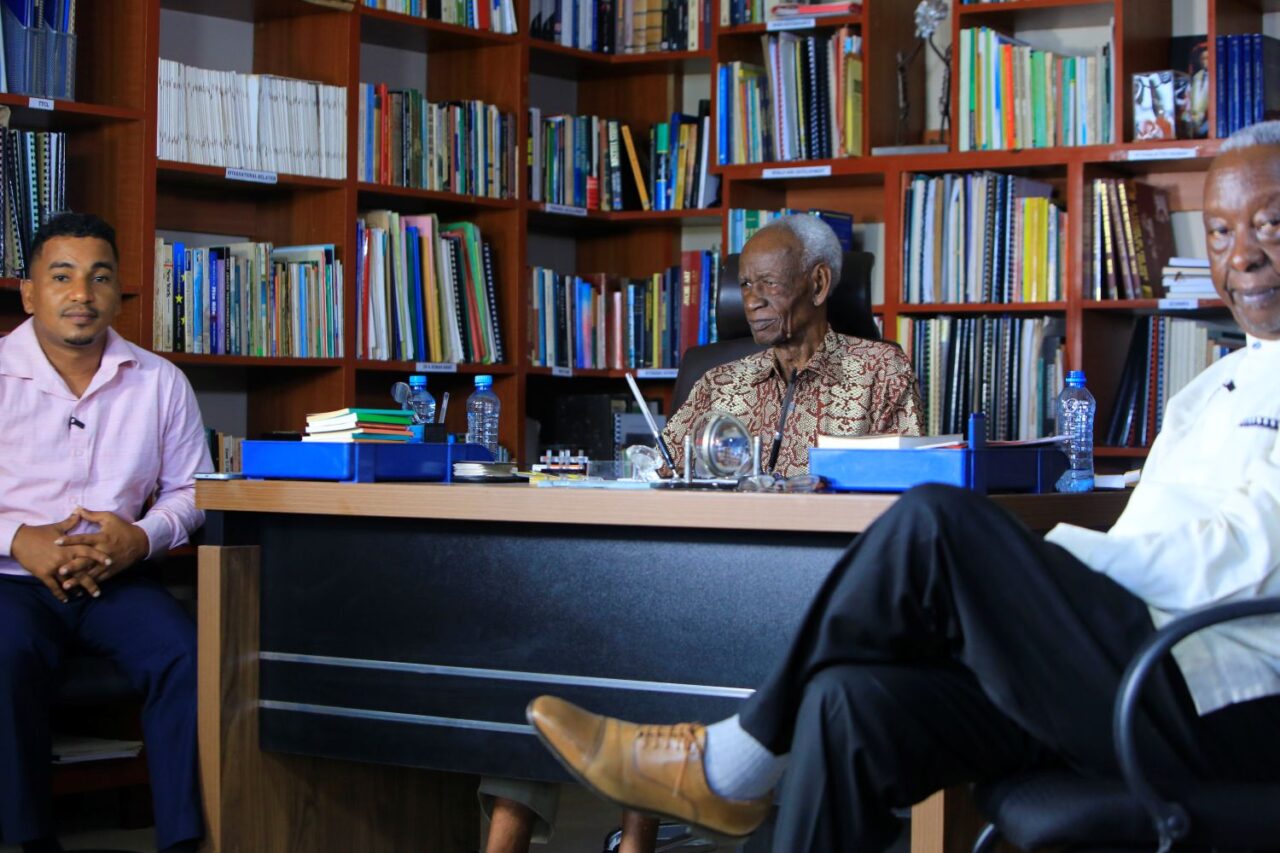
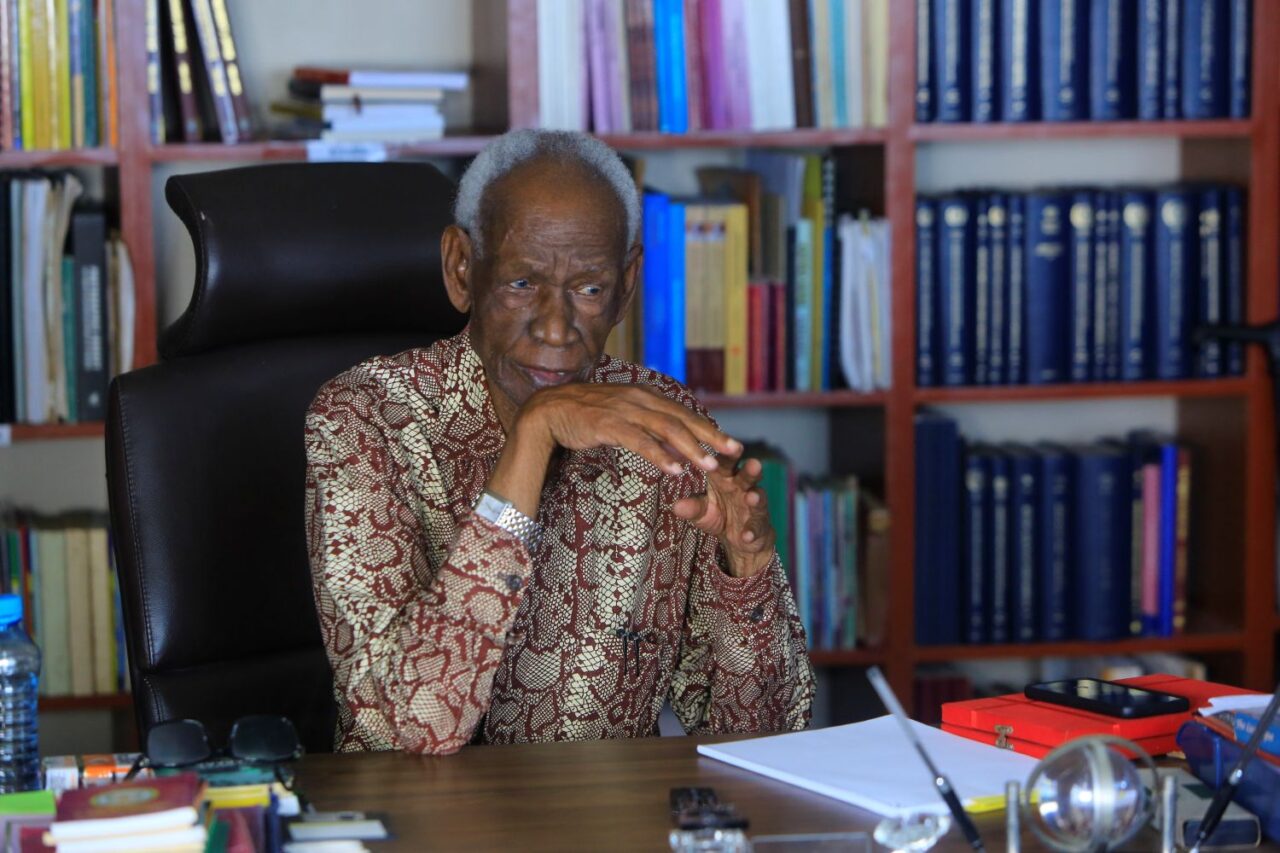
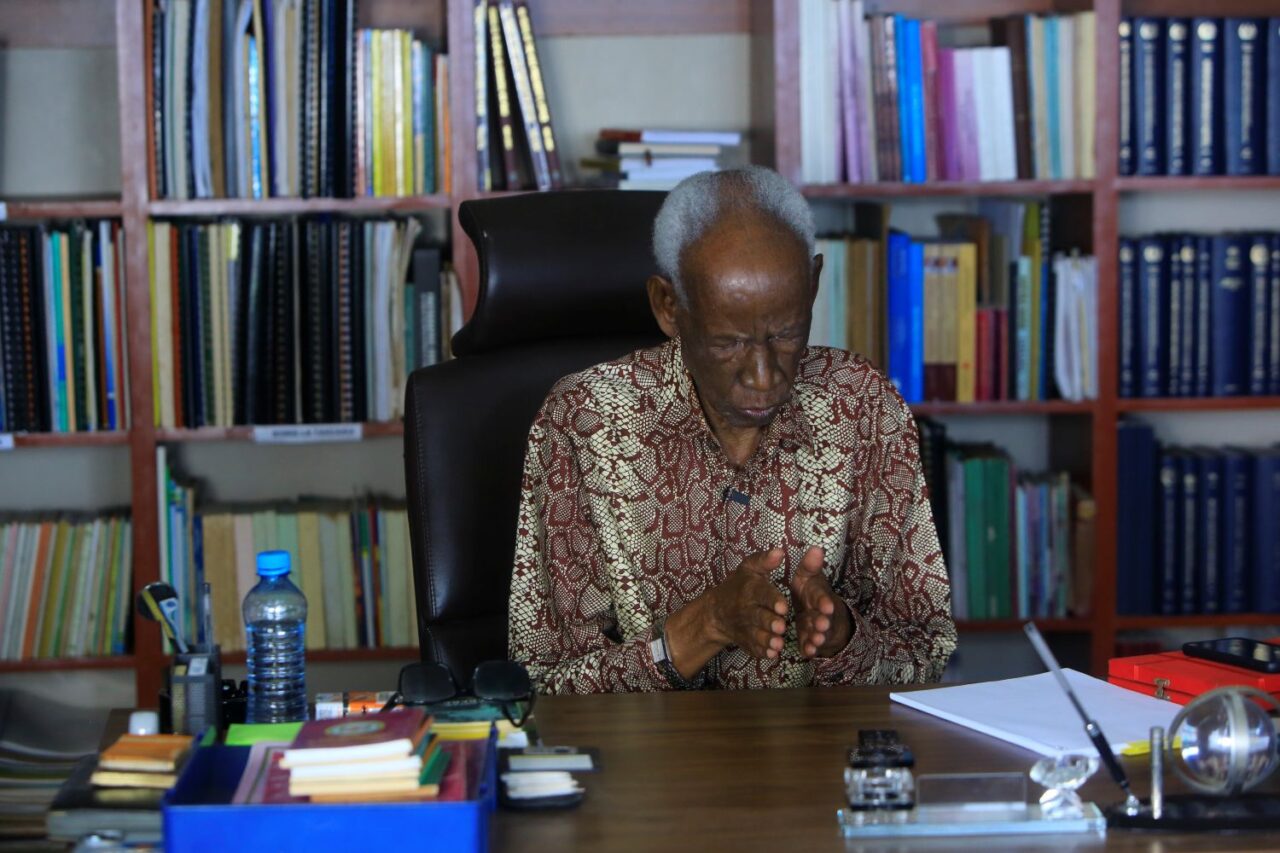
The following interview features former Prime Minister Joseph Sinde Warioba. The interview was conducted on May 9, 2026, and published on May 10. It was produced through a collaboration between The Chanzo and The Jenerali Ulimwengu Post . You can watch the full interview below or continue reading here.
Jenerali Ulimwengu: Brother Joseph Sinde Warioba, welcome to The Jenerali Ulimwengu Post.
Warioba: Thank you, thank you.
Jenerali Ulimwengu: Brother Warioba, I had been asking you for a long time to grant me an interview, but you kept telling me to wait, to wait, to wait. Now I think the time has finally come, and you have agreed to have this conversation with me. Back then, about two months ago, you said you were first waiting for the report of the commission that was formed to investigate what happened on October 29.
I have waited, and the commission has now released its report. I personally have not seen the actual report. What I have seen is only the speech by the chairman of that commission. So I do not know whether you have received the report itself, and if you have, what are your views regarding that report? Welcome.
Warioba: This question is a bit difficult for me to answer. Last year, in October, we experienced events here in our country. We conducted elections in a way that brought us shame, and there was violence in which many citizens lost their lives.
At that time, after those events occurred, there was a national discussion in the country, and at times even heated arguments. After those incidents, it felt as though we had a new Tanzania, one that did not resemble the Tanzania of yesterday.
So we began consulting each other, asking ourselves how we could heal these wounds, we have suffered so that we could have a new beginning and preserve our Tanzania, a Tanzania that had been built on equality and justice, unity, solidarity and patriotism. We wanted to return to that.
During those discussions, the government decided to establish a commission so that the commission could investigate, determine what had happened, and identify the way forward so that we could resolve these issues.
Because of that, at the time I did not enter into these public discussions. Since the government had announced that it was forming a commission, I felt that, since there was now a commission, and since members of that commission had been appointed, prominent individuals, it should be allowed to do its work.
However, there were still arguments about whether that commission would be trustworthy. Despite all the criticisms people raised against the commission, I believed it was a commission that could genuinely conduct investigations and provide us with a report that would help us see how to rebuild Tanzania anew.
I went before the commission. They invited me, and they gave me ample opportunity. I spent about two hours with them, presenting my views.
Throughout that whole period, as you yourself mentioned, you were not the only one requesting to come and speak with me. Others were also asking for interviews. But my response was always: ‘Ah, let us wait. Let the commission complete its work, and afterward we shall talk.’
The commission has now completed its work. During that entire period, the government kept asking citizens to remain calm until the commission finished its work, to listen to what the commission had done and to wait for its report. So all of us waited, believing that we would eventually receive the commission’s report.
The commission completed its work and submitted its report, I think it was on April 23, and handed it over to the President. Many of us expected that the report would now be distributed, just as we had been promised: ‘Wait and see what the commission says.’
Commission report
So we expected to receive the report. But immediately afterward, we began hearing statements saying that this was the President’s commission and that the report belonged to the President. That confused me somewhat because I had expected that we would get to see how the commission carried out its work, what it discovered, and what recommendations it made.
What we have received concerning the commission has now become almost a theoretical debate, with people saying that the law gives the President authority to establish a commission and that the report is submitted to her, since it is the President’s commission.
Legally, that may be correct. I believe the law they are referring to does indeed allow the President to appoint a commission, let it conduct investigations, and then submit the report to her.
But we have had a tradition in this country. While they are discussing legal theory and saying, yes, it is the President’s right to receive the report of the commission she appointed, we also have a tradition here that, on important national matters, when the President appoints a commission and it completes its report, that report is made public. And there are examples of this.
Back in the 1980s and 1990s, especially toward the end of the 1980s, there was a strong movement here demanding the return of a multiparty political system. The movement became very significant, and the President decided to establish a commission to ask citizens for their views.
That was the Nyalali Commission. The commission carried out its work and released its report. That report was made public. It was not read only by the President. And not only that.
In 1995, during the election campaign process, the major issue for citizens was corruption. Everywhere I went, even when I participated in the early stages of seeking sponsors [nomination signatures to run] and support, what citizens were talking about was corruption.
During the campaign, President Benjamin Mkapa realized that citizens considered this to be the biggest problem. After he was elected in October, he did not even wait long. By December, he established a commission , the commission on the issue of corruption, and, with great honor, he appointed me as its chairman.
We went and carried out the work, just as the Chande Commission had done, following the procedures required by law. We completed the investigation and submitted the report to the President.
The President said this was important and that citizens needed to know what the commission had done, so he made the report public. He made it public, and if you remember, newspapers published the entire thing. It was huge. That report itself was massive, I could even show it to you, more than five hundred pages.
Everything contained in it was published: the procedures the commission used, what citizens said, and the recommendations that were made. People were able to know all of that. So to say that it belongs only to the President and that she simply keeps it to herself, that is difficult.
I was also fortunate enough to lead the Constitutional Review Commission. I worked on it for eighteen months, and we produced a report. The report was very large. If you look there, what you see in red, together with this small ‘booklet,’ are only part of the report.
The report itself was actually small, but it had many appendices, and all the appendices were released publicly, more than seven of them. Among them was a volume containing citizens’ views about the constitution, explaining what they said about every article.
There were also citizens’ views about policies, laws, and governance. There were the views of constitutional councils, which were essentially citizens themselves. Then there were other materials, statistics, random data, and even the draft constitution itself, because the draft itself was an appendix to the report.
Citizens were allowed to know all this because it was an important issue for the nation. And this current matter is even bigger. We are in a state that feels almost like national mourning. Citizens are waiting for us to speak.
I expected that the report would be released publicly together with all these appendices, because the report itself is usually brief. To understand how the commission carried out its work, you need to look at the appendices.
Now this issue of saying that the report will not be made public troubles me greatly. What I have here is the speech by Chairman Judge Chande. I have read it, read it again, and studied it carefully. I realized that there are important matters in it.
For example, regarding the deaths that occurred in October, they mention the number of deaths. But if you had access to the full report, it would explain how they arrived at those figures, how the information was gathered, and whether those numbers were sufficient to account for all the deaths.
Even they themselves state that the figures are not definitive and that there could be more cases. This is a major issue. Citizens needed to know this because we now want to move forward and prevent such events from happening again.
If this information is not known publicly, then there is a problem. Despite the shortcomings, after reading this speech, one thing is clear to me: the commission itself appeared to expect that the report would be made public.
I read where the chairman says: ‘I have mentioned only some of the recommendations contained in the report. Stakeholders will undoubtedly have the opportunity to study them in depth within the report itself.’
This shows that the commission intended for the report to be read. The stakeholders are all Tanzanians. They were the ones who were told that this report was coming. So I say this situation troubles me because the expectation we were given was that the commission would investigate and then come back and tell the people what it had found.But we do not have that.
To me, it feels as though certain matters are being hidden. That is why it troubles me.
Even within the commission’s own statement, there are issues that appear which, had we received the full report, we would have been able to examine in greater detail and understand fully.
For example, they say there was a group of people that organized these acts of violence. These groups recruited people, trained them, and established camps. In some places, the camps were reportedly only ten meters away from police stations. They also distributed money.
Now I do not know whether this happened only in the regions involved or across the whole country.
So you begin asking yourself: if all this happened, how could the security and defense organs fail to know about it?
That creates serious concern, and we would want to understand how such things could happen without the authorities being aware. And this creates the impression that these security institutions are becoming distant from the citizens.
Because if these institutions were truly close to the citizens, it would not be possible for all those plans to be carried out without the security organs being aware of them. That is one issue.Secondly, regarding the deaths they mentioned and how they occurred, I personally believe the deaths were far more numerous than what they are stating, more than five hundred.
But they say there were acts of lawbreaking, and they recommend that another commission be formed to investigate, and that those who acted outside the law should be held personally accountable. In other words, they are saying that one should go and identify the police officers who acted unlawfully and deal with them individually. That also gives me some concern.
It troubles me because, if you go searching only for those who carried out the acts, what about those who gave the orders? And we have had examples of this before.
In 1976, the government formed a task force of experts from the police and security services. At the time, as you may remember, we had the problem of elderly women being killed in Mwanza and Shinyanga because they were being accused of witchcraft.
The task force was sent there to conduct investigations. What we wanted was an investigation into why these events were occurring, so that they could return and provide a report to the government on the measures to be taken.
Jenerali: The problem involved killings, murders of elderly women accused of being witches.
Warioba: But instead of simply carrying out investigations, the task force went there, established camps, and began torturing citizens. Some died, while others were left disabled.
When this became known, the first step that was taken was accountability. And those who were held accountable were the leaders, even though they were not physically present there.
As you may remember, former President Ali Hassan Mwinyi resigned. Siyovelwa, who was then Minister for Security, resigned. The regional commissioners of Mwanza and Shinyanga — Mabawa and Kisumo, also resigned.
Only after that came the second step: identifying those directly involved. They were arrested and prosecuted. Now, in this case, it is as though they are saying the police broke the law. So now you want another commission to investigate whom exactly? The police institution as a whole, or specific individuals?
To me, this also feels like an attempt to cover up what happened. For example, the report says that police officers went to a place where young people were watching videos and killed thirteen people there. This evidence may indeed be found, but who will come forward and identify which specific officer committed those acts? The citizens there do not know those officers personally.
So the investigation may conclude that, yes, the events occurred, but the perpetrators are unknown people. Because it will be difficult otherwise, unless one simply looks for a scapegoat. I believe that, based on the little we already know, there should have been accountability. That alone would have satisfied citizens that concrete steps were being taken.But these repeated commissions seem more like attempts to let matters gradually be forgotten so that we simply continue as usual.
Jenerali: Now let me ask you something. The question comes directly from what you yourself have said. Some people argue that simply by looking at the commission itself, by examining how it was formed and who was included in it, the shortcomings you are talking about were to be expected.
If you look at it closely, everyone on the commission came from the government establishment. There was not even a single independent person. There was a retired Inspector General of Police, a Minister of Defense who was in office when these events occurred, and other senior government officials.
So people say it was like appointing a monkey’s commission to investigate what another monkey had done. Some believed that the problems you are now complaining about could never have turned out differently, that this outcome was predictable from the beginning.
Warioba: As I said earlier, that debate already existed when the commission was being formed. People discussed it openly. I was asked about that very issue right here by Jamhuri, and I said that despite all those concerns, I understand how commissions operate because I myself have led commissions before.
Commissions go to the citizens, and there is a record of what citizens say. No commission can completely hide what people told them. I told them that my concern was not whether the commission would do its work, but whether the government would implement the recommendations once the commission presented them.
I also told them that many of the people on that commission were individuals I had worked with before and whom I considered to have integrity, especially their chairman.
Some of them I had worked with during the Criminal Justice Commission. I saw firsthand how they worked. They presented the truth exactly as it was, because after the Criminal Justice Commission, I was associated with them and witnessed their work closely.
They revealed matters that perhaps even the government itself might not have liked. So the composition of the commission itself was not my main problem. My problem is that what the commission produced was never released publicly.
And not only that, after the report was completed, there have been efforts to prevent people from discussing the commission at all. You now see people gathering together to praise the commission even though they never actually read the report itself.
At the same time, there have been efforts to stop those who are suspected of having different opinions. I will give you two examples. Before the commission released its report, two groups invited me to participate in seminars.
The first was Tanzania Centre for Democracy. The chairman of the center, the leader of ACT-Wazalendo, together with the TCD secretary, came here and invited me to participate in a seminar they were organizing to discuss the direction the country should take.
I sat with them here, and they requested my participation. I apologized and told them: No, I cannot participate now. We already have a commission conducting investigations. Since these are the very matters being investigated, I can only participate after the commission releases its report.
So they went back and, after consultations, changed the date of their seminar so they could wait for the commission’s report. The second case involved another group, I believe it included the Tanganyika Law Society, UDASA, the university, and others. They brought me a concept note explaining the seminar they wanted to organize, together with the schedule.
It was supposed to take place on April 24 and 25. They also asked me to participate. I gave them the same response: No, I cannot participate. The matters you intend to discuss are exactly what the commission is investigating. Let us wait for the commission’s report first, and then we can talk.
Later they returned and told me that, following that advice, they had postponed the seminar. At first the seminar had been planned for April 24 and 25. I told them: According to the schedule here, the commission is expected to release its report on April 24, although later they said perhaps April 25. If you hold your seminar on the same day the commission releases its report, people will not even pay attention to your discussions.
So they too went back, consulted among themselves, and changed the dates. Both the Tanzania Centre for Democracy group and the university group later returned to me and said: ‘You told us you could participate after the commission released its report. The report is now out, and we are planning new dates. The university group told me they were planning for May 7 or 8, while the TCD group was considering May 11 or 12. I told them: Give me some time in May to reflect.
After about two days, I contacted them again and asked for more details so I could see the agenda.
That same day, both groups informed me that the government had stopped the meetings. They said the government feared that such discussions could create turmoil.
So the Tanzania Centre for Democracy , which is an organization made up of political parties, was prevented from carrying out its activities. And regarding the university-related group, I was told that after UDASA released a statement, their event too was blocked.
So you can see that the effort is not only about keeping the commission’s report away from citizens. Even those who want to discuss it, especially those suspected of holding different views, are being stopped.
Jenerali: Perhaps those stopping them know that people have not even seen the report itself, and they wonder what exactly people would discuss in such meetings.
Warioba: I do not know. What I was told is simply that they were prohibited because the discussions might cause turmoil.So I do not know about this ‘turmoil.’
Khalifa Said: Yes, Mzee Warioba, thank you very much for that. Regarding the question asked by Mzee Jenerali: do you think it was possible for the commission to do what you expected of it, considering the terms of reference it was given?”
Warioba: When you look at the terms of reference, those are public documents. All the instructions given to a commission come from the person who establishes it. But when you go to the citizens, they have their own concerns and perspectives.
All the commissions I have chaired, even when we were given terms of reference about corruption, once we went to the people, citizens themselves understood corruption in their own way and had their own issues to raise.
So you may have official terms of reference, but when people come to speak, they will say what is truly on their minds. And you record everything they say. Those records can ultimately influence or even change the direction of the work.
If you look at the terms of reference for the Constitutional Review Commission, there even came a point where certain matters were officially considered untouchable , one of them being the Union issue.
But when we went to the citizens, they expressed their own views, including matters that were not even contained in the official terms of reference. Terms of reference are merely guidelines. They do not mean you go to citizens and tell them, ‘Do not discuss this issue.’ No.
As I told you earlier, during the Constitutional Review Commission, citizens were invited to speak about constitutional matters. But when we reached them, someone would say: ‘I know nothing about the constitution. I want to speak about issues affecting me personally.’
So people talked about the conduct of District Commissioners, about certain laws, about policies, and many other matters. You cannot simply ignore those things.
We had to document all of them. That is why I expected this commission also to come back and say: ‘This is what citizens told us.’ Because the people directly affected are the ones involved, and without hearing their views, you cannot truly know their thinking.
And I noticed that when the chairman presented the report, he referred to many appendices. Just as we did in our commissions, those appendices would have helped you understand what citizens actually said.
Khalifa Said: I just want to understand clearly. So you believe the truth may actually be contained in the report that was submitted? Because many citizens believe there may be nothing substantial even within the report itself. But you seem to believe that if we had access to the entire report.
Warioba: Yes, I do believe so. If you were able to examine those appendices, you would know what citizens said. Recommendations are one thing, but understanding what the people themselves expressed is something else entirely. That would have been very helpful.
But now we do not know. And what troubles me even more is this: when you hear people praising the commission, you notice that whenever others appear who might not praise it, they are immediately discouraged. People are told: ‘No, this is not helpful. Do not do this.
Khalifa Said: And perhaps one final question, with your permission. Mzee Warioba, you spoke about accountability, and there has been a debate about exactly where should accountability begin.There is a large group in our society that does not even recognize the legitimacy of the government itself.
So there are opinions suggesting that accountability should begin at the very highest levels. In your own view, at what level should accountability begin for you to consider it acceptable?
Warioba: That is exactly why I say that, since I have not seen the full commission report, I cannot specifically name who should be held accountable. But if the commission concluded that unlawful acts occurred, then the first step would be to begin with the people responsible for overseeing those sectors.
They should be held accountable. And accountability at that level demonstrates that the government recognizes this as a serious problem.
As I told you regarding the Mwanza-Shinyanga case, accountability began with the senior leaders. The Minister of Home Affairs, the Minister of Security, the Regional Commissioner of Shinyanga, and the Regional Commissioner of Mwanza all accepted responsibility.
In a situation like this, there must also be individuals whose responsibility can be identified, people who were supervising these matters. Those individuals should visibly be seen taking responsibility.
Jenerali: So, Brother Warioba, we have now reached the point you described.What do we do from here? Because if there is a deadlock, this is truly a serious deadlock. We are stuck. What should we do to move forward? How do we find a solution?
Many people are traveling around trying to help. Former Malawian President Lazarus Chakwera has come. Former Liberian President Ellen Johnson Sirleaf has come with other influential African women leaders.
Clearly, there are efforts being made because people sympathize with us, seeing that we have reached a very bad situation. What do you think can now be done, by those in government, by civil society organizations, and by citizens, so that we can get out of this situation? Because we cannot continue living like this. The psychological atmosphere is extremely bad.
Foundation
Warioba: When I began speaking earlier, I said that after the events of October, we woke up in a new Tanzania , one very different from the Tanzania we once knew. The Tanzania we knew had built a culture founded on the belief that all people are equal, that all citizens have equal rights as Tanzanians.
When you ask about Tanzanians, people describe them as united and closely connected. Tanzanians are patriotic people. And because of that, Tanzania became a peaceful nation.
So now the challenge is: how do we restore Tanzania? How do we return to a society with equality and justice? How do we rebuild unity and solidarity, because right now they are no longer there? How do we restore patriotism and peace?
How do we get there? That is why I say these discussions are important, and why I am troubled when they are prevented. That is where our focus should be.
Now forgive me, because I may speak at length here. There are three major areas we must address.
The first is taking steps that will safeguard peace in this country so that we can return to a peaceful condition.
The second concerns our Constitution.Our Constitution says that the foundation of authority lies with the citizens themselves. But since all citizens cannot directly participate in governing, they have the right to elect representatives who will speak on their behalf.
So the second issue we must examine is our electoral system. And the third issue, which I believe is the major root cause, is the Constitution itself. Perhaps I should discuss these one by one. When it comes to peace, the founders of this nation built it deliberately to become a peaceful country. They took certain steps to guide us toward becoming a peaceful nation.
Here I even have the Constitution of Tanganyika African National Union from July 7, 1954, because it clearly outlined the goals of the movement. Let me read some parts of it to you. Earlier you mentioned that I am a senior CCM member, yes, that is true.
This 1954 TANU Constitution says: ‘The objectives of the Tanganyika African National Union (TANU) shall be: First, to prepare Tanganyikans for self-government and to strive tirelessly until Tanganyika achieves independence and governs itself.’
That was the first goal. The second goal was to eliminate tribal discrimination and all other practices that hinder unity among Africans, and to build one nation of Tanganyikans. The fifth goal was to eliminate racial discrimination of every kind.
Those were their objectives. And if you read the documents written later by Julius Nyerere concerning these goals, I have them here, including the writings called ‘TANU na Raia’ (‘TANU and the Citizens’).
But before writing those, TANU had first established guiding principles. I do not remember exactly when they were written, but it was before independence, because in these booklets Mwalimu quotes those principles repeatedly.
Warioba: Let me read them all to you.
‘All human beings are my brothers and sisters, and Africa is one.
I will serve my country and all its people.
I will dedicate myself fully to eliminating poverty, ignorance, disease, and oppression.
Corruption is the enemy of justice.
I will neither receive nor give bribes.
Leadership is a trust.
I will not use my position, nor another person’s position, for my own benefit.
I will educate myself to the best of my ability and use my education for the benefit of all.
I will cooperate with all my fellow citizens in building our country.’
‘I will always speak the truth; slander and intrigue are forbidden to me.’
All those date back to 1958.
Jenerali: Now tell me, when you read those, I think they were called the TANU Member’s Pledges.
Warioba: They were formulated as principles. The purpose was that TANU leaders would explain these things to the citizens, so people would understand: this is the direction we are taking. Later, they became the member’s pledges.
Jenerali: Now, those things you just read there, within your party, I ask you: where are they in your party? Where are all those things you have read here? And those are only some of them. There were others too. There were ten altogether. When I look at those pledges and then look at your party, and I have said you are a senior member — do they resemble each other?
Warioba: I will leave the answer to that question in my own mind.
Now let me continue.
When you look at this document, TANU and the Citizen, what we are reading here was almost like a national creed, a belief system for the nation, that this is the kind of Tanzania we want and these are the kind of Tanzanians we want. At that time, they were Tanganyikans. It was a national creed.
After independence, Mwalimu stayed for only a few weeks as Prime Minister, almost just one month, then he stepped down and returned to work directly with the people and the party. That was the period when he wrote these two documents. TANU and the Citizen was written in April 1962, correction, it was written in May 1962.
If you look at what he discusses in it, fundamentally he talks about equality and justice. In fact, you will find that throughout the document he writes the word “JUSTICE” in capital letters many times. He talks about unity, patriotism, and truth.
And this is the quote we often repeat: Truth has one very good characteristic: it does not care whether someone is great or small; it does not care whether someone is an enemy or a friend. To truth, all people are equal.
He also wrote: Truth has the habit of taking revenge when ignored.
He wrote that in 1962, that truth has a habit of avenging itself when ignored. In this document, he explained truth at great length and wanted people to speak the truth freely, without being silenced.
When he returned to government, he began implementing the principles that had been written into the constitution and party regulations. One of the goals was to eliminate every form of discrimination.
Even before doing this, as I read earlier, one major issue was removing racial discrimination. But within the TANU system there were still people who held discriminatory views.
So in 1961, before independence, it became necessary to draft a citizenship law. At that time, Mwalimu remained a Member of Parliament and was also Prime Minister. I think it was in October 1961, less than two months before independence, when Parliament debated that bill. Many TANU leaders opposed the idea of Europeans and Asians becoming citizens of this country. They argued that citizenship belonged only to Black Africans.
In one speech, while serving as Prime Minister, he said: ‘If this Parliament passes a discriminatory law, my government and I will resign.’
He fought hard to stop it. At that moment, there was pressure to make citizenship exclusive to Black people, but because of his efforts they passed a law without discrimination. It stated that if you were born here, or if one of your parents was born here, then you were a citizen by birth, regardless of race.
Even after returning to government, he demonstrated this not only in words but also in actions. If you look at his cabinets, all of them included Europeans and Indians. There were people like Derek Bryceson, Amir Jamal, and others who were close to him. Even his close assistants, everyone knows Joan Wicken was one of his closest assistants throughout. Others such as Annar Cassam also joined him.
So he demonstrated equality through action. Then he turned to larger issues: eliminating tribal discrimination and religious discrimination. You and I both know how strong discrimination was in those days.
Then we formed the Union in 1964 and strengthened national unity through those efforts. Citizens abandoned all forms of discrimination, and as we continued up to today, you can go anywhere, in towns or villages, and find people living together without discrimination at all.
I come from a village in Mara Region called Nyamuswa. Nyamuswa used to be a chiefly village where our chief, Makongoro, lived. He was a Muslim, and because of his influence there were many Muslims there. In a neighboring village there were many Seventh-day Adventists. In those days, relations between such groups were not very good.
But today’s Nyamuswa is different. If you go there now, you will not even be able to tell who is Muslim, who is Christian, or what religion someone belongs to. They live together with mutual respect and shared culture. I grew up there, and people know how much they respect one another.
At our home, whenever we wanted to slaughter an animal, even for household use, we would go and ask a Muslim man to come and slaughter it, because you all lived together. If a Muslim did not slaughter it, Muslims would not eat the meat, while Christians had no problem with it. That is how people cooperated.
Wherever you go, if you find elders gathered together, they come from many tribes yet cooperate as fellow citizens. In our local representative office in Nyamuswa, for about fifteen years our local area representative was called Antony Nchimbi, a Ngoni man. He came there, carried out his duties, settled among the people, and became part of the community. Even me, by then, despite being Prime Minister, I would go there looking for the representative. There was absolutely no discrimination.
And in many places across this country it was like that. Even in music there used to be tribal divisions. I do not know if you witnessed it. There was a band called Kilwa Jazz Band, which mainly involved people from the southern regions. There was Western Jazz Band, I think associated with the Nyamwezi and Manyema people. In Tanga there was even a band called Nyamwezi Jazz Band for the Nyamwezi people.
After independence they were told: ‘This reflects tribalism. Change the names.’ So it became Jamhuri Jazz Band. That division ended.
Then when we established the National Service, it helped build a new culture where Tanzanians lived together. Sindimba dance used to belong to the Makonde people, but eventually Sindimba was danced everywhere. Hiari ya Moyo music used to belong to the Nyamwezi, but later it spread, throughout the country. Taarab music used to be identified with coastal people, but eventually even the Gogo and the Haya were singing taarab.
We began building a shared national culture. People mixed completely. Young people today do not carry those old divisions. In the past there were tribal groupings everywhere, but today if you go to a boda boda stand, do you find people organizing themselves tribally? Or among Bajaji drivers? They all live together.
We removed much of that discrimination, but in politics it never disappeared completely. Politicians continued using tribalism and religion during elections. The problem is not with the citizens; it is with the politicians who exploit these divisions.
All these issues we are discussing were shaped by leadership. Citizens were prepared to become one nation. But now things have changed. We eventually decided to restore the multiparty system, and after its return, political parties began turning to become like tribes. At that time the goal had been to unite citizens, but now parties have come to divide them. Political parties have become like tribes.
And they have party uniforms as well. So if it is a meeting for a certain political party, people wear that party’s uniform. If someone from another party comes wearing their own uniform, it becomes a conflict. We have reached a point where we are no longer acting as Tanzanians together. That is one thing that has divided us. It is a departure from the foundations that were originally established.
And now it has continued like that. Then we returned again and started reviving tribalism. You hear people saying that chiefs should supervise morals and traditions. Yet here we were building a Tanzanian culture, and now someone comes and says we should return to those beliefs and systems we had already removed.
Jenerali: Why is this happening? There are many theories. Mwalimu often said that when a person becomes intellectually and mentally bankrupt, they begin searching for things like tribe, religion, or which side of the country someone comes from. Why has your party allowed these things to happen?
Warioba: I say, it is not only my party. I have said politicians in general.
Jenerali: But they are in your party too, and they are the ones leading the country.
Warioba: Here I want to speak about the nation; I do not want to go into party matters. All parties today are doing these things. As I told you, even back then, despite efforts to stop such behavior, politicians still continued with it.
Even if you talk specifically about my party, I think the difference is that at least in those days people condemned such actions, and sometimes they even took measures against them. Nowadays it is almost as if these practices have been officially approved; they have become normal procedure.
And it is not only within political parties. Even in civil society institutions these problems exist. They are there. So that is one thing that has divided us. We must return to the original foundations. Since these principles have been broken, we must find a way to restore unity among Tanzanians, because we are divided.
Right of people to choose
That is on the political side.The second issue is the people’s right to choose their own representatives. Since the beginning, our constitution, I think Section Eight, has stated that the basis of power is the citizens themselves, and that they choose their representatives.
During the period when I was in government, this right of citizens was strongly protected. There were occasional violations here and there, but the government ensured that during elections the goal was to enable citizens to cast their votes, have those votes counted, aggregated properly, and ensure that whoever was declared elected had truly been chosen by the people. That was the system at all times, and the government supervised it carefully.
If they saw that somewhere citizens were being denied their rights, they intervened. During voter registration they made sure people were properly registered. They did not allow ineligible people to be registered. When preparing polling stations and materials, they ensured that every eligible voter could reach the polling station, find the necessary materials available, and vote under proper supervision. Then the votes had to be counted correctly, totaled properly, and the results announced transparently. That was the procedure.
Of course, there were still people breaking the rules. One example I often give is that politicians in the middle of the process sometimes produced fake ballots. In one constituency, someone would manufacture fake votes, bribe election officials, and have those ballots inserted into the box.
Jenerali: This was during the one-party era?
Warioba: Yes, during the one-party era, when CCM was the only party. Even within CCM, people stole votes from one another. In any election, whether within CCM or another party, problems will always arise.
So what did we do at that time, and I was there? We introduced measures to stop fake ballots. Today, when someone goes to vote, they are given a ballot paper that is officially stamped. In the past, there was no such stamp. That measure was introduced precisely because fake ballots had started appearing. It prevented someone from printing ballots independently and carrying their own stamp from polling station to polling station.
Jenerali: Even though there were those measures, the rootcause is the lack of intergrity
Warioba: Let me continue. Irregularities still occurred. But the law stated that if you were dissatisfied, you should go to court. And people did go to court. I myself am an example.
In 1990, I contested for Parliament in Bunda and won by a large margin. My opponent was dissatisfied and took the case to court. The election was annulled because I had campaigned using a government vehicle. The election had to be repeated.
Then in 1995, I contested again and lost. I was dissatisfied, so I went to court, and the election was annulled. At that time, the Electoral Commission was trusted, and the courts were trusted. But nowadays, the Commission is not trusted and the courts are not trusted. That is the big difference.
Why are they no longer trusted? Because of the practices that emerged over time. As these things continued, corruption entered elections. It started with the voters themselves, with takrima (gifts and hospitality). You remember takrima? That is where it began. There was public outcry about it, but people simply found other methods.
Eventually it reached a point where the greatest corruption became concentrated in nominations — party nominations. If you look at political parties today, the real issue lies in the nomination process.
When multiparty politics began, parties had the authority to nominate candidates without even consulting the citizens. Even in the elections of 1958 and 1959, parties simply selected their own candidates. TANU would appoint its candidates without consulting people or caring about local opinion.
I usually give this example: Maswa was a rural Sukuma area. In 1958 or 1959, TANU selected Wambura from Musoma/Serengeti to be its candidate there. He did not even know the Sukuma language, while many local Sukuma people did not know Swahili. So they didn’t not go [to listen to him] and he passed unopposed. That is how things were done.
Then in 1960 we held another election. TANU leadership meetings selected candidates and sent them to constituencies. Usually people accepted them, except in one place, Mbulu.
A young TANU member named Herman Sarwatt challenged the party’s choice, saying, ‘No, we do not accept the person you selected.’ Sarwatt stood as an independent candidate against Amri Dodo, the local chief. That is when people realized there was a problem.
Still, things continued. Then in 1965 we entered the one-party system, but it was decided that no one should pass unopposed. So in every constituency, the ruling party would nominate two candidates. Yet the same mentality remained: leaders still wanted their preferred people selected.
For example, if they wanted so-and-so to win, they would pair him with an unknown candidate so victory was guaranteed. But the results shocked everyone. Citizens voted against some of the officially favored candidates. Some powerful figures lost. Bomani lost despite being paired with someone almost completely unknown. Mnanka lost in Tarime even though his opponent could barely express himself properly. There was even a joke that at rallies the man would only say in broken Swahili:
‘Citizens… help… knock down this log.’
Yet people were shocked that Mnanka still lost.
That is when the party realized that it should not impose candidates without understanding whom citizens actually wanted. That is when kura ya maoni, opinion polls began. Before nominations were finalized, there would first be internal voting to indicate whom the people preferred.
At first it worked well. Then corruption entered again. Corruption entered, entered, and kept growing until many citizens began feeling they no longer truly had the right to choose, because the people being nominated were those preferred by party leaders, not by the citizens. Whether for parliamentary candidates or councilors, the nomination process itself became the center of corruption.
At first, district executive committees conducted these internal opinion votes. Corruption entered there too. Then CCM said: ‘These are too few people. Let us widen the electorate. A candidate cannot bribe everyone.’ So they expanded participation to ward and district leaders together.
But still it did not work. Back in 1965, the opinion vote involved all party members, yet corruption still dominated. Do you remember in 2020 when CCM tried to stop bribery? They created regulations saying candidates should not start campaigns too early or engage in certain practices. But when voting came, corruption was still there.
And what followed became even worse: people now speak about corruption as though it is normal. I saw a newspaper report where a candidate complained — I do not know whether it was true — that during the CCM nomination process there was a system with two stages. Anyone who wanted to contest could present themselves, then there would be a screening process to reduce the number to three candidates for the opinion vote.
But corruption entered there too. Instead of evaluating merit, what mattered was the size of your envelope. If your envelope was large enough, you passed through. And there have been many complaints about this.
People have even experienced situations where, after going through the opinion polls and receiving many votes, they still do not get selected. Corruption has entered the process.
To me, this is the biggest problem of all, because leadership is supposed to fight corruption, yet leadership itself has become involved in corruption. In these opinion polls, all the people voting are leaders, and they are the same ones receiving bribes, leaders from every level. So what can people expect? What can citizens hope for?
As a result, citizens have been stripped of their power. Elections, as someone once said, have become a marketplace. If you have a lot of money, you succeed. That is one of the things that has entered the electoral process.
But the second issue that has interfered with elections is the setting aside of the Constitution and the law. Beginning in 2019, the procedures that were used ignored the principles laid down in the Constitution. The Constitution contains clear foundations regarding nominations.
Let me read Article 67 of the Constitution to you. These same qualifications also apply to councilors and to the presidency. It says:
‘Without prejudice to the provisions contained in this Article, any person shall qualify to be elected or appointed as a Member of Parliament if:
(a) he or she is a citizen of the United Republic, has attained the age of twenty-one years, and is able to read and write in Kiswahili or English;
(b) he or she is a member and candidate proposed by a political party;
(c) within the five years preceding the election date, he or she has not been convicted by any court of law for the offense of evading payment of any government tax.’
Those are the qualifications. For voters, the requirement is simply that one must be a citizen aged eighteen years or above. These conditions are also found in the Election Act: if you meet these qualifications, you may contest.
There are also categories of people who are disqualified from contesting. For example, anyone who voluntarily acquires citizenship of another country cannot run for office. There are many other disqualifications listed as well.
So during the electoral process, what you are supposed to examine is whether a person possesses these qualifications. If they do not, then they are disqualified.
But starting in 2019, they stopped using what is written in the Constitution and in the Election Law. Instead, they introduced another system of disqualifying people , one that was not written anywhere. Many people were disqualified over trivial matters. For example, if you abbreviated ‘Dar es Salaam’ while filling forms, you could be disqualified.
And those carrying out the disqualifications targeted certain political parties. There were parties in which not even one candidate was disqualified, while candidates from other parties were removed in large numbers. That system was used in 2019, in 2020, in 2024, and again in 2025.
Then in 2025 they introduced yet another method of disqualification. Yet if you look in the Constitution or in the Election Law, what the Electoral Commission did is not there. The Commission does have the authority to create regulations, but those regulations must conform to the law itself,
Jenerali: Because regulations are only meant to explain the law.
Warioba: Nowhere does the law say that if a political party fails to do a certain thing, the entire party will be disqualified.
Khalifa: You mean failure to sign certain codes of conduct
Warioba: Yes, you will not find that in the Constitution, the Election Law, or even in the Political Parties Act.
What has happened is that authorities are using powers granted by law to do things that go beyond the legal foundation. That is how we have reached this point.
And this has divided people deeply — very deeply. Beyond that, even the institutions responsible for overseeing these matters have lost public trust because of their actions. People no longer trust the Electoral Commission. People no longer trust the Registrar of Political Parties after seeing how these things have unfolded. People no longer trust the security organs. People no longer trust the courts.
We have abandoned the old standards. Nowadays corruption is treated as normal. Disqualifying candidates has become normal.
And you no longer even hear about efforts to stop fake ballots. In the past, measures were taken to prevent fake voting. But people have spoken about fake ballots in the elections of 2019, 2020, 2024, and 2025.
You say there are records showing voter turnout. Citizens say: no, there are also records of the results themselves. In the previous election, we obtained those extraordinary records because the Commission itself voted.
Jenerali: How
Warioba: These are the fake votes I’m speaking about. How will you get them if it is not for the Commissions. Those figures must have come during the tallying process or somewhere else.
That ‘ninety-something percent’ voter turnout and ‘ninety-something percent’ election results, that is exactly what I am talking about. This has lowered our national standing? Yes, our national dignity has declined greatly, because everyone knows that those elections were not just.
Jenerali: In your opinion, the statistics released by the Commission after the October 29 election were fake?
Warioba: Yes. Yes, I believe so.
So if we want to recover, we must correct these things. Citizens have the right to choose their own representatives. What is happening now has taken away that right. And this is not a small matter. Once people become accustomed to such practices, it becomes difficult to change.
Jenerali: As the Swahili saying goes: ‘Someone accustomed to hanging cannot adapt to slaughtering.’
Warioba: I am not a Swahili guy (both laughs)
Jenerali: You are speaking about a system led by your own party — unless you now want to deny that it is your party?
Warioba: I am speaking as a Tanzanian. Do not ask me questions aimed only at one party. I am speaking about everyone, because these problems do not belong to one party alone. What is happening now, even if power changes hands tomorrow, whoever comes next may do the same things, because they will have learned these practices from what is being done under CCM today.
So I am speaking about Tanzania as a whole.
Jenerali: Now, where do we go from here? Earlier I said we are stuck.
Wait, let me finish the third issue. I have not finished it yet.
New Costitution
The issue of the Constitution. In the chairman’s recommendations, Chairman Chande’s recommendations, one proposal was to form a committee of constitutional experts. Their task would be to review various constitutional documents and then collect the views of citizens.
Here they are saying that we should obtain a new constitution by 2028. But given the current situation, I do not see how we can realistically achieve a new constitution by 2028.
The Commission says it is important for a new constitution to be in place by 2028 so that it can be used in the 2029 local government elections and the 2030 general elections.
To achieve this goal, the government should establish a committee of constitutional experts tasked with reviewing the existing Constitution, the draft Constitution from the Constitutional Review Commission, the proposed Constitution of March 2014, as well as reports from various commissions, committees, and task forces.
After reviewing all these documents, the committee of experts would gather citizens’ opinions and contributions and then prepare a draft for a new constitution.
So this is another commission? But why?
Our problem is not a lack of understanding about what should be included in a new constitution. That is not our problem. Our real problem is the absence of political will. The issue of a new constitution has been discussed for more than thirty years. We already know the major problems we have.
A new constitution does not mean rewriting everything completely from scratch, no. A new constitution comes when there is an important issue that needs to change, and instead of simply amending it, people decide that the constitution should be rewritten entirely.
If you take the 1961 colonial constitution and compare it with the 1962 Republican Constitution, then compare it with the 1965 Interim Constitution, and then compare all of them with the 1977 Constitution, you will find that a large portion of what is inside remained from the earlier constitutions. You only change it when there is a major issue.
We changed the 1962 Constitution because we were changing the system of government. We moved away from the Westminster system to a presidential republic system. That is what happened. Therefore, the things inserted into that constitution were those related to the Republic.
With the Interim Constitution of 1965, what we did again was to take the Tanganyika Constitution and include matters concerning the Union. We had entered into the Union, and we said that the Union Constitution would come later.
The 1977 Constitution was new because it was the Union Constitution. Most of its content dealt with Union matters. That is why it was rewritten completely, if I may put it in Kiswahili terms.
When we reached a point where there was political will to change something, it became easy.
Now, during this recent period we have gone through, do we not know our own problems? When we went to the citizens, they had their own concerns, some major and some minor.
One major issue they raised was that they wanted independent candidates. In this proposed constitution, they included that provision, but they added conditions. You can already see that practically no one would qualify to contest. The people wanted power for themselves, so that if things were not going well and they were given an MP they did not approve of, they could remove that person.
But the biggest issue they raised was that leadership ethics had deteriorated badly. They said this issue must be included in the constitution to control the situation. This was discussed everywhere, and for the citizens it became one of the biggest issues: ethics.
We were dismantled by the Constituent Assembly because we included this issue there. We stated that Tanzania’s culture is based on certain principles. We included leadership principles and said that if someone failed to follow them, action should be taken. We also included prohibitions for leaders, saying that if a leader did certain things, action should be taken against them. We even established an institution to oversee this. The Assembly dismantled it.
So the major issue demanded by the citizens was rejected by the leadership. That was one issue.
The second issue that brought a huge debate, especially among leaders, was presidential powers. People said the powers of the President should be reduced.
As a Commission, we examined powers in general. We said that if you look at presidential powers alone, it is possible that if the other branches are also given authority, then the President’s powers would naturally reduce. Therefore, we proposed a fundamental change in the structure of power: that the government should perform its duties, Parliament should perform its duties without interference, and the Judiciary should perform its duties independently.
For this to happen, the government had to leave Parliament. Ministers should not be Members of Parliament, and the Judiciary should be given greater authority. This was rejected.
We also discussed presidential powers of appointment. We introduced limits through the Constituent Assembly because in the past the President did not appoint so many people. Mwalimu Nyerere saw this problem early because he himself had such powers.
At one point he said, “I appoint too many people. I do not know them, nor can I supervise them in their work.” He even said he suspected that some of the people he appointed came through corruption. Someone would bribe one of his advisers, who would then come and tell him, “This is a very good young man,” while in reality he had been bribed. Or someone would recommend a relative through nepotism, saying they were highly qualified.
So he decided that he would only retain the power to appoint those people whose work he directly supervised.
And in this constitution, it says that the President shall have the authority to appoint people to leadership positions responsible for setting policy in government departments and institutions, as well as chief executives responsible for overseeing policy implementation.
Those responsible for setting policy were only eight positions: ministers, deputy ministers, regional commissioners, and district commissioners. He said he would appoint those.
As for those overseeing implementation, permanent secretaries, deputy permanent secretaries, heads of institutions, ambassadors, and heads of defense and security agencies, the constitution stated that everyone else would be appointed by public service commissions within their respective sectors.
That is what it said. I have been giving these examples. If you take the military, the President appoints only those at the top — the Chief of Defense Forces, the Chief of Staff, and a few others. Everyone else is left to the Defense and Security Council. The President does not bother with appointing, for example, a brigade commander somewhere.
The same applied to the police. The President appoints only the top officials. Below that, he does not concern himself with appointing regional police commanders because that is not his job. There is a Police Service Commission for that.
The same system applied throughout government. There was a Public Service Commission responsible for appointments instead of troubling the President with matters like appointing District Executive Directors or District Secretaries.
But later, I think around 2007, they brought changes. They first abolished the Public Service Commission, then transferred those powers to the President. That is why today you see the President appointing everyone.
But Mwalimu had already seen the dangers. He said the President could easily be misled, even politically. At first he tried hard to personally oversee both policy and implementation. Eventually he left implementation to his deputy — you know, Kawawa. Some people began complaining, saying, “Why is he being given these responsibilities when legally and constitutionally they do not exist?”
Then in 1972 they said, “If that is the issue, let us create the position of Prime Minister.” So they created the office of Prime Minister. Later, others complained that the Prime Minister had been created without being given real powers.
You may remember that in 1984 he said even those powers were inadequate. He sent me and another elder to study the experiences of other countries. We went to France to examine the relationship between the President and the Prime Minister.
When we arrived there, we found that policy belongs to the President while implementation belongs to the Prime Minister, even when the Prime Minister comes from a different political party. So we examined that and concluded that Tanzania could not fully adopt such a system, but that we should at least give powers to the Prime Minister.
That is why in this constitution we clearly wrote the powers of the Prime Minister. He would be the supervisor of the day-to-day operations of government, with implementation under his authority.
Because of that, the constitution says that when the President forms the Cabinet, he must consult the Prime Minister.
Jenerali: Personally, I think that is truly a kind of schizophrenia, there are two competing ideas running at the same time. On one hand, you want to give powers to the Prime Minister; on the other hand, you take those powers away. For example, the Prime Minister cannot dismiss a minister he does not want, even though he may know that minister is ineffective.
Warioba: I think eventually we will simply have to decide whether we want a parliamentary system or a presidential system.
Jenerali: Right now we have mixed the two systems together, and in doing so we have confused ourselves. For example, when we talk about the Prime Minister of the United Republic of Tanzania, what responsibilities does this Prime Minister actually have in Zanzibar?
Warioba: Wait, we will get there. So that was the second issue. The third issue was the electoral system. Many of the reforms we proposed on a large scale were accepted by Parliament. Regarding presidential powers, we also proposed that although the President would still hold direct authority, in some cases appointments should be made through consultation, not by the President alone.
In matters of elections, we proposed that the President would appoint members of the electoral commission, but only after consultation. Qualified people would first apply and be vetted elsewhere before being submitted to the President for appointment, rather than the President simply choosing whomever he personally wanted.
The Union
That proposal was largely accepted. But the biggest and most difficult issue remained the Union itself.
Since the time of the Nyalali Commission, the Union issue has been discussed extensively. You were in the G55 group, so you know its problems.
Yes, it has been discussed for a long time. Back then, after the Shelukindo Commission and the Amina Commission, the government brought preliminary proposals to Parliament. Those proposals showed that some matters listed under Union affairs would be removed.
At that point, you people reached a stage where you said that if that was the case, then Tanganyika should also have its own government. It was discussed, but we never reached any agreement.
So we passed it.
You passed it.
Jenerali: We passed it in Parliament, but Mwalimu Nyerere torpedoed it.
Warioba: However, they still saw there was importance in the matter, which is why the Kisanga Committee was later formed. The same proposals were brought again, and they were rejected again. Then the Constitutional Review Commission came, and they were still rejected.
This is not a small issue. When we were going around during the Constitutional Review Commission, the major complaint from Zanzibar was that Tanganyika was wearing the “coat” of the Union. In practice, it often appeared as if the Union Government was dealing more with Tanganyika’s affairs.
But people on the mainland also had their own grievances. They complained that in Zanzibar, mainlanders were denied certain rights. So this issue continued growing. And what has happened? One major problem is that governments themselves have been violating the Constitution.
When the Union was formed, we agreed that certain matters would belong to the Union. Initially, there were eleven Union matters, and later they increased to twenty-two. Those were matters for both sides.
Then Tanganyika decided that its own affairs would be handled by the Union Government. So now the Union exists only around those twenty-two Union matters.
During this period, after the G55 movement, the governments realized they did not want to return to Parliament. Instead, they started deciding on their own that certain matters should simply be removed from the Union Constitution.
Our Commission discovered that the governments had been removing Union matters without going to Parliament, even though Parliament has the authority to add or reduce Union matters. The governments deliberately avoided Parliament.
That is why we spoke about it in my speech when presenting the draft constitution. And when President Kikwete came to respond, he admitted that the governments had indeed removed certain matters from the Union list.
There were even other matters still being considered for removal, depending on whether Zanzibar appeared capable of handling them independently. Take oil and gas as an example. During the Sixth Phase governments, agreements were reached to remove oil and gas from the list of Union matters.
Now, because Union matters have been reduced this way, especially economic matters involving Zanzibar, many Tanganyikans have become very vocal. They now say that Tanganyika itself has effectively become the Union.
They argue that Tanganyika is being governed in partnership because mainland affairs are decided collectively by both mainlanders and Zanzibaris. For example, when discussing mainland agriculture, Zanzibaris are involved. In infrastructure and administration, they are involved. They can even become District Commissioners on the mainland.
But when it comes to Zanzibar’s affairs, a mainlander has no involvement at all.
So mainlanders now say, “We want our own government here.”
This is a major problem.
And if we are not careful ,first of all, if this issue is not resolved and a constitution is written that does not answer these concerns, the citizens will reject it. The people will reject that constitution. We will go backwards, things will remain as they are, and the same problems will continue.
But if we weaken the Union, and especially if we break the Union apart, then we will enter into serious problems. The Union is the glue of our national unity. If you remove that glue, we will fragment. And once fragmentation begins, it will not stop there.
In Zanzibar, people will begin discriminating among themselves, this one is from Pemba, that one is from Unguja, this one is from Makunduchi, that one is from Lungi. The divisions will continue.
And the same thing will happen on the mainland. Someone from the Lake Zone, someone from elsewhere, eventually we would completely fragment. But the reality is that the Union has greatly benefited ordinary citizens.
During the election campaigns, Honourable Hamad Rashid Mohammed was campaigning to become President of Zanzibar. One day I received a video clip of him speaking during his campaign about the importance of the Union.
He mentioned that at the time, mainlanders living in Zanzibar numbered about 450,000 people. Considering that Zanzibar’s population then was about 1.8 million, that means mainlanders made up nearly a quarter of Zanzibar’s population. That is not a small number.
But he also said that Zanzibaris living on the mainland numbered about 940,000 and were spread throughout the country. That shocked me, so I called Hamad and asked him, “Are you sure about these numbers?”
He told me that in fact, Zanzibaris on the mainland had reached around 1.4 to 1.5 million people.
These are people who are completely mixed together with the rest of society. If you break the Union, both sides will face serious problems.
Zanzibar would suddenly have an enormous diaspora it could not manage, and the mainland would also have a very large diaspora population it could not manage.
Because once the Union breaks, the rights these people currently enjoy as citizens disappear. A Zanzibari living on the mainland would lose the rights they currently have as a citizen. They may own a house, land, or property, but suddenly they would become foreigners.
The same applies to mainlanders in Zanzibar. I used to explain this to leaders, but they did not understand me. One day I was speaking with a senior leader in Zanzibar, trying to show him the danger in advocating for complete Zanzibar independence with its own flag and separate sovereignty.
I told him the consequences could be severe, mainlanders living in Zanzibar would lose their rights, and Zanzibaris on the mainland would also lose theirs. He replied, No. Even if countries separate, the relationship between Zanzibaris and mainlanders is one of blood and family. The relationship will continue.
Then I told him, Perhaps you think this way because you live there in Zanzibar. But if you come to the mainland and ask people who their relatives are, you will get very different answers. I told him that in the south, the Makonde, Makua, and Yao peoples see their relatives as being in Mozambique and Malawi.
If you go to Arusha, a Maasai person sees relatives across the border. Where I come from, the Kuria and Luo peoples also see relatives across the border. You can even find one family split between both sides of a border.
If you go to Ngara, a Muhangaza may say his relative is in Burundi. So I asked him: if all those people do not receive special cross-border rights, why should Zanzibaris receive them?
I asked whether a Maasai from Tanzania should automatically receive Kenyan citizenship rights when he goes to Kenya, and whether a Kenyan Maasai should automatically receive Tanzanian rights when he comes here.
I said we would create a serious problem. I explained to him that these problems he was discussing were problems of political authority and administration, but the importance of the Union lies with ordinary citizens. We must ensure the Union survives. Otherwise, we are heading into danger.
And from the way people are talking now, these are exactly the same questions we encountered during our first round of consultations with citizens. These were the issues citizens spoke about most strongly.
That is why we decided to conduct research. And we did conduct research. This document here contains part of that research. We researched leadership ethics, presidential powers, the electoral system, and the Union. Everything is documented here.
So what he was saying is this: these are the major issues. If you do not resolve these issues, then you do not have a constitution. You simply do not have a constitution. These are fundamental constitutional questions.
Jenerali: And yes, you included them in the draft constitution prepared by your Constitutional Review Commission. But later they were tampered with by what was called the Constituent Assembly.
In truth, it was not even legitimate to call it a Constituent Assembly because they simply took the existing Parliament, whose members had already been elected in the previous election to serve as ordinary MPs, and then turned those same MPs into the core members of the Constituent Assembly before merely adding a few more people.
That arrangement stripped the Assembly of legitimacy because the existing MPs ended up greatly outnumbering the additional members who were brought in. And in the end, its like the child giving birth to the mother.
Warioba: What I am saying is this: you are focusing too much on political parties. What I am saying is that a system should be created that will prevent whoever comes into power from doing these things. But these ideas are rejected because they concern leadership, and we have seen this happen before.
You know, I dealt a lot with issues in Zimbabwe. We were even involved during the making of their constitution. You would be surprised that the same things people like Ian Smith were doing under their laws , when Robert Mugabe came into power, he used those same laws. That is exactly the point I am making. What I am saying concerns leadership. The moment you touch leadership issues, they resist.
What I was saying is this: there is no need for all these complicated stages they are proposing here — saying you do not want a constitution at this time, then saying there will be a reconciliation commission, followed by committees, committees of experts, councils of elders. Personally, when I look at this Commission, the President will form the commissions and they will work just like this one. They will do their things there, and nobody will trust them.
I am saying that if there is political will, we already know the questions. They are in the draft constitution, they are in the reports, all the issues are already known. If there is political will, we can sit down and resolve this quickly.
That Constitution of 1977 took a long time. It was supposed to take only one year from 1965 because the interim constitution was meant to last for one year before a Union Constitution was adopted. But because of the problems that kept emerging, the process dragged on. The problems were persistent because there were two parties.
At that time we had two parties: ASP and TANU. Eventually, people realized that if we continued without one united party, there would be endless conflict and insults. That is why Mwalimu initiated the process then. Around 1975, he accepted nominations and said: “We say we have one party, but in reality there are two. Let us think about how to unite these parties.”
And remember, during that process, each party consulted its members. In TANU, every branch met, discussed, made decisions, and recorded them carefully — who agreed and who disagreed. Later, when they reviewed the reports, they found that most branches and the majority of members had agreed. I do not know what process ASP used, but eventually they sat together and agreed to form one party because that was essential for the Union.
After they agreed, they formed CCM on February 5th. They discussed these issues of party unity and procedure, and in fact, that should have been the Union process itself. Then they said the commission should continue and examine what constitutional changes were necessary. The matters were clear, which is why drafting the Constitution took a short time.
What I am saying now is that today’s leaders, all of them,should sit together. If they truly want something, this is not a technical matter; it is a political matter. They should agree politically on these issues together.
I am speaking about Tanzania as a nation, but you see political parties taking rigid positions: this party has its stand, that party has its stand. I am saying these are national issues.
For example, look at 2020 before the elections, there were arrests everywhere. Then in 2025, more arrests. I ask myself whether this is intentional or whether they simply do not realize that they are establishing a pattern where every election season will come with mass arrests and revenge.
I once gave the example of a country in Latin America. There was a president who persecuted the opposition. Later the opposition leader won power and retaliated by imprisoning him. Then the former leader returned and won another election and imprisoned the opposition leader in return. It became a cycle of revenge. We see how political conflicts create deep social divisions. In neighboring countries too, we have seen presidents persecute opposition leaders, then the opposition comes into power and does the same thing back.
Khalifa : “I have a question, Mzee Warioba. Excuse me, Mzee Warioba. You have spoken very well about major and serious issues, especially the importance of fundamental reforms and the need for political will. I want to ask you: where exactly should this political will come from?
Because anyone watching here would conclude that since this country gained independence, only one party has been in power, CCM. Other parties have consistently raised these same constitutional concerns. Common sense would suggest that the obstacle standing between the reforms we want and the current situation is CCM itself, because they are the ones in power.
So my question is: what do you think makes CCM fearful to the extent that it hesitates to implement the changes you are talking about?”
Warioba: I do not want to reduce this to party politics. I am speaking about Tanzania, not one party. Political parties and Tanzanians themselves must reflect.
Khalifa: What should ordinary Tanzanians do?
Warioba: We have divided ourselves along party lines to the point where people now live according to party commands.
Someone dies in your community, and you accept when the party comes and takes over while everyone else stands aside. I am saying there comes a point when citizens themselves must say these issues concern all Tanzanians.
Political parties have divided citizens, and all parties are guilty of this. So when I speak, some people hear criticism of the government and CCM. But when I look at other parties, I also see problems on all sides. Change will come eventually; you cannot stop change forever. But if all of us do not participate responsibly, whoever comes next will simply continue the same practices.
The problems are not only with CCM. However, CCM controls the government and therefore controls state power. But even on the other side, there are groups that are rigid too. Both sides contribute to the problem.
Khalifa: But Mzee Warioba, surely you agree that if CHADEMA says today that it wants a new constitution, it cannot go anywhere because they do not have the authority.
Warioba: You say CHADEMA; I say Tanzanians. That is the point.
Khalifa: Ordinary citizens are watching all this and asking themselves: ‘What can I do?’ We discussed how the value of the vote has diminished. People cannot even meet freely anymore. There is fear in society.
Warioba: And that is what I wanted to say: if you continue suppressing people this way, you create unrest. Look at the histories of other countries. When you suppress people, as I have said in this that it was noted that some people have secretly recruited others, trained them, and funded them while authorities remain unaware. When you suppress and ignore people, underground resistance begins. That is my fear. You will find CCM has it stand, CHADEMA has its stand, this become problematic.
Khalifa:What do you think CCM fears?
Warioba: If you look at CCM, its main task is about leadership. I already told you: they even prevent information from coming out.
Khalifa: Why they do that?
Warioba: That I can’t answer
Khalifa: But do you believe that for the nation to move forward, the political willingness of CCM leadership is essential?
Warioba: I am saying everyone together — CCM, CHADEMA, ACT Wazalendo. One of the biggest problems I see is that these parties have become enemies who no longer speak to each other. If a CCM leader talks to a CHADEMA leader, people see him as a traitor. If a CHADEMA leader talks to CCM, it is the same reaction. Yet on national matters, everyone supposedly wants the country to improve.
Khalifa: Given everything that has happened under this government and CCM leadership, your own party, are you proud to be a CCM member?
Warioba: I am CCM by conviction. If you read the party’s founding beliefs and promises, my beliefs have not changed at all.
Khalifa: But are you proud?
Warioba: Why should I be proud. I want us to discuss political problems, not hunt for witches. It seems like you are searching for someone to blame.
Jenerali : I think what Khalifa is asking is this: you have spoken about things you believe are good for the country and necessary, and the people with the power to implement them are largely CCM leaders. Yet every effort seems blocked.
Warioba: Have you come to interview me as a CCM member?
Jenerali: You have many identities, an elder, a retired statesman, a respected figure. So let me ask directly: if CCM lacks the political will to make these reforms, is it waiting for a situation like Kenya’s before Tanzania can get a new constitution?
Just recently another CCM member, Anna Tibaijuka, said that if people expect a new constitution through peaceful means, they may wait a very long time.
Warioba: What I have done here is describe the problems in our society. One, political parties have divided people so deeply that nowadays when a leader dies, some people celebrate. We have reached a point where humanity itself is disappearing. There is hatred and anger everywhere, and this concerns all parties.
Then there is the government’s role, the election system, disqualifications, fake votes, and all those practices. Those are government issues.
But you keep insisting on focusing only on CCM. I am speaking about the ideas of Tanzanians generally. Historically, all our reforms came from public ideas and discussions.
What saddens me most now is the suppression of ideas. This young man studied at the university, and I studied there too. Universities used to be places where new ideas emerged. When I was there, Mwalimu would come with no agenda and invite students to ask him anything. We asked very difficult questions, and he answered them openly.
When I became Prime Minister, I copied the same approach. Let people speak so you know what is truly in their hearts. But now we suppress discussion. We have developed a culture of sycophancy, if you flatter, you are accepted; if not, you are silenced.
And now we also have abductions and killings. I saw in a report that within two years more than 750 people disappeared. Some were later found, but 245 remain missing. And when you look at the kinds of people disappearing, there is a small group that many believe disappeared because of their political views. That is what creates fear among Tanzanians. You have people like Ambassador Polepole.
Personal safety
Jenerali: So, Brother Warioba, regarding what we have discussed, people being prevented from speaking, universities like Nkrumah Hall no longer being allowed to host political discussions, hotels refusing political meetings, there are even rumors that you yourself are under house arrest.
We came here ourselves wondering whether we would even be allowed to visit you. And it is widely believed, and even you have said, that your own party isolates you. Recently there was a major national event attended by nearly every retired leader except you. Why? And why do you still believe in a party that seems not to want you?”
Warioba: This is not about me; it is about the country. I will not answer that question directly. What is happening affects every Tanzanian regardless of party.
First of all, it is not true that I have been under house arrest. Let me explain from my own experience. People have claimed I was under house arrest, I was not. But it is true that there have been attempts to intimidate me.
At one point I was told to switch off my phone and not use it until they instructed me otherwise. I asked them: under what law? For what reason? Their answers did not satisfy me, so I refused to switch off my phone. But clearly they wanted to cut off my communication.
Another time I was invited to a public meeting, and I received a phone call telling me: ‘Mzee, do not attend that meeting.’ I asked why. They said it has not benefit. I asked: who decides whether it benefits me or not? I refused. Then they sent other people close to me to persuade me not to go. But I refused again.
It was an open public event. I said: I will stand [to speak].
Do you remember I did an interview here with Jamhuri [magazine]?
Jenerali: Jackton Manyerere
Warioba: Jamhuri published a summary in their edition, then they said they would publish the full interview word for word. They started, but after a while I was called by people from Jamhuri saying it had been stopped. The main thing was to stop it from continuing, so they looked for a reason and it’s operation were halted for a while. The part that remained was not published; it was that stoppage. So there were those attempts.
Jenerali: And did that second part come out?
Warioba: It has not come out to this day, and this is it, that you switch off your phone, don’t go here. It’s that there is that, and you are talking to people, it reaches a point where there are other people who are leaders, they want to tell me something, but they are afraid to come and be seen meeting me. They are afraid to call; they say especially my phone is being listened to. So they go to someone they know is close to me and tell him, so that he can find a way to come and tell me. You see there is that fear.
And others of course are not authorities, but because of this situation many people have been advising me, “old man be careful, be cautious, what you are saying may even bring you problems.” Others say you may be kidnapped, others say you may be harmed, you may even be poisoned and so on. So there is fear among some of my friends, but my answer to all of them is that I belong to God; it is he who will decide when he needs me.
So those things cannot stop me from saying what I want. What I am saying is that there are efforts to suppress ideas, and that is what scares me, because telling the truth is what brings change in the normal system.
If you prevent people from speaking, they look for alternative ways, and those alternative ways are not good, they are underground. What I want is that we should not reach there. You know those who came before, people did not believe that they were making decisions knowing they would affect themselves; they had that courage, they were doing it.
If you take for example the Arusha Declaration, those leadership code, those who passed them were leaders and it started with them, but they looked at the nation and said here we must do this.
Leadership is about dealing with problems and not thinking that if I do this will I personally be safe, you are not a leader. What I am giving is advice; don’t ask me here what you are going to do, or ask me to judge someone, I am giving advice. That if we do not deal with this, I see darkness ahead. I may not be here, but there is darkness.
In the past we used to use arguments, we had discussions, people were firm but you understood each other.
When you see all these changes, do you think Mwalimu, if he thought about himself, would he have done it? You say we are abolishing chieftaincy—he is a chief’s child and his brother is also a chief; they were very close. Chief Wanzaghi and Mwalimu were very close, he was older brother to him. But he knows he is making a decision that will affect his family, but he made it.
Mwalimu was a very committed Christian; he used to go to St. Peter’s every day for the 6am mass, then return home for breakfast and start work. But he made decisions that even affected his religious denomination. He even went as far as nationalizing institutions. He used reasoning. So now he says this is a big problem, a big problem. If we do not have courage, even if it concerns us, it is important for the nation to do this.
In this sense I see the issue of the Constitution or reconciliation, what are they reconciling? Because reconciliation, if it is reconciliation, it is in this context I have spoken about.
First, we must return to the basics that made this nation one that believes in equality and justice, that believes in unity and solidarity, that believes in patriotism, that is how we will get peace. So all things that have interfered with these principles, we must remove them.
The electoral system, we know that in the past we tried, every election had problems, but they were small. But now there is a disconnect between leadership and citizens. Citizens feel they have no rights; these disqualifications, citizens’ powers must be protected and leaders must have legitimacy.
Mwalimu says the origin of our leadership is twofold: first, it is the people, we were not sent from the moon to come and lead this country. Nor are we colonial leaders who were sent by a foreign government to rule this country. Our leadership must come from the people of this country without bribery, threats, or tricks of any kind.
These are words from 1962, this is the leadership we want. So let us ask ourselves, is this the leadership? It seems we have reached a point where we need to correct ourselves. Otherwise, what I see is that change will come anyway; let us do it in an orderly way. If we do not, those who are dissatisfied may use other means, and those means will bring problems, that is what Tibaijuka was saying.
There will be problems because of this Commission; when they appoint a reconciliation commission, people will remember this commission. If you bring a committee of experts, they will think about these things, elders. We have reached a point where people no longer trust, no longer trust that those who are set to do things are doing them for the benefit of citizens. It has become a power problem.
When you look at all this talk about power, whether of the union or authority, it does not concern citizens. In the past, when people came from Zanzibar, you would hear at Namanga people saying “the place of Pemba people.” Do you still hear that today? People have gotten used to each other, there are no problems.
Now if we talk about breaking the union, and Azam exists, there are boats, someone can go from here to Zanzibar, do their work and return. Now imagine if every trip you make you need a passport, someone near here could finish your passport in less than a month. Let us look at citizens’ interests; we are dividing them.
I often tell my colleagues, if you take these CCM or TANU promises, let someone tell me which promise I have not implemented. Or let someone tell me I have implemented all of them, because the measure of a CCM member is this: you make a promise and you implement it. Are we doing that?
Jenerali: Now let me ask you a question, and I want to ask Khalifa whether he is satisfied with you or whether you can still be asked more questions and answer. If you are tired, tell us.
Warioba: Just ask.
Jenerali: Do you fear for your life?
Warioba: As any other normal human being.
Jenerali: I am not talking about illness, we all have our illnesses, diabetes and so on, but is your life in danger?
Warioba: I have not seen those signs, as I told you. Many people advise me to be careful; actually some tell me, “old man maybe just stay quiet, what you are saying may bring you trouble in your life.”
Jenerali: And others have said publicly that this old man should retire, enjoy his pension, and stop talking.
Warioba: And then they want to form a committee of elders.
Jenerali: If a committee of elders will be formed, you will surely not be included. Recently you were not invited to a big event of all retirees.
Warioba: Who said all retirees? That is theirs; they decide whom to invite.
Jenerali: But you do not worry about your life?
Warioba: I do not, I do dwell on that.
Jenerali: And I saw you with the President in a photo not long ago; that shows she also has no problem with you?
Warioba: Actually, I spoke with Jamhuri one day before and the next day I met the President, we talked. I gave her my ideas as usual. It was not a formal meeting to reach agreements, no. It was that the President asked to meet me; I went, we talked, I gave her my thoughts on various issues, and she told me hers. There are issue she told me that I will take and I hope some of my ideas she may take into account or look at them preferably. But that is normal; it is not the first time meeting leaders. I meet them, we exchange ideas. That is normal.
Jenerali: Reports say the last time you met the President was over three years ago.
Warioba: [Laughs] If you go to those gossips claims, I do not need to go into that.
Jenerali: So that is not true?
Warioba: I am not going there.
Khalifa: I just had a question. First, I am satisfied. As a young person, I am pleased to see elders like you who have served the nation for a long time, and you still choose not to stay silent even though you could live peacefully without all these troubles. We are encouraged, and we too should speak and fight for our country in whatever small way we can.
But I want to ask you, in all this situation, everything you have described, things do not look good. What gives you hope that change is possible? What drives you to say that although the situation is bad, change is still possible?
Warioba: Even when we were young, we used to talk. Let me give you an example. There was a group called TANU Study Group; I was one of the founders. We wanted a platform to give ideas to our leaders, so we formed that group under the TANU Youth League, when Elly Anangisye was Secretary General of the Youth League. Then Mwalimu and Kambona officiated the group at the youth building.
So we used to sit and discuss our views. After discussions, we would send our ideas to party headquarters. They differed from those of the elders. Some elders said this group is of disrespectful children, almost traitors, and action should be taken.
Mwalimu helped us, and I always quote him: he said, Let them speak; youth must have different ideas. If you find a country where youth ideas are the same as elders’, that country is stagnant. Change comes from new ideas, and new ideas come from youth.
So what you are saying, I have often said, let youth speak, that is where change comes from. We operate out of habit, but you may have different ideas. I am giving you history so you know how these problems were handled before, so you can improve things.
But if changes bring problems like today’s, we must look back and see what was done before. But now days there are this debate, I thoughts it was a strange one, one side says peace comes first then justice, others say justice first then peace. They see it as a theoretical question.
I ask: for 50 years we have had peace, so why are we now discussing it? It is because we removed the foundation that created peace. Now we must find a new foundation. But people think it is just theory.
These young people may also say what we said in TANU Youth League, and some will say their troublesome, but an elder once said let them speak, and we will also speak. If it is good, we will take it.
Khalifa: But why do you think it is important to do that?
Warioba: Because of change. You cannot stop change; it depends on how you manage it. I am saying let us make change through normal procedures. If we do not, it will still come, and when it comes, those who bring, may not inherit the current situation and explore it.
What worries me most now is suppressing ideas. Ideas would help us. We are just arguing; eventually you see there is truth in it. If we suppress it, I am very worried. As I said, I am disturbed by reports that people are planning things, training others, giving them skills and money, and we only discover it after it happens.
Jenerali: And all that is happening within the country, even very close to police stations, and police do not know.
Warioba: I saw a report saying in African countries they asked people: if you have a problem, do you go to the police? Tanzania was last. Only 12% of Tanzanians go to police; in other countries 70–80% do. So here, for crime they may go, but for other issues they do not. In the past, even when a visitor entered a hamlet, a hamlet representative would report to the village chairperson. Today people are afraid.
Fear is big. Apart from suppression, Tanzanians fear that if I do this I may be kidnapped or harmed. I think I have finished your questions.
Jenerali: Thank you very much, brother Joseph Warioba. We will continue communicating.

One Response
Very profound interview, I got a lot from the historical perspective of this country
Thank you so much.