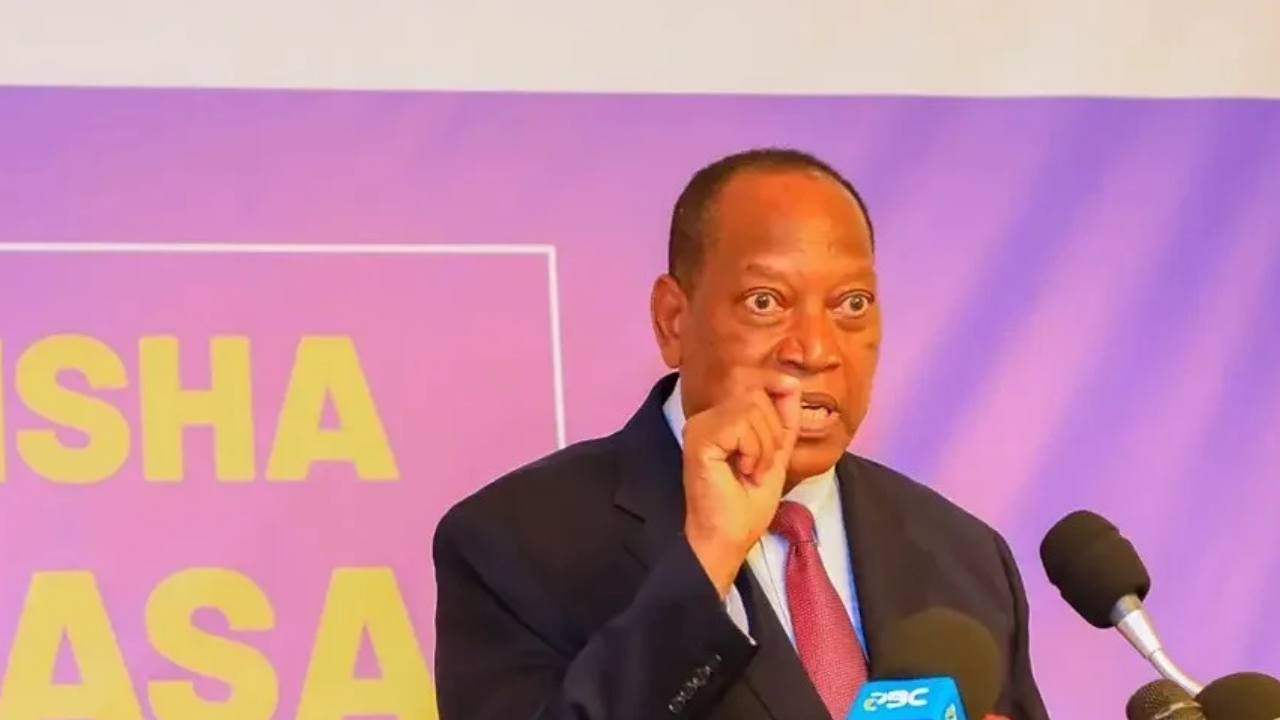

Dar es Salaam – Justice Shaban Ali Lila, chairperson of the Presidential Commission of Inquiry to Investigate the Perpetrators of Violence and Breach of the Law During and After the October 2025 General Election, on Monday briefed journalists on how the six-member panel intends to identify and hold accountable those behind the unrest that followed the October 29, 2025, poll.
Speaking in Dar es Salaam, Lila, a retired Justice of the Court of Appeal of Tanzania, said the commission’s task follows directly from the earlier fact-finding inquiry chaired by retired Chief Justice Mohamed Chande Othman, which found that at least 518 people died during the violence but stopped short of naming individual suspects.
“As you may recall, Tanzania held a general election on October 29, 2025, in fulfilment of a constitutional requirement,” Lila told reporters, adding that violence in some areas meant the poll “did not conclude peacefully everywhere.”
Lila said the body he now chairs is distinct from the Chande commission and carries the formal title, the Commission to Investigate the Perpetrators of Violence and Violations of the Law During and After the October 2025 General Election. Unlike its predecessor, this panel exists specifically to identify individuals for accountability rather than to establish broad findings.
READ MORE: Six-Member Regional Commission Begins Criminal Probe Into Tanzania’s October Election Violence
“Following those riots and that breach of peace, various forms of harm occurred, and based on the outcomes of that harm, the president formed this new commission to investigate the incidents arising from the damage caused during the riots and breach of peace,” Lila said.
Six commissioners
The chairperson introduced the five commissioners serving alongside him. Two are drawn from outside Tanzania: Justice Petrus Tileinge Damaseb, Deputy Chief Justice of Namibia’s High Court, and Justice Barishaki Boni Cheborion of Uganda’s Court of Appeal, who also sits on the East African Court of Justice.
The remaining three commissioners are retired justices of Tanzania’s High Court: Gad John Mjemas, Awadhi Mohamed Bawazir and I.L. Nelson Sumari. Paul Kadushi, appointed under the Commissions of Inquiry Act, serves as secretary.
Lila explained at length how Namibia’s judicial hierarchy differs from Tanzania’s, noting that a position equivalent to Tanzania’s Jaji Kiongozi is termed “Deputy Chief Justice” in Namibia, and that the “Supreme Court” designation there does not carry the same meaning as in Kenya, since Namibia has no separate appellate tier akin to Tanzania’s Court of Appeal.
Terms of References
Lila outlined the five terms of reference guiding the commission’s work. The first is to investigate and identify perpetrators of the violence and determine how each participated in planning, financing, coordinating or executing the unrest.
READ MORE: President Samia Appoints Special Criminal Commission to Probe Election Violence
He noted that Chande had already told the president the violence “was not accidental” but was instead “planned, coordinated, financed and executed according to a specific plan,” a finding this commission must now build on by naming names.
The remaining references direct the commission to investigate abnormal deaths among children and vulnerable groups; destruction of property beyond the immediate riot areas and missing persons; allegations of excessive and unlawful use of force during and after the election; and any other matter the commission considers relevant to its work.
To carry out its mandate, Lila said the commission would gather information through direct, face-to-face testimony from anyone with relevant knowledge, alongside a review of documents connected to the events. He said all evidence-gathering would follow existing laws and procedures governing such commissions.
Once testimony has been received, the commission intends to hear submissions from anyone named or implicated before it, Lila said, adding that those summoned would be told in advance, in outline, what they will be expected to address.
150-day deadline
Lila reminded journalists the commission has 150 days to complete its work, a period he described as one that must be used carefully to gather, analyse and compile findings into a report for the president.
The timeline mirrors that given to the Chande commission, whose own 153-day inquiry drew on testimony from more than 1,300 victims and tens of thousands of written and digital submissions before concluding in April.
Lila appealed directly to journalists to help publicise the commission’s work, asking that anyone with relevant information come forward. He gave a dedicated telephone line, 0733 777 777, through which members of the public can reach the commission by phone, email or letter, adding that arrangements would be made to bring forward anyone unable to travel to the commission’s offices.
He also asked reporters travelling with the commission to different regions to help notify residents of upcoming hearings through available media channels.
The commission was formally inaugurated at State House on August 7, when President Samia Suluhu Hassan urged citizens to cooperate with its work, saying it would “delve deeper to find out exactly who instigated, who was involved, and who provided funds” for the violence.
Monday’s briefing marked the panel’s first detailed public explanation of how it intends to go about that task.