
The Dar es Salaam branch of the Tanzania National Archives, located in an unassuming side-street near the Kisutu magistrates court, has an unusual rule. When a historian opens a file of documents, they are invited to sign a sheet to indicate that they have consulted the source, in the hope that this might facilitate connections between researchers. Almost invariably, the name at the top of the list – accompanied by a date sometime in the 1960s or 70s – will be ‘J. Iliffe’.
The passing of Professor John Iliffe on 20 August 2026 provides a moment to reflect on the legacy of a historian of Africa – and especially Tanzania – with few equals. Iliffe was a prolific writer, who published books on an astonishing array of subjects. He wrote about Africa’s poor and the HIV/AIDS epidemic, just as much as the continent’s capitalists and ruling elites.
Students will most likely first have encountered his work through Africans: The History of a Continent, a sweeping introductory account that was nonetheless much more than a simple primer, with its accent on the explanatory power of demographic history. He completed a fourth edition just before his passing.
Iliffe’s career was associated more closely with Tanzania than any other country. In 1965, he completed his PhD at the University of Cambridge on German colonialism in the country, which formed the basis of his first book, Tanganyika under German Rule. That same year, he joined the newly established Department of History at what was then University College, Dar es Salaam. He was one of a number of foreign Oxbridge-trained historians brought to the new department by its first head, Terence Ranger.
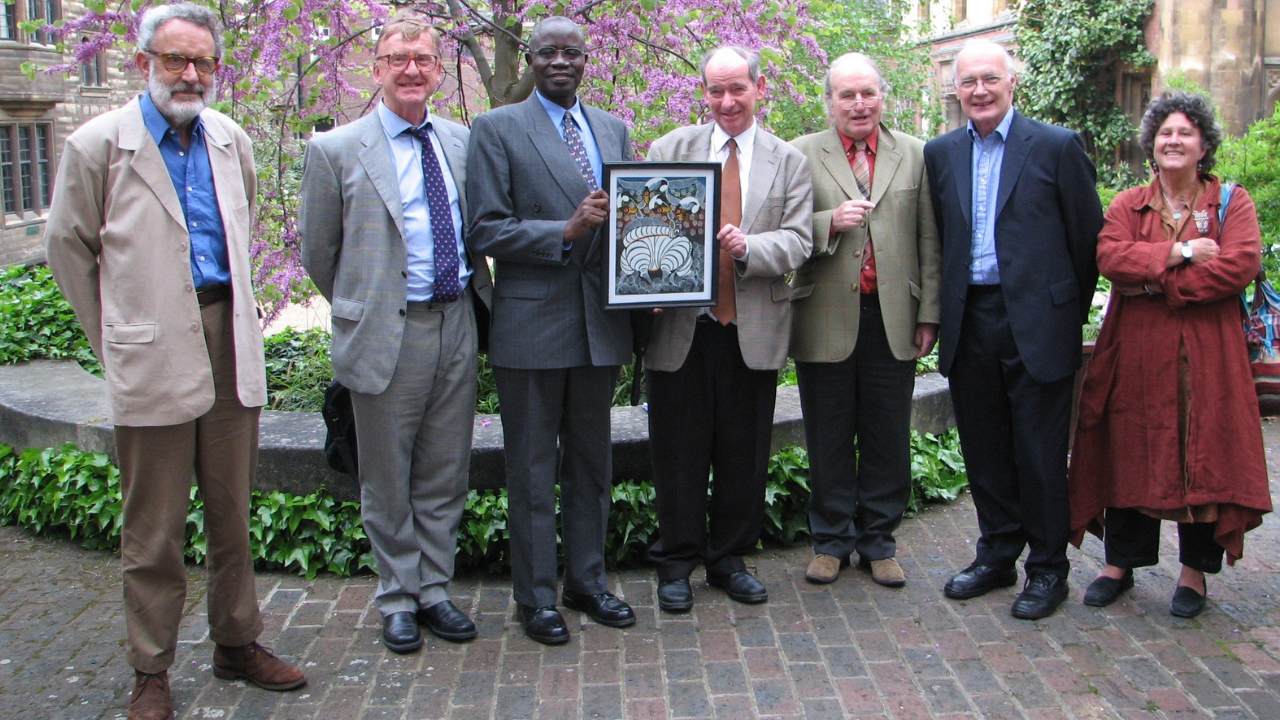
This was a propitious time for the writing of African history. In imperial universities, the study of Africa’s past had long been sidelined – at best neglected, at worst actively disparaged. African governments sought to use their expanding universities just to educate a generation of engineers, economists, lawyers, and doctors, but to develop histories for a forward-looking, independent continent. This required, as President Julius Nyerere himself recognised, new methodologies: a turn away from a written record produced by outsiders and towards oral histories in Africa. Opening an International Congress on African History at University College in 1965, Nyerere called upon historians to immerse themselves in ‘the mass of localized unwritten historical knowledge, which has to be searched for, collected, checked, and written into a comprehensive story.’ Iliffe joined in these efforts. He co-directed, with Gilbert Gwassa, a major project on collecting oral memories of the Maji Maji rebellion across southern Tanzania.
READ MORE: Ali Sultan Issa: A Revolutionary Icon
The approach taken by this early generation of historians working under Ranger at University College would later be termed the ‘Dar es Salaam School’. Iliffe contributed a chapter on the African Association, the precursor to TANU, to a collection of essays entitled A History of Tanzania (1969). The volume, edited by two doyens of Tanzanian history, Isaria Kimambo and Arnold Temu, was characteristic of this genre of national, even nationalist history-writing. (The ‘Tanzania’ of its title had, after all, only been in existence for five years at the time of publication.) Iliffe’s reflections on his time in Dar es Salaam are to be published in a forthcoming volume commemorating the work of the History Department on ‘The Hill’ edited by current faculty members.
Iliffe’s magnum opus was without doubt his 616-page Modern History of Tanganyika, which covered the mainland’s past from the early nineteenth century to the moment of uhuru. In his introduction, Iliffe modestly wrote that his book sought ‘to synthesise research by many scholars working in Tanganyika since it became independent in 1961’. But Iliffe’s Modern History did much more than that, drawing on sources from colonial archives in Britain and Germany, as well, of course, as the fruits of the painstaking research in the Tanzania National Archives. At every university where I have studied and taught, the copies of Iliffe’s Modern History sit dog-eared on the shelves of libraries – testament not to the neglect of students, but their deep engagement with the text. In an age where the writing of national history in Africa has become unfashionable among academics, Iliffe’s Modern History still remains the gold standard.
For a historian who emphasised the importance of demography, Iliffe’s work was very much populated by people. He edited Modern Tanzanians (1973), a collection of short biographies. It comprised not the work of seasoned historians, but the remarkably mature research of undergraduate students at UDSM. At a time when other scholars were thinking about African history in increasingly abstract terms of class and capital, Iliffe stated that the project aimed ‘to put some more people into Tanzanian history’. Yet he also emphasised that it was ‘a book about people, not heroes’. This was typical of Iliffe’s work, which sought to explain and understand humanity in its diversity, rather than glorify or condemn. Grand narratives, abstract theory, or moral lessons were of little interest to him, even as he wrestled with the serious questions of colonialism and capitalism.
For a scholar with such a formidable reputation, Iliffe eschewed the limelight. He was, as his former colleague Derek Peterson put it in an obituary, ‘the opposite of an influencer’. Iliffe did not spend time on the conference circuit. Yet those who spent time in his company attest not just towards his work ethic, but the warmth he showed as a colleague and teacher. He regarded email as a distraction, preferring to communicate in writing. Iliffe developed an archive of his own research materials, composed of index cards organised into a system of shoeboxes that took up much of his study. Their value to the pursuit of history will live on: his notes on the archives of TANU, likely inaccessible inside Tanzania, have been repurposed in recent work on the origins of anticolonial nationalism in Eastern Africa. As John Lonsdale, a longtime Cambridge colleague, wrote in tribute, ‘future scholarly generations who will never know him personally, will, so long as reading continues, benefit from engaging with his thoughts, always expressed in such clear and uncomplicated prose.’
Indeed, Iliffe’s influence and ideas live on in the rich work being produced by Tanzanian historians today. Dr Salvatory S. Nyanto, a senior lecturer in the Department of History at the UDSM, attested to me how Iliffe’s thinking had inspired his own research in multiple ways. In his Modern History, Iliffe developed the idea of the ‘enlargement of scale’ in the nineteenth century to demonstrate how people in Eastern Africa engaged with the new opportunities and threats brought about by their awareness of economic systems that stretched far beyond their locality. Nyanto explains how the same principles underlay the development of an ‘agrico-commercial bourgeoisie’ among Omani Arab and Swahili merchants in Tabora region. Nyanto similarly points to Iliffe’s later book, Honour in African History (2005), as essential for developing his own work on social struggles around slavery and its legacies in Tanzania.
I met John Iliffe just once, sometime around 2018. John was long retired; I was a junior researcher at Cambridge, working just a short distance from his study. He kindly – by letter – invited me for lunch. At the time, I had recently completed a PhD on the history of revolutionary politics in Dar es Salaam. After our lunch, John asked if he could read it and I duly dropped off a heavy, hardbound copy later that day.
Only the next day, it arrived back through my office letterbox with a thump. At first, I feared the worst – that John had simply judged my thesis not worth his time. I should not have worried, as the speedy turnaround time reflected John’s work ethic. The thesis was accompanied by a letter, which began with some brief words of praise and encouragement. There followed several pages of dense, handwritten notes of generous, trenchant, constructive criticism. From what many colleagues have said, it was characteristic of the man. Vale.
George Roberts is a Lecturer in Modern History at the University of Sheffield and the author of Revolutionary State-Making in Dar es Salaam: African Liberation and the Global Cold War, 1961–1974. The opinions expressed here are the writer’s own and do not necessarily reflect those of The Chanzo. If you are interested in publishing in this space, please contact our editors at editor@thechanzo.com.