
Aliko Dangote’s indication that he may favour Mombasa, Kenya, over Tanga, Tanzania, for his planned 650,000-barrel-per-day refinery has unsettled many in Dar es Salaam.
It should. But this is not about prestige, rivalry, or national pride. It is about something far more important: whether Africa will continue exporting raw materials and importing finished products at a premium, or finally begin adding real value at home.
Tanzania’s response so far has been too cautious and insufficiently strategic. Instead of clearly presenting why Tanga is the strongest choice, the debate has drifted into complaints and emotion.
Yet the stakes extend far beyond Tanzania and Kenya. This refinery could reshape industrial development across both the East African Community (EAC) and the Southern African Development Community (SADC). On the fundamentals, no location in East Africa matches Tanga.
A refinery with a capacity of 650,000 barrels per day would transform the region’s energy landscape. It could produce more than 40 million litres of petrol daily, alongside over 20 million litres of diesel and nearly 23 million litres of kerosene and aviation fuel, in addition to products such as LPG and heavy fuel oil.
READ: After Pamoja Bid, Is a ‘Pamoja Refinery’ Coming Soon in East Africa?
That scale matters because East Africa remains heavily dependent on imported petroleum products. In the 2023/24 period, Tanzania imported approximately 4.31 billion litres for domestic consumption and another 4.91 billion litres for transit markets.
Kenya imported around 9.1 billion litres over the same period for both local and regional demand. Combined, these figures indicate a regional consumption market of roughly 40 million litres per day, with demand continuing to grow.This is why the refinery is such a strategic opportunity.
Tusijidanganye — let us not deceive ourselves. A project of this magnitude would strengthen regional energy security, reduce dependence on imported fuel, and ease pressure on scarce foreign exchange reserves, as petroleum imports account for a substantial share of foreign currency expenditure, leaving economies vulnerable to global energy crises.
Africa’s Long Dependence
For decades, African economies have remained trapped in the same cycle: exporting crude oil, minerals, and agricultural commodities, only to import refined and manufactured products at far higher prices.
The result has been chronic pressure on foreign exchange, weak industrial growth, and continued dependence on external supply chains.
Dangote’s refinery in Lagos, Nigeria has demonstrated that another path is possible. Built with African capital and ambition, it is now the world’s largest single-train refinery.
It has reduced Nigeria’s dependence on imported fuel, supported foreign exchange stability, created thousands of jobs, and positioned the country as a net exporter of refined petroleum products and fertiliser.
READ MORE: Africa’s Gas Giant Sleeps While the World Burns
Recent figures from the Nigerian Midstream and Downstream Petroleum Regulatory Authority show the refinery reaching output levels of more than 40 million litres per day, significantly reducing fuel imports into Nigeria.
That achievement is historic. One African entrepreneur has eased pressure on one of the continent’s largest economies and demonstrated the power of value addition.
At a time when wars, shipping disruptions, and volatile global markets continue to expose the risks of import dependence, East Africa should seize this opportunity to build its own refining and industrial capacity.
Why Tanga Still Makes Strategic Sense
The argument for Tanga is not sentimental. It is grounded in geography, economics, and long-term regional strategy.
First, the East African Crude Oil Pipeline (EACOP) already terminates in Tanga. That structural advantage cannot easily be replicated elsewhere. Refining crude at the pipeline’s endpoint is the most logical and cost-effective arrangement.
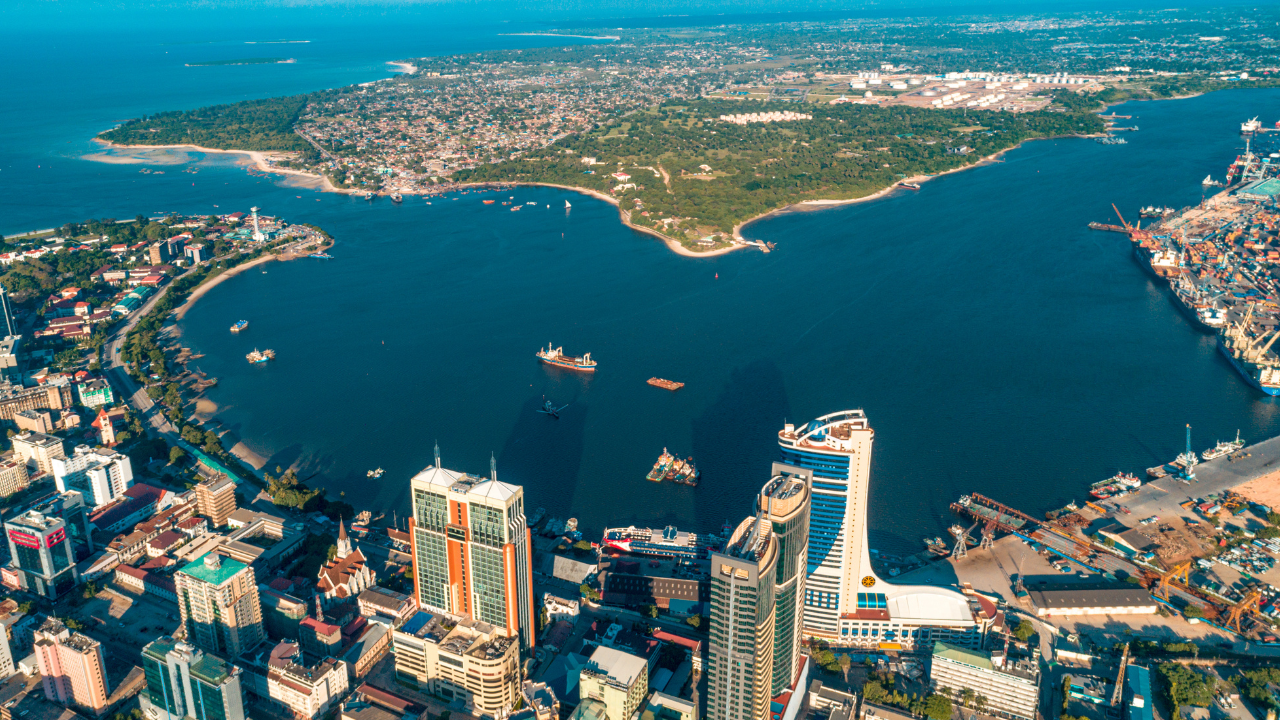
Second, Tanga occupies a unique position between two of Africa’s most important fuel distribution corridors. Dar es Salaam currently handles roughly nine billion litres of fuel transit annually for Tanzania and neighbouring countries, while Mombasa serves a similarly large northern corridor market. A refinery in Tanga could efficiently supply both systems.
To the north, a relatively short products pipeline connecting Tanga to Mombasa could integrate directly into networks serving Uganda, Rwanda, Burundi, South Sudan, and eastern Democratic Republic of Congo.
READ MORE: Why Tanzania’s Location Is Its Untapped Goldmine
To the south, the existing TAZAMA pipeline already links Tanzania to Zambia ending near southern DRC, supplying a significant portion of Zambia’s diesel demand. A future connection between Tanga and Dar es Salaam would extend refinery access deeper into Southern Africa, including Zambia and Malawi.
No other location offers such direct access to both EAC and SADC markets simultaneously.
Land availability also strengthens Tanga’s case. Large-scale industrial land acquisition in Kenya is often slowed by high compensation costs and lengthy legal processes due to predominantly private ownership structures. Tanzania, by contrast, can allocate strategic land more quickly and at lower cost for nationally significant infrastructure projects.
Importantly, a refinery of this size is not merely about petrol and diesel. It becomes the foundation for wider industrialisation: petrochemicals, fertiliser production, plastics manufacturing, engineering services, logistics, and technical skills development. The economic multiplier effects would extend across the region and create thousands of jobs.
The Real Barrier
The greatest obstacle is not engineering or financing. It is political and commercial resistance.
The biggest obstacle is not technical or financial. It is political and commercial. Powerful import networks in both Tanzania and Kenya profit from bringing in refined fuel — sometimes dumped cheaply from Russia, India, or elsewhere — and selling it at high margins. Local refining threatens their comfortable business model. That is why they resist it so strongly.
Dangote faced similar opposition in Nigeria but persisted. He has repeatedly argued that no refinery can survive without protection against unfair fuel dumping practices.
If East Africa truly wants industrialisation, governments must be prepared to support strategic industries. That means offering competitive land terms, mobilising regional financing, improving infrastructure, and ensuring fair market conditions for local refining.
Without that commitment, the project may never materialise.
A Strategic Decision for the Region
This debate is about more than one refinery. It is about the future direction of African economies.
Will East Africa remain primarily a transit market for imported goods and raw materials, or will it become a centre of production, manufacturing, and industrial power?
The global economy is changing. Supply chains are becoming more regionalised. Energy security is increasingly tied to national resilience. Countries that refine, manufacture, and add value domestically will be stronger in the decades ahead.
READ MORE: Ambition and Alignment: Unlocking Tanzania’s Fuller Potential
Tanzania should therefore stop reacting defensively and start leading strategically. Tanga should be presented not simply as a Tanzanian port city, but as the natural energy and industrial gateway connecting East and Southern Africa.
The government should offer Dangote a practical and competitive investment framework, shield the project from entrenched cartel interests, and position the refinery as a catalyst for regional industrial transformation.
Africa’s future will not belong to economies that only import and consume. It will belong to those that refine, manufacture, and create value.
Dangote has already shown what is possible. The remaining question is whether East Africa has the vision and determination to follow.
Zitto Ruyagwa Z. Kabwe is a Tanzanian politician and the former Party Leader of ACT Wazalendo. He served as a Member of Parliament and Shadow Finance Minister, and Chairperson of the Public Accounts Committee of the Tanzanian National Assembly (Bunge). He is available at zitto_kabwe@outlook.com. These are the writer’s own opinions and do not necessarily reflect the viewpoints of The Chanzo. Do you want to publish in this space? Contact our editors at editor@thechanzo.com for further enquiries.


22 responses
As an observer of international trade, I find the argument for Tanga strategically sound. The maritime sector is increasingly moving toward ‘Port-Centric Manufacturing’ (PCM). Placing a 650,000 bpd refinery in Tanga creates a massive maritime industrial cluster that benefits from:
Lower Transaction Costs: Utilizing the EACOP infrastructure directly.
Market Depth: Simultaneous access to the SADC (via TAZAMA/Central Corridor) and the EAC (via the Northern link).
Industrial Multipliers: The transition from a transit economy to a production economy via petrochemical derivatives.
Zitto Kabwe is very correct: the biggest hurdle is often ‘incumbent inertia’ from existing import cartels. For Tanzania to ‘win,’ it must offer a regulatory environment that prioritizes regional energy sovereignty over short-term trading margins. Tanga isn’t just a Tanzanian asset; it is a regional strategic necessity.
As an observer of international trade, I find the argument for Tanga strategically sound. The maritime sector is increasingly moving toward ‘Port-Centric Manufacturing’ (PCM). Placing a 650,000 bpd refinery in Tanga creates a massive maritime industrial cluster that benefits from:
Lower Transaction Costs: Utilizing the EACOP infrastructure directly.
Market Depth: Simultaneous access to the SADC (via TAZAMA/Central Corridor) and the EAC (via the Northern link).
Industrial Multipliers: The transition from a transit economy to a production economy via petrochemical derivatives.
The author is correct: the biggest hurdle is often ‘incumbent inertia’ from existing import cartels. For Tanzania to ‘win,’ it must offer a regulatory environment that prioritizes regional energy sovereignty over short-term trading margins. Tanga isn’t just a Tanzanian asset; it is a regional strategic necessity.
Difficult, when the import cartels are incumbents from ministries to parliament member, lead by greedy it hadn’t dawn on them yet, nothing is more valuable than leaving the legacy of contributing to people wellbeing, People like Gate spent their life time amassing the wealth now they are old it mean nothing and their giving it away, history is gonna remember them as greedy busters and we gonna dance on their graves
Well put!
I read somewhere that the hardly strong argument raised to favour Mombasa over Tanga is that Kenya consumes more fuel than Tanzania. But this is a totally wrong call because it doesn’t take into account the other share which Tanzania consumes on behalf of SADC neighbours who transit their imports through Dar es Salaam. It must also be noted that the SADC share may only be expected to rise when new refinery opens up, and supplying that block of Tanga is comparatively cheaper.
If the refinery ends up in Mombasa, Tanzania may only be guilty of not being as aggressive as Kenya in marketing its potentials.
Tanzania should never had settled for winning the EACOP Project alone, should have envisaged the refinery before Ruti did, but it’s not too late until it proves otherwise.
I’m still perplexed by PresidentRuto’s unilateral utterances about the EA joint discussion to put up a refinery in Tanga,then a few days hearing of Dangote coming up with a proposal to buid a refinery at Mombasa.
I urge the govt of Tanzania to talk to the EACOP shareholder to make a joint counter proposal to Dangote or look for alternate investor/s..We can’t continue to play second fiddle to some astute politicians in EA.
Exactly!
There are very strong indications of Tanzania hitting oil in Lake Eyasi-Manyara. If the Dangote refinery goes to Mombasa let it go. Tanzania can deliver the crude (via EACOP) to Tanga and build own refinery there or at site in Eyasi and connect it to the TAZAMA pipe in the South. Either way the country wins.
The part everyone keeps skipping over is that Dangote has been explicit about what he actually needs, which is protection against fuel dumping, not just competitive land terms or pipeline access. In Nigeria, the refinery nearly stalled after it was built because imported refined products kept undercutting it. He spent years fighting that battle publicly and is still fighting it today.
So in my view, the real question for Tanzania isn’t whether Tanga has better geography than Mombasa. It does, and while both countries argue over location, import businesses are perfectly comfortable with that conversation continuing indefinitely. It’s whether any government in East Africa is actually prepared to tell import businesses, some of whom have serious political relationships, that the rules are changing. Wahenga walisema, ukitaka kujenga usione taabu kubomoa. That’s the actual negotiation. Until that commitment is on the table, the location debate is secondary.
Import dependency isn’t abstract. It’s the lived reality of almost every economy along this coast, including places that, not long ago, were the ones controlling what moved across the Indian Ocean…
The part everyone keeps skipping over is that Dangote has been explicit about what he actually needs, which is protection against fuel dumping, not just competitive land terms or pipeline access. In Nigeria, the refinery nearly stalled after it was built because imported refined products kept undercutting it. He spent years fighting that battle publicly and is still fighting it today.
So in my view, the real question for Tanzania isn’t whether Tanga has better geography than Mombasa. It does. It’s whether any government in East Africa is actually prepared to tell import businesses, some of whom have serious political relationships, that the rules are changing. Wahenga walisema, ukitaka kujenga usione taabu kubomoa. That is the actual negotiation. Until that commitment is on the table, the location debate is secondary.
Import dependency isn’t abstract. It’s the lived reality of almost every economy along this coast, including places that, not long ago, were the ones controlling what moved across the Indian Ocean…
The part everyone keeps skipping over is that Dangote has been explicit about what he actually needs, which is protection against fuel dumping, not just competitive land terms or pipeline access. In Nigeria, the refinery nearly stalled after it was built because imported refined products kept undercutting it. He spent years fighting that battle publicly and is still fighting it today.
So in my view, the real question for Tanzania isn’t whether Tanga has better geography than Mombasa. It does. It’s whether any government in East Africa is actually prepared to tell import businesses, some of whom have serious political relationships, that the rules are changing. Wahenga walisema, ukitaka kujenga usione taabu kubomoa. That is the actual negotiation, and import businesses are perfectly comfortable with the location debate continuing indefinitely. Until that commitment is on the table, everything else is secondary.
Import dependency isn’t abstract. It’s the lived reality of almost every economy along this coast, including places that, not long ago, were the ones controlling what moved across the Indian Ocean…
Zitto R.Z. Kabwe, the writer of this article, has presented his views quite reasonably, constructively and patriotically.
I bet his views be sided by parties under concern.
The refinery will eventually end up being set up in Kenya! Tuelewane wadau! The goose is already cooked!
Dangote is no stranger in Tanzania, remember what happened the time investing the cement factory in mtwara, Dangote fell prey to cartels with government support on the use of gas for his factory, if not magufuli mtwara cement factory would have now a story. But look the country’s political situation now..unpredictable! any serious investor would not be part of the failed regime, n don’t think at this age n exeperiance someone can lecture Mzee Dangote the a,b,c,d on the parameters for successful investment.
Failed regime?this is a biased view and in terms of political matters don’t let the media lie to you Kenya is more rotten and drawn on tribal and religious lines(apparently a few big tribes and Christianity,Muslims being minorities and ignored)won’t go deep in that because the writer himself is a politician and has a better insight before he kept up his debate and anyways no country is an utopia of everything you want even dangote knows this especially Africa Nigeria being worse than Kenya and Tanzania but he made it so we should keep political emotions out of this …..a failed regime is like somalia be thankful and appreciative of our country and not give it labels to justify your biased views
Thanks
I don’t think you’re being objective on matters Kenya, how does tribalism in this case affecting the refinery and 2 Kenya doesn’t have any religious conflicts….you can still sell yourself to the investor without being emotional.
If I were Dangote, I would take a look at Countries Corruption rankings. Because that says alot about the governments. Especially having gone through a very hard time setting up the Refinery in Nigeria because of corruption within the government.
Tanzania corruption ranking is 84th out of 180 countries, while Kenya ranks 130th. https://www.standardmedia.co.ke/national/article/2001540583/report-ranks-kenyas-corruption-fight-among-the-worst-globally.
https://tradingeconomics.com/tanzania/corruption-rank
That, to me would be the deciding factor.
International businessmen such as Dangote have to be courted by Governments. Just after leaving the Kenyan summit this week he was in Norway meeting with industrialists like himself on developing the fertilizer, chemicals and plastics additions to his plant in Nigeria. The Tanzanian government should be looking for Dangote and bot vice versa. But it seems like the Tz government is looking after their own internal big fish at the expense of larger international trade. Crude oil trade is in US$ at 40 Million liters per day how much dollars would be coming into Tz.
People tend to forget the blunder of Tanzania’s president in the whole matter, an investment of that magnitude was ceded to your country by two presidents in your absent based on unplanned Dangote announcement, instead of welcoming it you publicly humiliated the president that ceded it to your country. You could have made your positioned known behind close door and if you must say it publicly, it could have been on a lighter note and diplomatic way. To an investors it is a very wrong signal, more like the president is not in support of such project which means future trouble, for Ruto it means he is not patriotic enough to attract such investment into his own country, instead he proposed another country, history may never forgive him although he has stated a good reason why it should be in Tanzania but the president has shown that it is not important to her.
In all this Tanzania’s president is to be blamed, her pride is more important that the investment.
Zitto Ruyagwa presents a reasonable argument on behalf of Tanga.
On two important points…. Protection from import dumping and land acquisition, it’s my belief that indeed Tanga is favorite against Mombasa, to Dangote.
As a Kenyan I have seen important infrastructure projects stall for years ….one shining example the Mombasa-Malindi Rd that’s taking ages to get done……..due to land acquisition issues.
Food security, as basic as it is, remains an issue in Kenya because our rich cannot allow growth in our agricultural sector despite the the country’s obvious capacity to mitigate climate change effects and tap into evolving technology.
And yes…..Dangote should be given the option that’ll be easier to integrate the EA and SADC markets as fast as possible, for the realization of regional and continental growth aspirations of it’s people, especially the upcoming generation.
Tusijidanganye!
The issues raised by the writer are easy to navigate but the most important factor is the political goodwill of the ruling class to support the project and shield it from dumping of cheap products from the West. Let’s face it, the politicians don’t give a f** about the economic growth the project will bring but are selfish and only about themselves. The refinery will most likely find its way in Kenya, we all know Ruto, very cunning human… but Tanzania isn’t any better. Dangote has experience working in Tanzania in Mtwara, from discussions, it’s not something he would want a repeat.
This is a mind game ruto playing with Tanzania. Who believes that a president can advocate for such a project to be established in another country?
It appears Tanga’s proposal depended if Tanzania can play the part ..Even Ruto travelled to Tanzania to convince them to see a joint investment with other two Uganda and Kenya….Tanzania did not understood it and surprisingly started to voice opposition of non inclusion in the first place…..When Tanzania did not read properly the game plan, investor had no choice to go with 2 willing countries …poor Tanzania