
Dar es Salaam. Tanzania’s trade surplus with member states of the Southern African Development Community (SADC) has expanded dramatically over the past five years, driven largely by booming gold exports to South Africa and growing trade ties with the Democratic Republic of Congo (DRC).
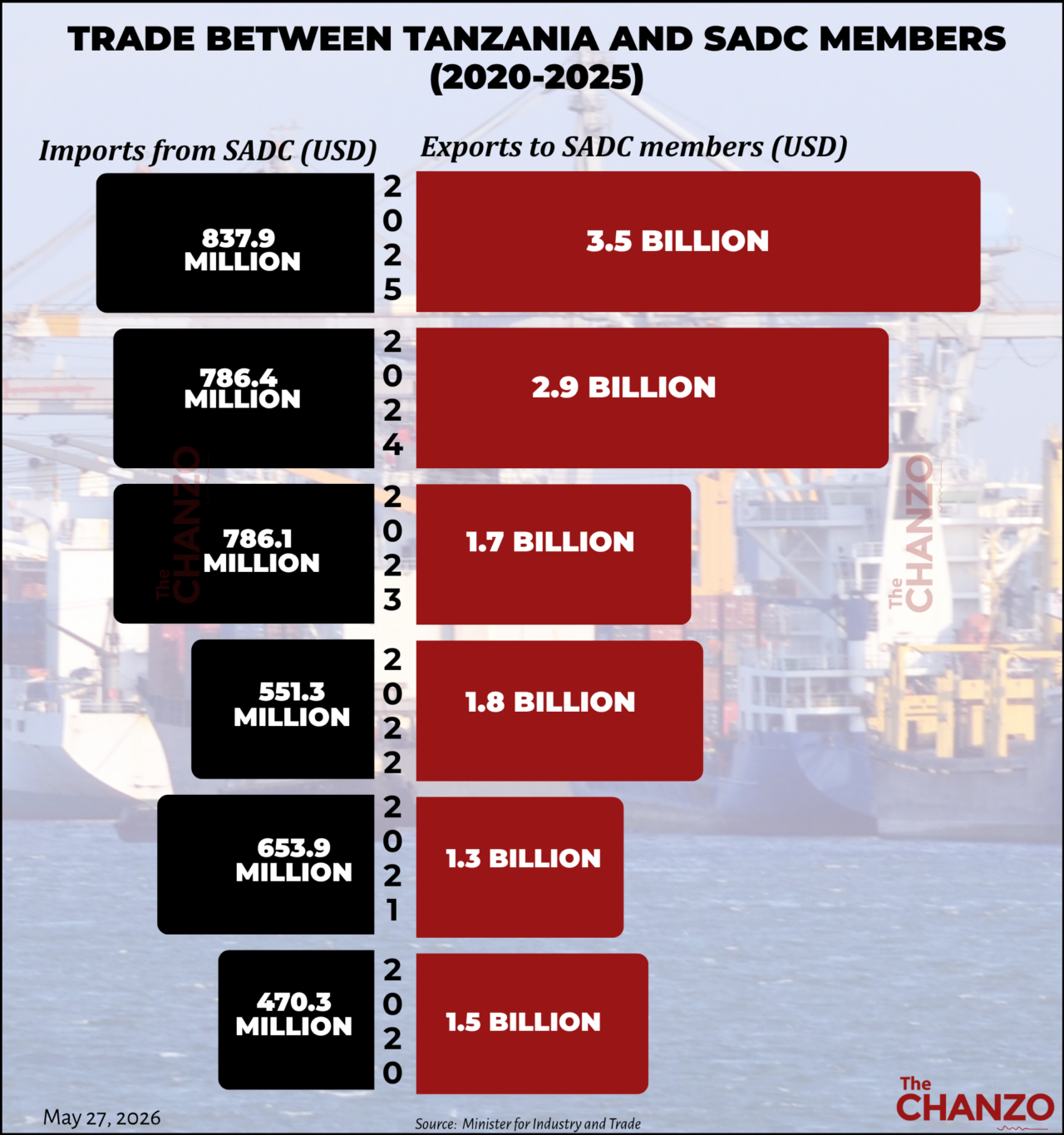
Data presented by the Ministry of Industry and Trade show that Tanzania’s trade surplus with SADC countries rose to USD 2.71 billion in 2025, nearly tripling from USD 988 million in 2020, highlighting the country’s increasing competitiveness within the regional bloc.
The sharp rise was fueled by a substantial increase in exports, which climbed from USD 1.46 billion in 2020 to USD 3.55 billion in 2025. In contrast, imports from SADC countries grew at a much slower pace, rising from USD 470.3 million to USD 837.9 million during the same period.
South Africa and the DRC remained Tanzania’s most important trading partners within SADC, serving as the principal destinations for Tanzanian exports. Together, the two countries accounted for 88 percent of Tanzania’s total exports to the regional bloc.
According to the Bank of Tanzania’s 2025 report, Tanzania exported goods worth USD 2.77 billion to South Africa in 2024/25 while importing products valued at USD 535.5 million, resulting in a substantial bilateral trade surplus. Exports to the DRC reached USD 304.2 million, compared to imports of only USD 9.2 million.
Gold continued to dominate Tanzania’s export basket to SADC countries, accounting for 76.8 percent of the country’s total exports to the region. Other significant exports included manufactured products and agricultural commodities.
Analysts note that the heavy reliance on gold suggests Tanzania’s exports to SADC are concentrated in mineral resources rather than consumer and capital goods. This presents an opportunity for the country to further diversify its export base by expanding value-added manufacturing and industrial production aimed at regional markets.
READ MORE: Tanzania Unveils Kwala Dry Port to Boost Cargo Handling and Regional Trade
On the import side, South Africa remained Tanzania’s leading supplier within SADC. Major imports included spirits, chemicals, soft drinks, iron and steel products, fertilizers, and industrial transport equipment.
The SADC market has emerged as Tanzania’s strongest source of trade surplus, surpassing gains recorded in several other regional markets. The East African Community (EAC) also contributed positively to Tanzania’s external trade performance, with the country’s trade surplus with EAC member states increasing to USD 701.5 million in 2025 from USD 488.2 million in 2020. Kenya remained the largest destination for Tanzanian exports within the EAC.
Speaking while presenting the Ministry of Industry and Trade’s budget for the 2026/27 financial year, Minister for Industry and Trade Judith Kapinga said the government is continuing efforts to ensure Tanzanian products gain wider access to SADC markets by strengthening quality assurance and standards compliance.
She highlighted a recent achievement by the Tanzania Bureau of Standards (TBS), which obtained ISO/IEC 17020 accreditation for product inspection services from the SADC Accreditation Service (SADCAS). The accreditation makes TBS the first institution in Tanzania and only the second in East Africa to attain the certification.
“The international accreditation of our inspection system is an important and strategic milestone that enables the country to avoid technical barriers to trade, enhance confidence in regulatory outcomes, and facilitate access to domestic and international markets, thereby contributing to national economic growth,” Kapinga said.
In a further effort to expand the reach of Tanzanian products in international markets, Kapinga said the government plans to establish a Market and Industrial Intelligence Unit to address persistent information gaps affecting exporters and investors.
The unit is expected to provide businesses with timely insights on international market opportunities, seasonal demand trends, quality standards, tariffs and non-tariff barriers, while also helping authorities distinguish credible investors from those seeking to engage in unfair trade practices.
“The unit will be responsible for collecting and analysing international market intelligence, identifying product opportunities, demand trends and market entry requirements, preparing and disseminating market opportunity information to traders, and providing rapid alerts on changes in global markets,” Kapinga said.
The initiative is expected to strengthen Tanzania’s export competitiveness and support the government’s broader strategy of diversifying exports beyond minerals while deepening the country’s integration into regional and global markets.