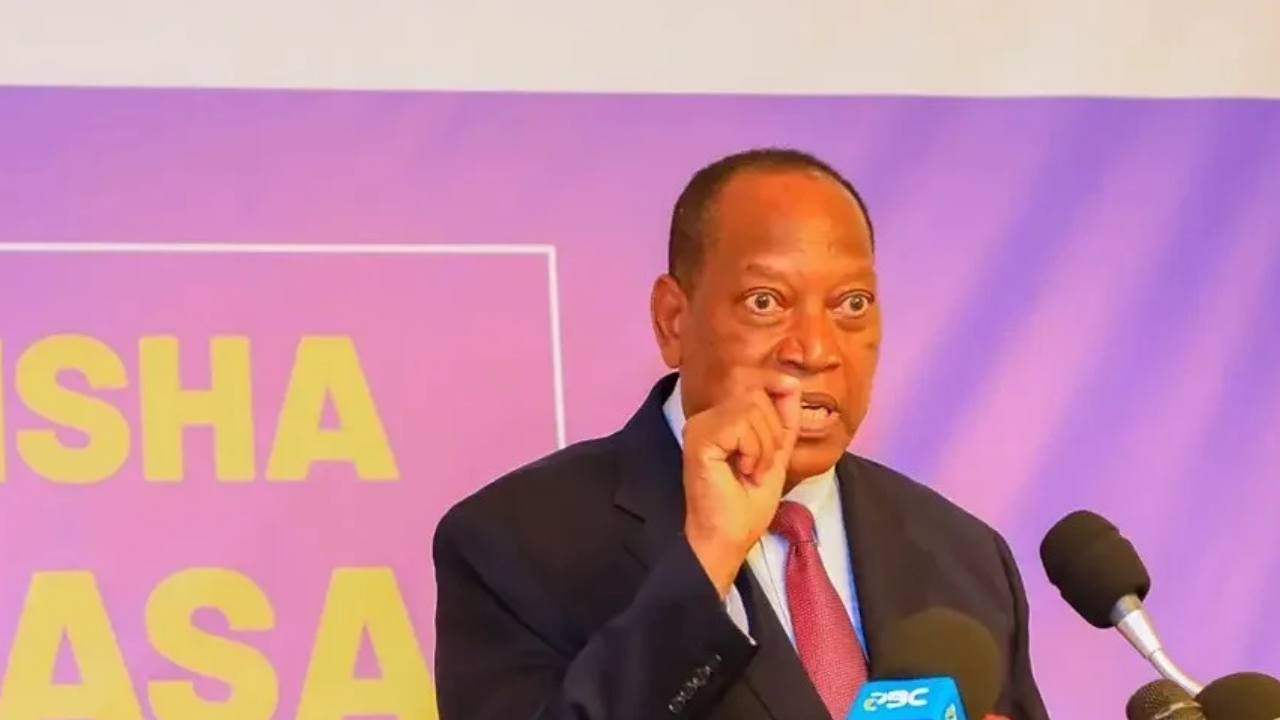

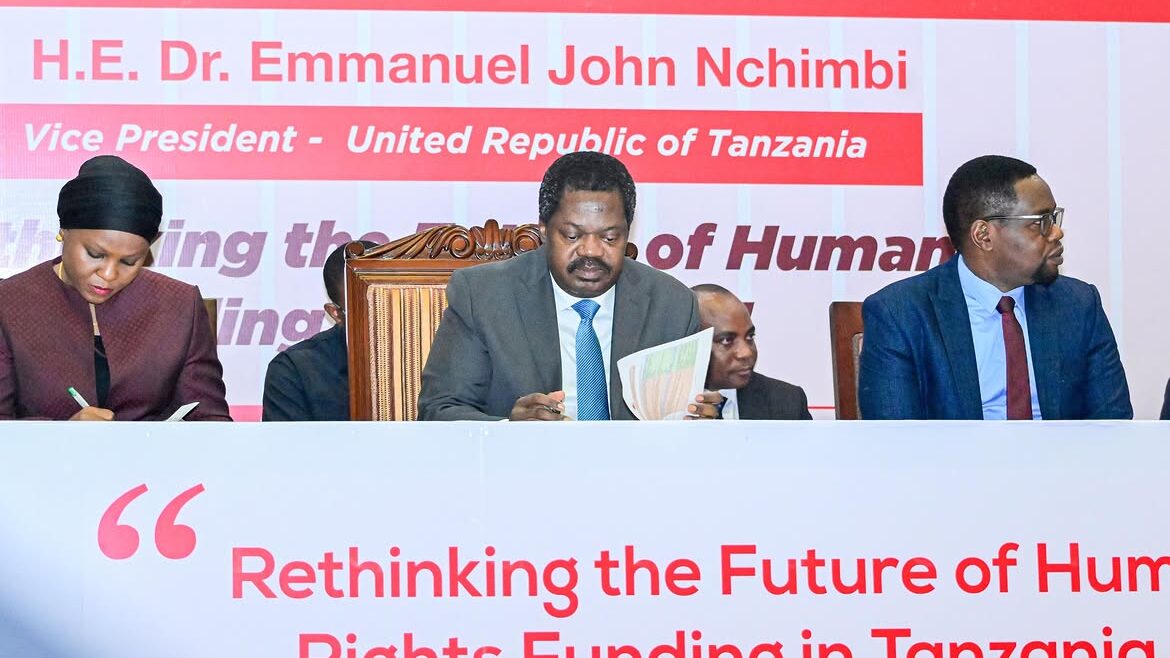
Dar es Salaam-Calls for political reforms and a new constitution have gained a new voice in the country after the Vice President, Dr Emmanuel Nchimbi, in a lengthy speech on July 24, 2026, called for consolidating efforts to secure a new constitution before 2030, saying it would resolve most of the country’s socio-political challenges, including prevalent injustice.
Nchimbi was speaking at the annual general meeting of the Tanzania Human Rights Defenders Coalition, which was held at Mlimani City in Dar es Salaam.
“If I had one thing to say to Tanzanians- if they said you get to say only one thing, this is your last chance, say one, I would say this: fight to get a New Constitution. Fight for a constitution that has the agreement of all stakeholders, a constitution built on national consensus, a constitution that will carry us forward for the next fifty years,” Dr Nchimbi remarked.
Nchimbi began his constitutional argument by analyzing stakeholders’ advocacy on various issues; he proposed that their focus should be on one thing rather than demanding multiple items. He argued that a new constitution would fix the overall system, as all laws that contradict it would be expunged once it is in place.
He further underscored that there is political will from the President. He recounted that during the drafting of the ruling party’s manifesto, when he was the party’s Secretary-General, he asked the President whether it was something she would back, since their research had indicated that people wanted a new constitution. He asserted that the President told him affirmatively that she would implement a promise for a new constitution.
“For you to be sure of getting a new constitution, one of the most important things is the will of the sitting President to have one. If I had a way to tell Tanzanians this in secret, without the President even hearing it, I would say: folks, the President wants this, push for it,” he said.
“But circumstances don’t allow that; so I have to say it here, from this platform: President Samia wants this, she wants it implemented,” he continued.
“It is better to seize this opportunity, because the President wants it done, focus on that. Let’s not wait until a president comes along who doesn’t want a New Constitution; the current constitution is one that a selfish president would happily keep, because it hands them power meaninglessly,” he argued.
In its 2025 election campaign, the ruling party CCM had proposed that it would start working on the constitution within 100 days. Following the election fallout, the President committed to resuming the process after receiving the report from the commission of inquiry investigating the October–November 2025 election crisis, saying that efforts toward reconciliation and a new constitution would begin using the report’s recommendations.
READ MORE: Emmanuel Nchimbi: Why His Selection as Samia’s 2025 Running Mate Matters
In his speech, Nchimbi referred to the timeline proposed by the commission — to have the constitution ready by 2028 so it could be used in the 2029 civic elections and the 2030 general election.
“And I’m speaking to all Tanzanians: I’m speaking to CCM members, I’m speaking to the opposition, I’m speaking to civil society organizations. To CCM members I say, a new constitution is for the good of your children, your grandchildren, and the generations to come,” Nchimbi emphasized.
He continued: “To the opposition parties I say, a new constitution is for your good, the good of your children, your grandchildren, and the generations to come. To civil society organizations and human rights defenders I say, a new constitution is for the good of your children, your grandchildren, and the generations to come. A new constitution is for the good of our country. Let us all fight to get a new constitution.”
Citizens’ Reaction
Nchimbi’s speech remained the most debated subject through the end of the week in Tanzania. His perceived stature as a reformer within the ruling party, together with a perceived rift in the party and the attacks against him, added weight to his statement.
While the statement was received positively, most citizens expressed doubt about his party’s and the government’s intentions for the country’s future.
“There is indeed a need now to fight for a Constitution, but the truth is that when it comes to actions, they turn out to be very different. Watching the Vice President speak today, you’d think this country doesn’t suppress human rights at all. Yet we see so many people being harmed and mistreated, with the law not being followed,” said Manyanya Manyanya, a resident of Dodoma, in a video interview with The Chanzo.
“Let them try to make what they say and what they do one and the same, to truly act on it, so that what they say comes straight from the conscience of their hearts. So that if it is true they have now decided to move away from the wrongs that have occurred in this country. The wrongs that are still going on in this country, then let them do justice to Tanzanians,” he added.
Many citizens have expressed concern that the civic and political space does not provide room for the nation to reach consensus on a major issue like the constitution, with many highlighting the crackdown, including the recent terrorism charges against activists.
“Regarding the Vice President statement on a new Constitution, if you look at the current situation, the existing Constitution is indeed very old. We therefore ask that, as we give our views on the new Constitution, the government or the authorities should not prevent us from doing so,” argued Kanyuka Jonas, a resident of Kigoma, during a video interview with The Chanzo.
He continued: “We have seen that many people express their opinions, but later they come under pressure and are arrested, accused of being agitators or inciters, and so on. We urge the government to allow freedom of expression so that citizens can freely share their diverse views, enabling us to ultimately obtain a new Constitution.”
Political Actors and Activists
In his speech, Nchimbi made a deliberate effort to address activists — a move many observers read as intentional amid heightened tension between the government and activists both inside and outside the country, including the linking of activism with terrorism.
“I so deeply long, I long, for us to have a Tanzania in which every Tanzanian feels pride in their Tanzanian identity. Where every Tanzanian feels peace within their own country. Where every Tanzanian feels safe within their own country. Where every Tanzanian has the desire to contribute to the development of their country. That is the country I long for,” Nchimbi said.
READ: President Samia’s Warning Linking Activism and Terrorism Sparks Debate in Tanzania
“I long for a country in which we may differ in ideology, we may differ over matters of political parties, we may differ over matters of religion and ethnicity, yet we recognize one another through our shared Tanzanian identity. This is the country I long for. I long that when I meet any activist at all, I recognize them by their capacity to think and to persuade,” he continued.
In his address, Nchimbi mentioned activist Maria Sarungi Tsehai, noting that the two used to meet in church during childhood, and recalled memories of Sarungi reading church lessons on Sundays. Sarungi is one of the most prominent activists living in exile; she survived an abduction last year and remains a frequent target of attacks from ruling party supporters and top government officials.
“But what I want to say is this: I long that, when I am sitting there with Maria Sarungi, someone who sees us would say, they are discussing the affairs of their country. They are talking conversing, and they are at peace; there is no hostility, there is no enmity,” Nchimbi said.
“That is the kind of nation I long for us to build. So I would ask each and every person, I would ask every Tanzanian to use every opportunity they have to restore unity, to restore solidarity, but also to uphold justice as the foundation of peace,” he concluded.
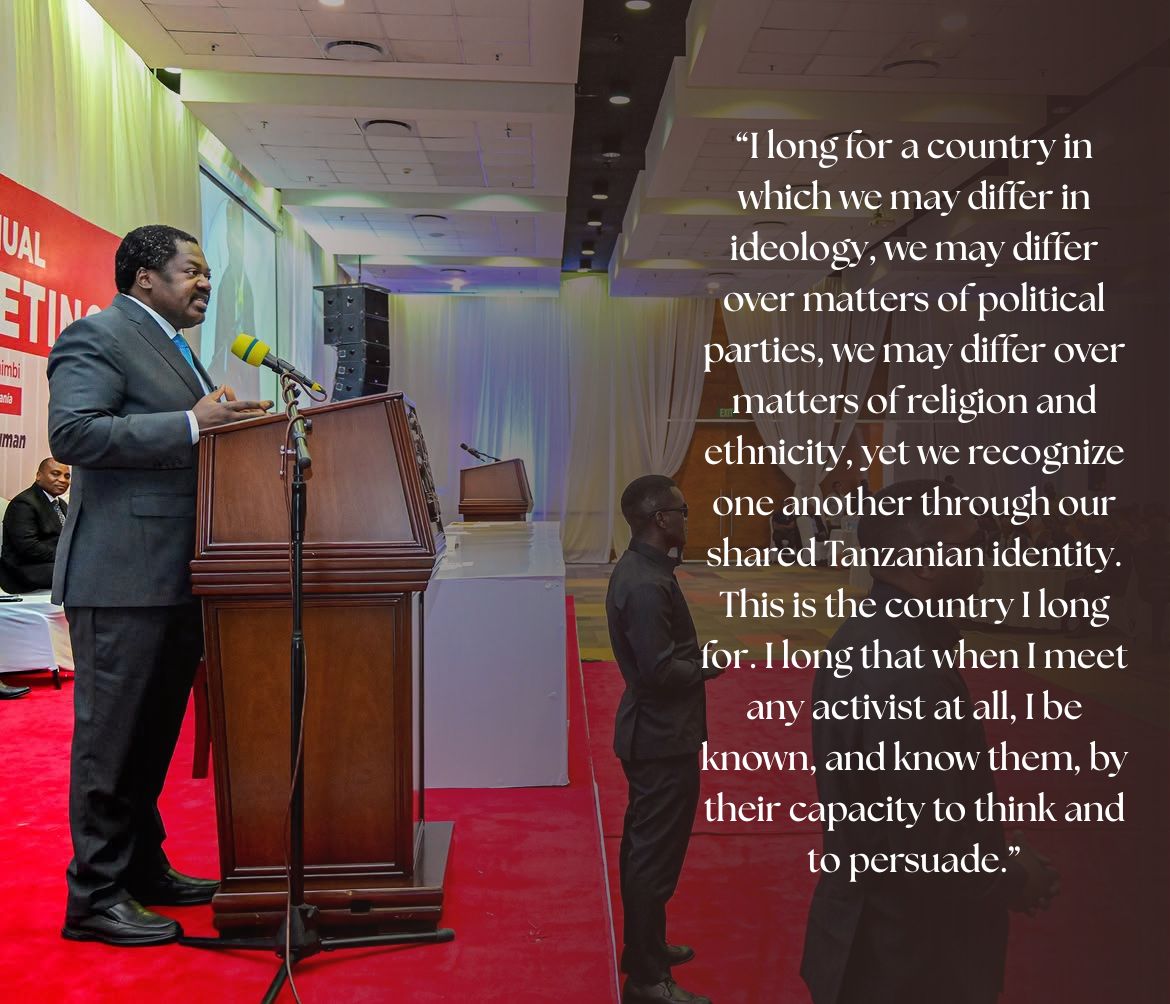
Several political actors and activists have reacted to Nchimbi’s call, some of them expressing doubts and even confusion fueled by the state of civic and political space in the country.
“I’ve taken time to reflect on what you said, Nchimbi: today you showed kindness in your words, because you said that activism is not hostility, and you named me directly. Also, you spoke about justice and accepting that there is no peace without justice, and wanting activists to be protected, and you also touched on trumped-up cases and wanting people released; these are very good things,” activist Maria Sarungi wrote on X.
“However, we cannot set aside what happened on October 29 and talk about a new Constitution and reconciliation without first confronting this major stain,” she continued. “People were killed, blood was shed, and therefore those responsible must be held accountable. The public deserves the truth: who was responsible, and where are the bodies?”
Sarungi went on to highlight other issues, including the release of opposition leader Tundu Lissu, emphasising her lack of trust in the ruling party.
In an emotional video, another influential activist based in the U.S., Mange Kimambi, described the confusion that Nchimbi’s speech brought, arguing it was meant to save his party amid a complete decline of trust among Tanzanians.
“Nchimbi’s video has left me, to the point that I’ve had a drink today, because it is very confusing. And I’ve seen that Tanzanians too are very confused,” Kimambi argued. “On one end we have a party that kills us, that hits us with terrorism charges, that has banned public rallies, a party that even up to now has refused to give mothers back the bodies of their children so they can bury them,” Kimambi said in a recorded video while breaking down in tears.
“A party that, after the killings were carried out, still went on to justify those killings, that it was okay, that those who died deserved to be killed,” Kimambi continued. “Then someone emerges from within that very party, someone holding a senior position, and comes to speak the very things we Tanzanians are demanding: justice. Tanzanians become confused.”
“I’m not confused, I know what is happening,” Kimambi said, highlighting reports of a fallout between top leaders in the ruling CCM. “What Nchimbi is saying may well be something he genuinely believes in his heart, and not a ploy to deceive us Tanzanians, but at the same time, we Tanzanians must tell Nchimbi that we, as Tanzanians, have already closed the chapter on the CCM party. CCM can no longer lead this country after October 29, [2025]. It is no longer possible,” she concluded.
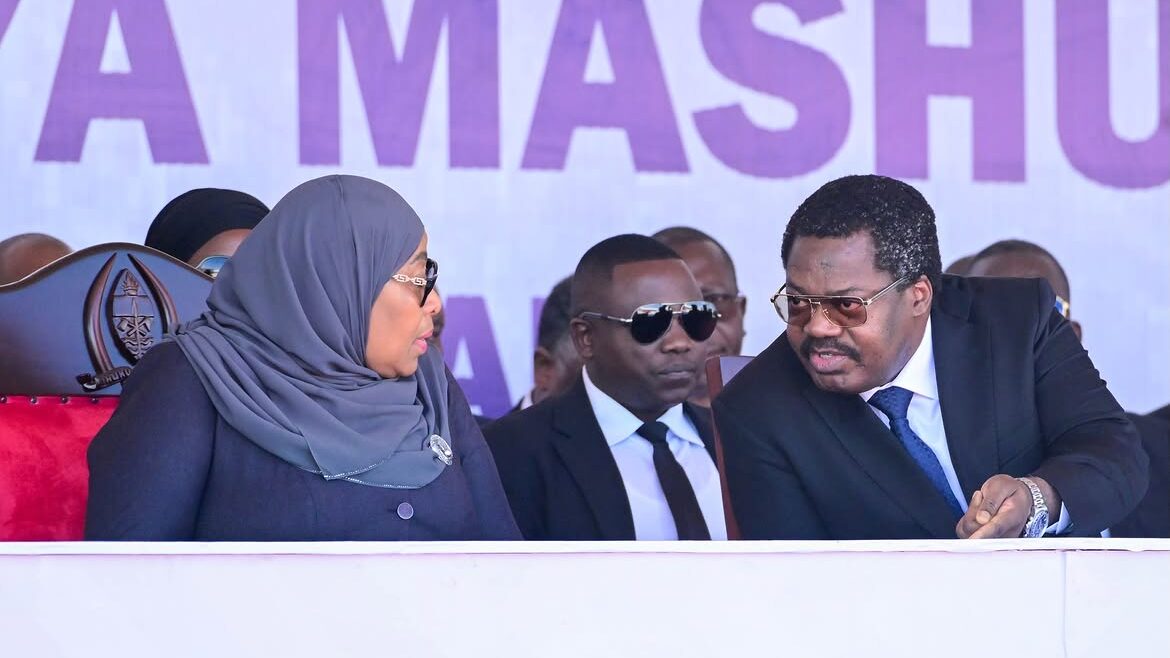
The Vice-Chairperson of Tanzania’s main opposition party, CHADEMA, John Heche, said Nchimbi’s statement was a message crafted for people to read between the lines about who is blocking the constitutional process. Analysing Nchimbi’s call for people to fight for a new constitution while at the same time arguing that political will exists, Heche suggested that it is the country’s top leadership that is blocking the process for self-gain.
“He tells us to fight so that we get a Constitution, so what does that mean? If Samia wants a Constitution, and Nchimbi wants a Constitution, then who is the one blocking it? Nchimbi used figurative language to tell us who it is that is blocking the New Constitution,” Heche argued.
Ruling Party’s Early Reaction
Nchimbi’s statement comes at a time when talk of a rift between the two top leaders of the ruling party is being played out through direct attacks on Nchimbi.
The most open attack came during a parliamentary session when a member of parliament from Zanzibar delivered a speech referring to a “Judas the betrayer” in the government, a speech many interpreted as an open attack on Nchimbi. Following the speech, there was pushback in parliament against the member, with some lumping the issue into a Tanganyika–Zanzibar union debate.
Following Nchimbi’s speech, the rift and pressure within the ruling party are anticipated to intensify in the coming days. Some observers have pointed out that at the last CCM Central Committee meeting on June 29, 2026, Nchimbi was missing from the official portraits, his chair left empty as he attended the SADC meeting. Likewise, at the last Cabinet meeting on July 16, 2026, Nchimbi was absent as he attended the Mkapa Legacy Summit. Since the speech, several CCM members have come out criticising their leader.
“A political party is an institution built upon the foundations of internal procedure, collective accountability, party discipline, and collective leadership,” wrote the Chairperson of the ruling party’s youth wing, Mohammed Kawaida, in an Instagram post accompanying a past video of the manifesto reading in which a new constitution was promised.
“The strength of an institution is not measured by the popularity of one individual, but rather by its capacity to safeguard its procedures, its culture, and its collective decisions,” Kawaida emphasized.
Another voice that weighed in on Nchimbi’s statement was the Chairperson of the ruling party’s elders’ wing, Rajabu Maganya, who emphasised that a new constitution has already been promised in the party manifesto, arguing that the matter is still within the 2025–2030 timeline.
“Let no individual or political party arise and incite Tanzanians to supposedly go and fight for a New Constitution. It has already been said that the New Constitution is coming. After all, who is blocking this New Constitution? After all, who is saying that we will not have a New Constitution process?,” Maganya said as he was speaking to party representatives in Ubungo on July 24, 2026,
Nchimbi’s call comes amid internal and external pressure on the government to resolve the political crisis lingering in the country. The Commonwealth had suggested a 30-60-90-day roadmap, including resolving the issue of the opposition leader’s detention, and recommended convening a credible, inclusive inter-party forum with neutral facilitation.
The government’s official response is that it is assessing the Commonwealth’s proposal. Moreover, in response to what the President described as efforts to protect the state against individuals using activism to derail the country, dozens of activists and opposition figures were charged with terrorism last week.