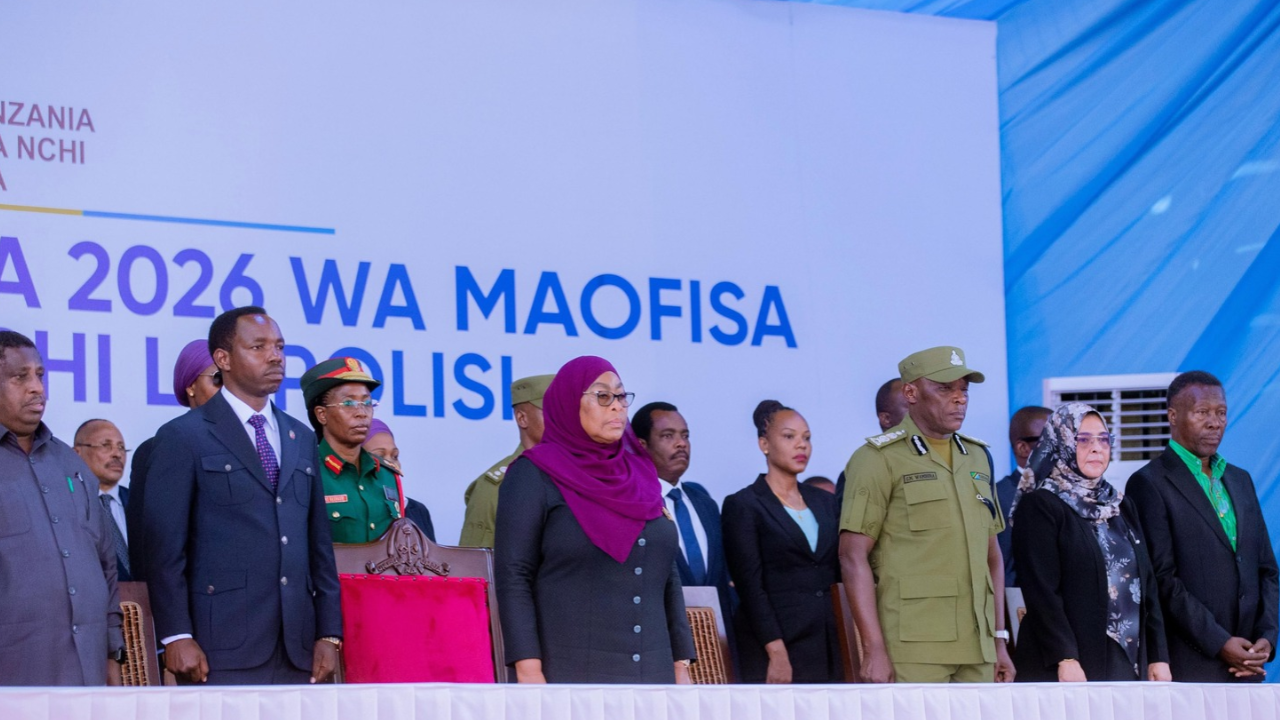

Arusha – Eighty-six officer cadets left training at the Tanzania Military Academy before completing their courses, its commandant said on November 21, 2026, as President Samia commissioned new military officers in Monduli, Arusha.
Major General Jackson Jairos Mwaseba said 70 cadets left intake 07/23, which undertook three years of training for a Bachelor of Military Science, while 16 left intake 73/25, a one-year regular officer training course.
They left “for various reasons, including deserting training, dishonesty and indiscipline,” he said. Mwaseba did not give a breakdown by reason or specify how many departures involved dismissal.
The disclosure came during a ceremony combining the commissioning of officers with the academy’s seventh military science degree graduation. Mwaseba said the new officers brought medical, engineering, aviation and other specialist qualifications to the force.
“I grant you commissions as officers in the Tanzania People’s Defence Force at the rank of second lieutenant, effective today, November 21, 2026,” President Samia Suluhu Hassan declared.
She invoked Article 148(2)(a) of the Constitution and section 30(5) of the National Defence Act in granting the commissions. The officers then took an oath pledging loyalty to their country and obedience to laws, regulations and orders issued by their superiors in accordance with the law.
Mwaseba said the new officers held bachelor’s and master’s qualifications across a range of professions, including specialist medicine, engineering, teaching, economics and the chemistry of oil and gas. Pilots were also among those commissioned, with President Samia presenting aviation wings to two officers on behalf of their colleagues.
The commandant said their preparation had combined academic, physical, mental and ethical development, with instruction in leadership, military tactics, decision-making and teamwork. The aim was to equip them to carry out duties in environments presenting different challenges.
Some newly commissioned officers had trained at the military aviation school, while others received training in Bangladesh, Burundi, China, Ethiopia, India, Malawi, Sri Lanka, Uganda and Russia, he said.
Separately, the academy had hosted foreign cadets through its officer exchange arrangements. Those completing training came from South Africa, Burundi, Ethiopia, Kenya, Mozambique, Namibia, Rwanda, Uganda and Zambia.
Mwaseba said the academy would continue improving its curricula, teaching methods and assessment to keep pace with changing security conditions and developments in science and technology. He credited government investment in infrastructure, equipment and technology with helping prepare officers for current and future challenges.
The technical emphasis follows discussions between the academy and Ardhi University on August 10, 2026, about academic cooperation and a proposed degree combining military studies with geographic information systems. Ardhi University described the programme as planned, rather than already operating.
Addressing the degree graduates, Mwaseba also emphasised the standards expected of them beyond their technical and military competence.
“The nation’s great expectation is that the education you have received will make you true patriots, with discipline and good ethics, able to assess challenges on the basis of justice and human dignity,” he said.
He urged the graduates to use their expertise in fulfilling their responsibilities in the wider interests of the military and the country.
The academy’s educational activities have previously included engagement with international humanitarian law, which governs conduct during armed conflict. In December 2018, 156 Monduli cadets visited the UN International Residual Mechanism for Criminal Tribunals in Arusha, where they received briefings including a presentation on that body of law.
The military science degree programme began in 2017, Mwaseba said, with the latest graduating intake starting its studies on November 6, 2023.
President Samia awarded degrees to the graduates and praised the academy’s leadership for supervising training intended to produce officers capable of performing their duties efficiently.
“These courses are important for our military and for the nation as a whole,” she said, before formally closing the graduation ceremony.