
If legacy is a longstanding impact of an event or action, what is the point of fussing over the legacy of an incumbent President, especially one who has just begun her second term? There are three reasons why the timing is right. Firstly, no other union government in Tanzania’s history has faced the level of legitimacy crisis the current administration has experienced over the past year.
Secondly, President Samia has delivered two instrumental speeches since October 29, 2025: one during the inauguration of the national assembly in November 2025, and another at the Sherry party in Dodoma on January 15, 2026. The President has used both speeches to set out her vision for the second term. Thirdly, the president has, in her own words, indicated what she hopes her legacy will be. Unfortunately, as I demonstrate in this analysis, she may not get that wish.
A search for legacy
While concluding her speech to the national assembly in November, President Samia said a prayer: “I pray to the Almighty God that the sixth-phase government’s tenure be judged not only on the basis of the material things [vitu] we will leave behind, but also due to the humane smile [tabasamu la utu] that we will have brought to the faces of Tanzanians.”
Although delivered barely a month after October 29, when anger, shock, and fear dominated the national mood, and smiles were badly needed, the speech revealed two things. First, the President is worried about her legacy; second, she regards infrastructural improvements as her signature legacy.
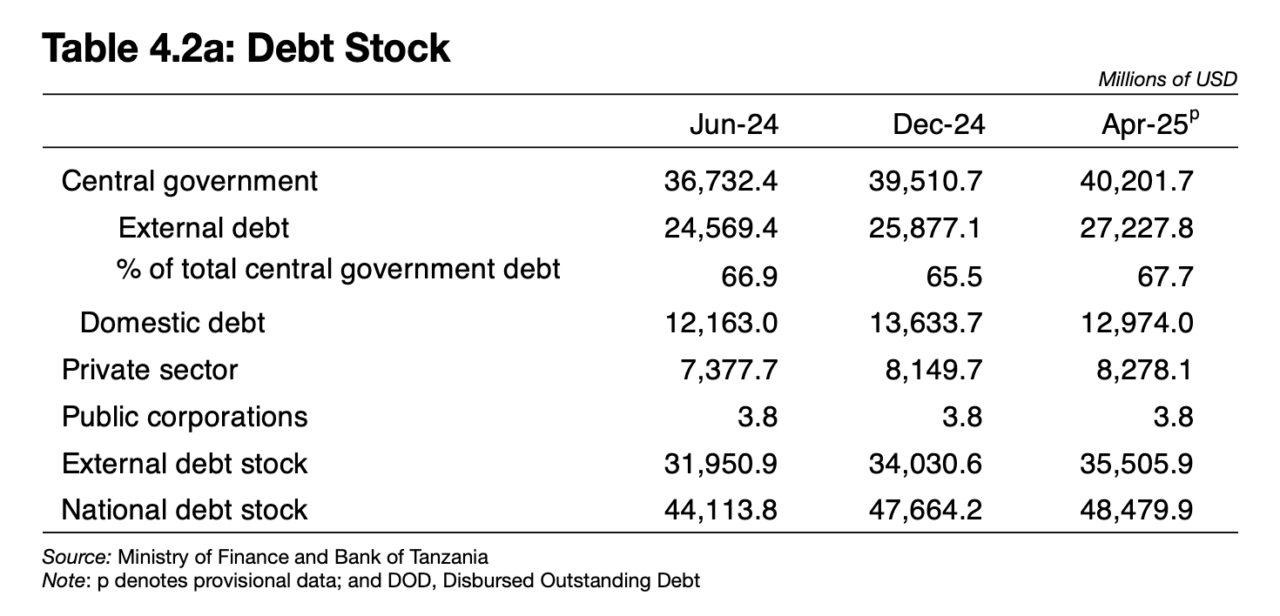
The problem, however, is that the general public associates the effort to close Tanzania’s massive infrastructure gap with her predecessor, John Pombe Magufuli. President Samia deserves credit for continuing and seeking to complete her predecessor’s strategic projects. However, this effort significantly expanded Tanzania’s debt-to-GDP ratio, from 38.5 per cent in 2021 when the incumbent assumed office, to 47.6 per cent in 2024.
READ MORE: Activist-in-Chief: How Samia’s Presidential Legacy Is Shaping Up
The most recent figures (see table below) put the value of the debt at 48.2 per cent, with the majority of the borrowed funds spent on transport and telecommunication infrastructure. Although the debt is considered sustainable, the pace of growth has long divided opinion and fostered negative perceptions of the government.
There is also a narrative problem. Although his government relied on expensive debt, Magufuli created a popular public narrative that his administration took money from the rich and Western imperialists to fund transformative projects and was serious about combatting corruption. The perception of the current regime is that it takes from the poor, borrows heavily from imperialists, and has no interest in fighting corruption. This is what is likely to stay in people’s minds for many years to come, unless a miracle happens.
Stymied by politics
In her speech to diplomats on January 15, 2026, President Samia signalled her reservations about how much political reform she can deliver in her second term. She said, “I pledge to establish a Truth and Reconciliation Commission to proceed [with] our new Constitution process.” She didn’t promise a new constitution, but a commission that will advance the new constitution process. This language reflects the cautious framing she used in her speech to parliament in November, when she also emphasised the process rather than the outcome.
Political realities have transformed President Samia’s outlook. Back in 2021, she came across as a leader who held liberal views on both politics and economics. She seemed to believe in the possibility of a vibrant political scene, one that would not necessarily undermine the ruling party’s dominance. Five years later, there is strong evidence that her political views have become increasingly conservative, while she continues to hold a liberal outlook on economics. No wonder the President now sees investments in infrastructure and the revitalisation of the economy as the hallmarks of her leadership.
By any measure, the economy is doing well. The Bank of Tanzania (BoT) data show the economy grew by more than five per cent in 2025, while overall inflation stayed below four per cent. The country remains an attractive investment destination, with about 861 new foreign-investment projects registered in 2025, according to President Samia’s Sherry-party speech.
READ MORE: Samia Should Not Allow This Blot to Taint Her Legacy
Despite this rosy picture, youth unemployment remains stubbornly high, and underemployment has become a common feature of many private-sector jobs. Nonetheless, the government appears hopeful that, with steady economic growth and astute planning, these challenges can be addressed.
A critical question at this point is whether the regime’s achievements in infrastructure and the economy can, in the long run, outweigh its inability to deliver political reform. Will citizens view more jobs, better social and physical infrastructure, and improved public safety as acceptable compensation for the lack of political freedoms? Based on its actions, the incumbent regime believes the answer is yes.
Delicate bargain
Some commentators have compared the electoral violence that gripped Tanzania on October 29 and the days afterwards to the 1989 tragedy of Tiananmen Square in China. In both cases, popular demands for democracy ended in bloodshed. If anything, the October 29 events have tested Tanzania’s sense of exceptionalism as a stable and predictable polity; one that has long been run by a progressive political entity, Chama Cha Mapinduzi (CCM). This reputation is now highly contested, especially in the aftermath of the senseless killings last October.
It is worth noting that the leader who ordered the Tiananmen Square crackdown, Deng Xiaoping, is now feted as the father of China’s modern economic transformation. Deng was a political conservative and held liberal economic views. His regime’s crackdown buried dreams of democratic reform but delivered prosperity. Is this the bargain that President Samia’s government is pursuing?
The sixth-phase government faces a major challenge: atoning for its brutal response to the events of October 29. The remainder of its useful time, perhaps three years before succession politics gains momentum, is inadequate for instigating economic miracles. Its legacy will, by any means, depend largely on how it responds to what happened during the last election. Truth, accountability, and credible reform must be its guiding principles.
READ MORE: President Samia Can Ignore New Constitution At Her Peril
It is generally too early to determine the political significance of the October 29 events. Despite being unprecedented, their long-term impact on Tanzanian politics remains unclear. Nonetheless, scholars who study Tanzanian politics know two things: first, crisis is central to how the ruling CCM learns and adapts. It may be a while before a similar moment recurs. For people who desire change, this may not be good news.
Secondly and finally, Tanzania is highly sensitive to its status and has, in the past, made puzzling decisions to salvage its image. The question is how far the current regime is willing to go to reclaim its legacy and preserve Tanzania’s sense of exceptionalism. May we live to bear witness.
Dastan Kweka is a researcher, analyst, and writer based in Dar es Salaam. He is available at kwekad@gmail.com on X as @KwekaKweka. The opinions expressed here are the writer’s own and do not necessarily reflect those of The Chanzo. If you are interested in publishing in this space, please contact our editors at editor@thechanzo.com.