
For every minute of a day, between 20 million and 50 million Tanzanian shillings circulate in gambling activities. More than half of this money comes from sports betting, especially football.
For the government, gambling has become one of the ways to collect taxes, with tax revenues increasing from 33 billion in the financial year 2016/17 to 261 billion in the financial year 2024/25.
A GeoPoll study from April 2025 showed that a large proportion of people participating in these activities in Tanzania spend less than 10 US dollars, which is approximately 25,000 shillings per day; however, among the countries surveyed, Tanzanians were found to gamble more frequently than others.
We spoke to some stakeholders involved in betting, and beyond the images of winnings and motivational messages on the radio and social media, there is a side of betting that appears hidden or concealed from the public—many people suffer quietly, and some even lose their sense of life purpose in the process.
The other side
It is another day for Joachim Joseph. It has become his routine that after finishing his welding work, the first thing he plans is to go to the slot machines, using whatever money he earned from welding to play and see if he can make something extra.
This is a routine that Joachim follows almost like a religion, and he has been doing so since 2023. Joachim, a father of four children, explains that he was drawn into gambling after seeing other people play and win more than what they had invested.
However, this habit has started to affect his family, especially as there have been frequent changes in the household budget. Typically, Joachim spends about 20,000 shillings, an amount that is nearly equal to his average daily income from welding work.
After the impact became significant within the family, Joachim’s wife asked him to stop gambling, but he has been unable to do so, and now he plays in secret.
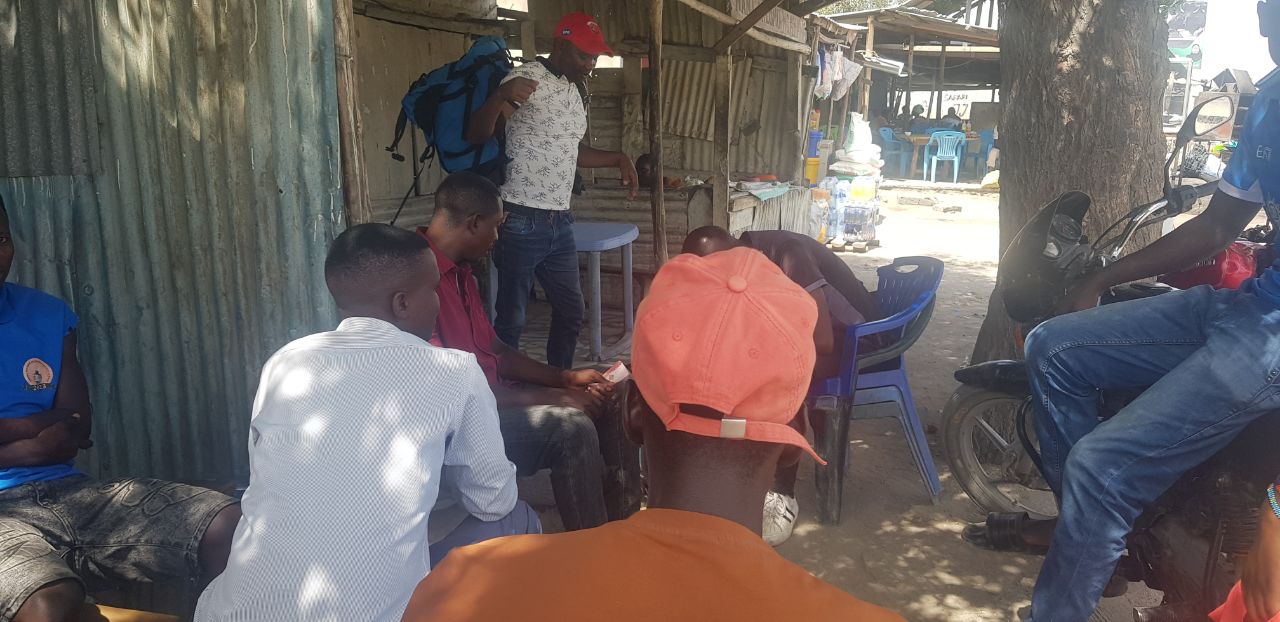
“These games really slow down progress, because your partner may need you to do something. You might agree, but when you get some money somewhere, you tell yourself, ‘let me try to increase it.’ That idea of increasing it is where you end up losing it,” Joachim explains in an interview with The Chanzo.
“Since she doesn’t see me when I’m playing, it becomes difficult for her to know. So there is deception involved—but what can you do? There is nothing in this world that can remain a secret forever. Things like this greatly affect marriages,” Joachim adds, describing his promise to quit gambling and how his marriage has been affected.
The issue of gambling has made Joachim feel like a captive of his daily decisions. He admits that while he does not want to stop playing, the negative consequences continue to build up.
“When you lose, and you had planned to go home with money, you start thinking about how your children will survive. So once you realize you’ve already bet and lost all your money, your mind becomes very unsettled,” Joachim explains.
Better to miss food than to stop gambling
Silas Bugotabululu (33) is one of the individuals who describes himself as an experienced gambler, saying he has reached a point where he cannot stop betting because he has already tasted its rewards.
“In 2021, when I tried it for the first time, I won on the very first day. That’s where my journey began. I placed 10,000 shillings and won 600,000,” says Silas, a father of two, in an interview with The Chanzo.
Silas mainly bets on football matches. He explains that although there are days when he loses, the days he wins have convinced him that quitting betting altogether is impossible.

“It’s better for me to place even 500 or 200 shillings, as long as I have made a bet that day. If I don’t bet, I feel very uneasy. I would rather bet and lose, but I must place a bet every day. I’m willing to miss food, but not to stop betting,” Silas says while holding his phone and checking different matches.
“I’d rather place a bet and lose, at least I will have a peace of mind knowing that I tried and lost than not betting at all, that’s very difficult. Maybe I could stop if I reach a point where I’ve won big consistently and have other sources of income that bring me money beyond betting,” Silas who works as a DJ in a local pub emphasized.
In many of the conversations with gambling participants, one thing The Chanzo observed is that most of them insist that they are making profits. However, as the discussions go on, they eventually admit that they lose more than they gain, while still believing that tomorrow or sometime in the future they will recover everything they had lost.
Shame
Paul Dicklucky (34), a porter in Dodoma, explains that he got into football betting after seeing his colleagues trying it and made money.
“I remember the first time I placed a bet, I put in 1,000 shillings and won 250,000. When you look at that kind of money, I hadn’t worked for it, yet I got it—so I got drawn in,” Paul explains.
However, Paul says that since then, his own assessment shows that he has been losing more than he gains, yet he has been unable to stop the habit.
“Losses are far more frequent than wins, but I kept playing. I thought maybe I would reach a point where I could stop, but that never happened. You find yourself falling into debts that shouldn’t even exist,” Paul explains.
Severine Mwasisi (36) recalls that while in Dar es Salaam in 2019, he found friends playing on a slot-machine . One of his friends won 50,000 shillings, which attracted him to start playing. For the the past three years he had managed to win money only four times.
“The money I won never exceeded 100,000 shillings. I found myself spending far more than I was earning, and I realized it was a loss. From the pain I experienced while playing, I lost up to 1,000,000 shillings. If I had that money in hand, I would have made real progress, but now I’ve gambled it away,” Severine explains sadly.
Ester Joseph (23), a bar attendant and resident of Mkonze ward in Dodoma, has been playing slot-machine gambling since 2021. She says the biggest challenge she faces is being unable to stop, even though she has already decided to quit.

“You may find that you’ve already played and spent even 10,000 shillings and lost it, then you feel tempted to go back home, take more money, and come back to gamble,” Ester says. “So there are times when my financial situation really declines. I do have a plan to quit. Right now, I see that whenever I play, I mostly lose—things are not going well for me. Whenever I get money, I think about gambling, so I really want to stop.”
Addiction
A doctor from Mirembe National Mental Health Hospital, Dr. Kenneth Majolo, explains that situations like those faced by Severine, Paul, and Ester are forms of addiction.
“Once it becomes part of a person’s psychological system, it starts to damage them, because even when they get a small amount of money, they immediately think about going to bet. These gambling activities bring short-term pleasure, you may win one day and lose the next. That creates the illusion that it’s possible to make money easily,” explains Majolo.
Majolo adds that advanced stages of addiction significantly disrupt normal life patterns, including decision-making.
“If it’s a student, you may find they use their school fees, or they do anything possible just to get money to gamble. Sometimes people invest large amounts into betting, and when they lose, those are the ones who may end up harming themselves or even others,” he emphasizes.
Majolo who has also been involved in providing medical support to gambling addicts, explains that gambling now affects not only young people but individuals of all age groups.
“There is a lack of proper education for people. In reality, these games were once played mainly by wealthy individuals. But they have been brought into poorer countries like ours in Africa and other regions, because many young people are unemployed,” he adds.
There are also challenges seen within economic systems. For example, in some rural areas where livelihoods depend on farming seasons, the belief that money can be made through betting is pulling many young people away from productive activities.
The Chanzo visited one of the districts on the outskirts of Dodoma region, Bahi District, and spoke with various stakeholders who discussed how gambling is affecting productivity in the community.
The councilor of Bahi Ward, Augustino Ndonu, told The Chanzo that the impact of gambling in the ward, has become particularly severe.
“There have been cases where people have stabbed each other over gambling. Just recently, one person was attacked after a dispute over money. The one who had provided the money refused to let it go, pulled out a knife, and stabbed the other,” the councilor says.
He adds that many young people in the district now see betting as a source of income, which discourages them from engaging in manual or productive work.
“You find a young person waking up in the morning and going straight to gamble, believing they can earn money easily without working. Sometimes you send a young person on an errand, like buying rice, and they come back saying the money is gone, only to find out they used it for betting. We are worried about the future of young people,” he said.
Economists who spoke to The Chanzo warned that any disruption to the workforce, especially in rural areas, poses a serious risk to economic growth, particularly since rural communities are already under pressure from the pattern of youth migration to urban areas.
Education and advertising
Speaking to The Chanzo by phone, the Director General of the Gaming Board, James B. Mbalwe, explained that the board has been providing education to Tanzanians about the potential risks associated with gambling addiction.
“We have been educating the public, especially young people, to ensure that when they participate in these games, they do so in moderation and responsibly, so that they do not fall into the harmful consequences that may arise from gambling,” Mbalwe said.
Mbalwe also emphasized that they are conducting operations to prevent the establishment of betting activities in unauthorized areas, as well as continuing to stress the importance of keeping children away from such activities.
Some stakeholders have suggested that there is a need to regulate the overwhelming number of gambling advertisements, which have now become widespread across all media platforms in the country.
“Nowadays, in the media, most advertisements are all about football betting—betting, betting, betting and more betting. What kind of Tanzanian are we raising for the future? We are creating a society of people who are too lazy to think, people who prefer shortcuts, essentially national-level con artists,” warned journalist Elizabeth Riziki during a media stakeholders’ meeting on February 12, 2026.
This argument was also supported by the Chairperson of the Editors’ Forum, Deodatus Balile, who cited Kenya as an example of measures taken, including raising minimum amount to be used on gambling activities to protect students.
“If we leave betting unchecked, the nation will head in the wrong direction. Four or five years ago, Kenya faced the same situation. But on August 26, 2025, they passed a Betting Law. From now on in Kenya, no radio, TV, or social media platform is allowed to broadcast betting advertisements between 6:00 a.m. and 10:00 p.m.,” Balile explained.
“If we fail to protect our children and instead focus on earning billions from the National Lottery, we will end up producing thieves. We will build a broken nation,” he warned further.