
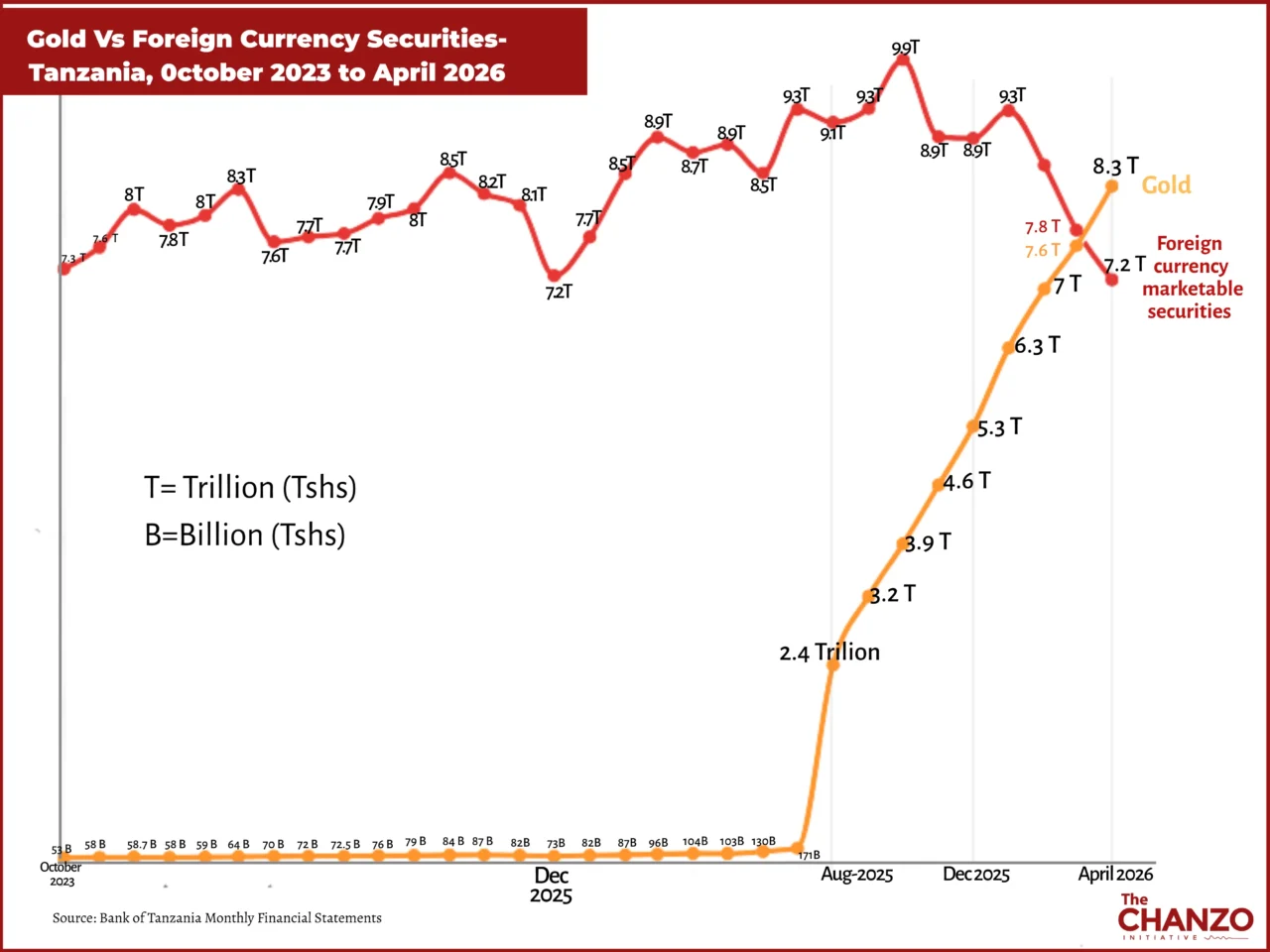
The Bank of Tanzania has accelerated its shift toward gold as a strategic reserve asset, holding a total of 8.3 trillion in reserves as of April 30, 2026. This includes 5.1 trillion in bullion gold and 3.1 trillion in monetary gold.
In the past, foreign currency marketable securities, mainly U.S. bonds and Treasury bills, formed the majority of Tanzania’s strategic foreign exchange reserves. However, by April 2026, they had fallen to second place, with a value of about 7.2 trillion.
Although domestic purchases of gold for reserves began in September 2023, the shift toward gold as a strategic reserve asset accelerated by August 2025, with purchases steadily increasing. Bullion gold now accounts for at least 60 percent of the country’s total gold reserves.
READ: Debate Ensued Over Reports of Tanzania’s Gold Reserves Sale Plans Amid Aid Cuts and Election Fallout
Amid rising geopolitical risks, many central banks have increased their gold holdings as part of their reserve strategies. Some countries, such as France, have gone further by repatriating physical gold reserves back to their own territories instead of holding them abroad.
In its first-quarter 2026 analysis, the World Gold Council stated that geopolitical risks will continue to play a major role in central banks’ decisions to purchase gold.
“Geopolitics remain front and centre in our outlook for gold demand in 2026. Our view remains that investment and central bank demand will be supported by ongoing geopolitical risk, with further investment impetus from elevated inflation and persistent high gold prices,” the World Gold Council’s Q1 analysis reads.
Gold accounts for at least one-third of Tanzania’s exports and is regarded as one of the country’s strongest products for foreign exchange earnings and currency stabilization.
In its April 2026 monthly economic report, the Bank of Tanzania underscored how gold acts as a macroeconomic stabilization commodity, highlighting how gold is able to offset macroeconomic impact brought by Straight of Hormuz closure following the U.S, Israel-Iran war.
“What sets Tanzania apart from many peer economies is a structural feature that functions as a natural safe haven during global commodity crises. Gold exports generate 30 to 40 per cent of the country’s foreign exchange earnings, with export values exceeding USD 3 billion in the year ending March 2026,” the Bank of Tanzania report reads.
“Historically, oil and gold prices move in tandem during geopolitical episodes, driven by shared risk premia, common US‑dollar denomination, and parallel speculative demand. In practice, this means that when global oil prices rise, gold export revenues expand sufficiently to offset the heavier oil import bill, mitigating the adverse effect on the current account,” the report expounds.
The Bank of Tanzania analysis underscores that the mechanism does not eliminate the domestic cost burden of higher fuel prices, which households and businesses will still pay more for petrol and diesel. However, at the macroeconomic level, the gold revenue buffer provides structural resilience that most regional peers lack.