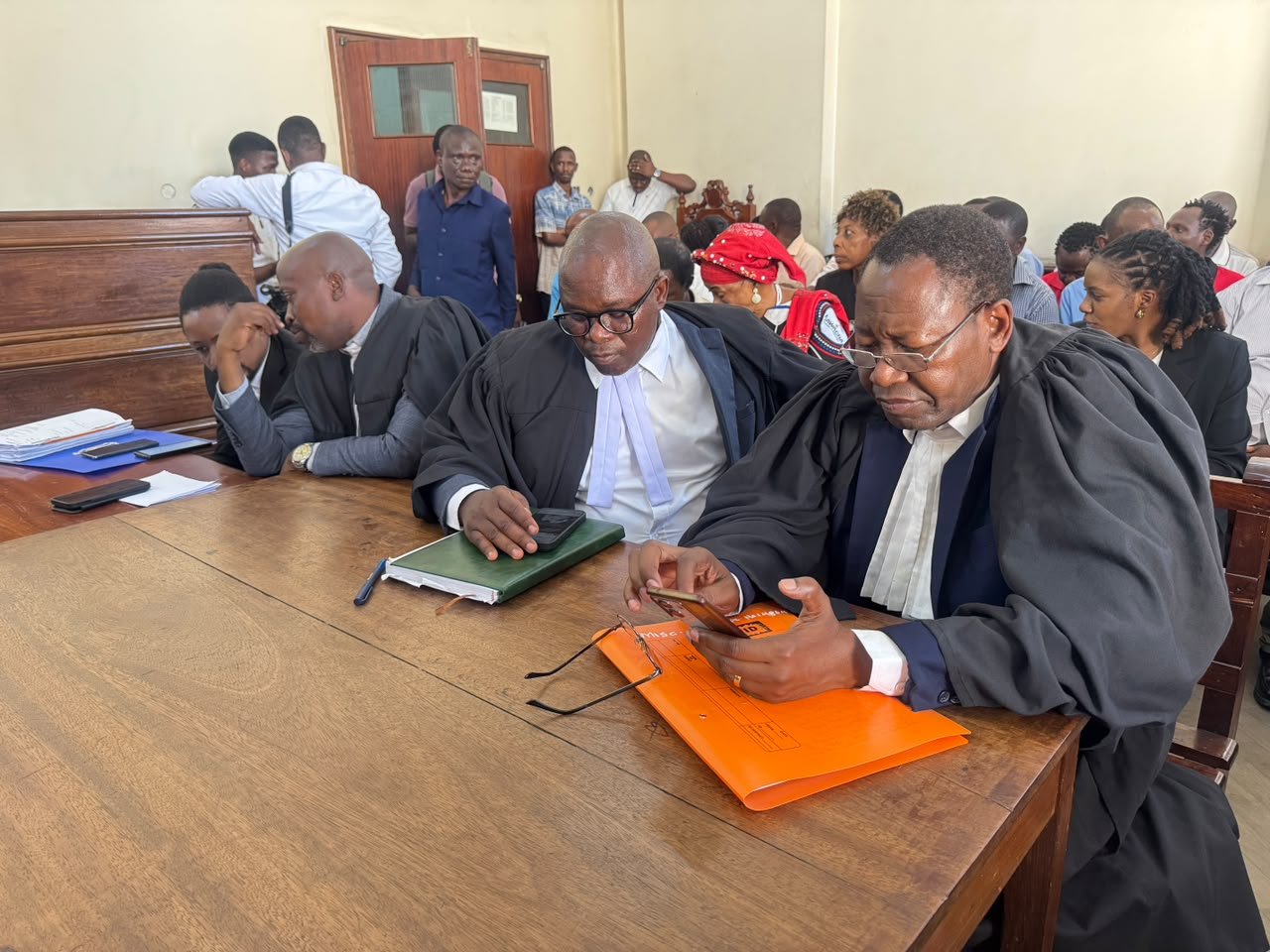

Dar es Salaam — The treason case against Tanzania’s main opposition party leader, Tundu Lissu, continued today , August 21, 2026, at the Dar es Salaam Sub-Registry of the High Court where a panel of three judges, Dunstan Ndunguru, James Karayemaha, and Ferdinand Kiwonde, ruled that Tundu Lissu has a case to answer.
Judge Ndunguru began reading the Court’s ruling at 9:57 a.m. and finished at 10:20 a.m. He began by revisiting the course of the proceedings, starting with a reading of the charges and noting that the accused had plead not guilty. Judge Ndunguru continued to name all 17 witnesses who had testified for the prosecution before moving into the reasoning behind the ruling.
He explained that among the principles the Court applied in reaching its decision was the rule that an accused person has a case to answer if the prosecution’s evidence, left unrebutted, would be sufficient to sustain a conviction.
The Court elaborated further, explaining that at this stage of proceedings, what must be shown is whether the prosecution’s evidence has established a case strong enough that the accused should be given the chance to respond . The Court stressed that at this point it does not examine, or go into detail on, the weight or credibility of the evidence; rather, it looks at the connection between the evidence presented and the charge itself, and how the accused is linked to that charge.
“So, since the Court does not go that far, and as I have said, all the evidence points back to the accused and to the words contained in the charge sheet,” Judge Ndunguru stated.
“This Court therefore finds, under section 312 [of the Criminal Procedure Act], that a case has been built against the accused — it has been ‘established,’ not ‘proven’; the word used is ‘established.’ This Court accordingly holds that the accused has a case to answer, so that he may have the opportunity to defend himself or present evidence against that brought by the prosecution,” he continued.
After delivering the ruling, the Court informed the accused of his rights in the matter, including the right to defend himself, or, should he choose to remain silent, the Court would allow the prosecution to comment on that silence. Tundu Lissu stated that he will defend himsel and proceeded to name his witnesses.
Below you can follow an excerpt of Judge Dunstan Ndunguru’s remarks as he read the Court’s ruling:
Judge Dunstan Ndunguru: …Both sides, the accused and the prosecution, indicated their intention to make submissions on whether the accused has a case to answer.
The court agreed with the submissions made by both sides regarding whether to raise the issue of whether the accused has a case to answer. Therefore, this ruling was based on the arguments presented by both the accused and the prosecution.
In presenting arguments on whether the accused has a case to answer, the accused went first, disputing the matter and arguing that the prosecution had entirely failed to build a case — that is, failed to establish an initial case that would require him to mount a defence.
In his submissions, the accused directed the Court to various principles previously discussed in a number of Court of Appeal decisions, concerning the point at which a court is expected to rule on whether an accused has a case to answer. He referred the Court to several decisions, beginning with Ramanlal Trambaklal Bhatt v. R [1957] E.A, at pages 334 and 335, and also to Murimi v. Republic [1967] EA 542, particularly at page 544, noting that this latter case adopted the principles already established in the former.
Even in responding on the applicable principles or the guidance already laid down by various court decisions, with reference to the cases cited above, the prosecution agreed that these were indeed the established principles to be applied when a court has to decide whether an accused has a case to answer or not.
Because these are legal principles laid down by the higher courts, this Court likewise endorses them as the principles that essentially apply, and holds that when a court faces circumstances requiring a decision on whether an accused has a case to answer, these principles must be followed. In essence, the principle holds that before a court can rule that an accused has a case to answer, it must address the central question that if the prosecution’s evidence is left unanswered by the accused, would it be enough or sufficient to sustain a conviction.
The prosecution need not call a large number of witnesses; rather, the Court must look at the evidence the prosecution has presented and ask whether, if left unrebutted, if the accused is not given the chance to mount a defence would that evidence be enough to convict him. That is the underlying principle.
Together with the said decisions, this Court also took into account and drew on the guidance given in DPP v. Morgan Marinyi and Others, Criminal Appeal No. 133 of 2023, a decision that in essence extended the reasoning in the Bhatt (EA) case somewhat further. In it, the Court explained that, at the stage when it is determining whether an accused person has a case to answer, what needs to be considered is whether the evidence presented points to or establishes the offence allegedly committed by the accused and whether it show there is a connection to the offence with which the accused has been charged. If not, the Court must consider whether the evidence can establish or support a lesser offence that is substantially similar, arising from the same genus as the offence with which the accused has been charged.
The Court also drew on DPP v. Philipo Ntonda, Criminal Appeal No. 217 of 2020 ,also available on TanzLII, in which the Court of Appeal went further still, holding that when a court is deciding whether an accused has a case to answer or not, it should not delve into analysing the evidence in depth, nor into assessing its weight or credibility, the Court should not go in that direction at all.
What matters fundamentally is examining the connection between the evidence presented and the charge at hand, and how the accused is linked to that charge. I would basically say that, having considered these principles together with the persuasive rulings the accused himself cited from neighbouring countries, such as Antony Njeru v. Republic (2006) from Kenya, as well as Republic v. Bernard Wangu Yankubu from Kenya, and also Republic v. James Nyagina and Others.
The accused also argued before the Court that, in his view, the prosecution had failed to prove the charge because it had failed to establish the three essential elements of the offence of treason, as set out under section 39(d), and as further elaborated in Gray Mattaka and Others and also as it appears in the Gandhi and Others case.
Thus, because these elements are drawn from the law itself and it is the law that created the offence, the prosecution did not, in fact, dispute what those elements are, which are essentially drawn from the cases I have mentioned, Gray Likungu Mattaka together with Hatibu. It says, the elements of the treason charge are: first, that the accused must owe allegiance to the United Republic; second, that the accused must have formed the intention to commit an act of treason; and third, that the accused carried out or manifested that intention through a publication or some overt act. So, as I have said, the accused argued before the Court that the prosecution had failed to establish these elements, while the prosecution, relying on the 17 witnesses it called, maintained that it believed all three elements had been established.
Essentially, based on the arguments of both sides, the first element , that the accused owes allegiance to the United Republic of Tanzania, was not in dispute. What remained contested were the other two elements: whether the accused formed the intention to commit the offence of treason, and, third, whether he manifested that intention through his actions or through a publication. Given both sets of arguments, this Court, having reviewed the charge sheet, the evidence brought by the prosecution, and the legal principles discussed and agreed upon by both sides, principles that are general in nature and which both sides accepted.
The question before this Court is whether it finds that the prosecution has established, not prove, the word used is established, a case against the accused. In other words, whether the prosecution, through its evidence, has built a case that would lead the accused to the opportunity to answer or defend himself.
This Court, in brief, reviewed the evidence and found that there was no dispute, it was not contested, that the words contained in the charge sheet were spoken by the accused, and that they were spoken in front of party leaders, supporters, and the public at large through the media, and that each witness who testified sought to connect the accused to those words and to the offence with which he is charged. Taking all of this into account, the evidence presented links the accused to the words spoken, and, looking further at the testimony of the last witness, referred to as “P,” who stated that he was present on the day of the meeting in question and recounted some of the words spoken, stating that those words were uttered by the accused in his presence and before other people as well.
Therefore, given this evidence, and as I said at the outset, at this stage the Court does not examine or go into depth on the weight of the evidence or its credibility. The weight and credibility of evidence are matters to be assessed once the other side has also had the opportunity to defend thesmelves, that is when the credibility of a witness’s testimony can properly be assessed. At this stage, the Court does not go that far.
So, because the Court does not go that far, and as I have said, all the evidence points to the accused and to the words in the charge sheet, this Court finds, under section 312 of the Criminal Procedure Act, that a case has been built, it has been established, not proven; the word used is established, against the accused. This Court therefore holds that the accused has a case to answer, so that he may have the opportunity to defend himself or present evidence against that brought by the prosecution.
The accused has the right to be informed of his right to mount his own defence or give his own testimony. He also has a second right, the accused has the right to call his own witnesses after giving his own testimony. However, section 312(3) still allows for the possibility that, should the accused choose to remain silent, that is, not offer a defence, the Court will be obliged to draw an adverse inference.
This Court states that, having informed him of that right, should he opt to remain silent, section 312 provides that the prosecution will also be given the opportunity to comment on the accused’s decision not to testify. The Court therefore informs the accused of all his rights under section 312. The accused will be given the opportunity to say anything regarding the rights just outlined to him under section 312(2).
Tundu Lissu: Honorable Judges, having heard the Court’s ruling, I wish to inform the Court that yes, I will defend myself. I will defend myself as a witness, the first witness, and, Honorable Judges, I will also call the following witnesses; I will ask the Court to issue them with summonses.
[He continued mentioning his witness]