
Kigoma-China’s Zijin Mining Group has inaugurated four new ships that will operate on Lake Tanganyika, strategically positioned to serve the company’s mining operations in the DR Congo. At the ceremony on July 20, 2026, officiated by Tanzanian President Samia Suluhu Hassan, the company’s Vice President described the progress as a major step forward in Africa’s mining journey.
The ships are part of Zijin Mining’s multimodal water-land corridor. The development follows the concession agreement signed between Tanzania and Zijin Mining in August 2025 for the operation of Kigoma Port and the Malindi Terminal.
The company had committed to building 2,000-tonne bulk carriers and to upgrading and renovating Kigoma Port and the Malindi Terminal at the Dar es Salaam port, improving yards, warehouses, and other infrastructure, and equipping them with modern loading and unloading facilities as well as intelligent management systems.
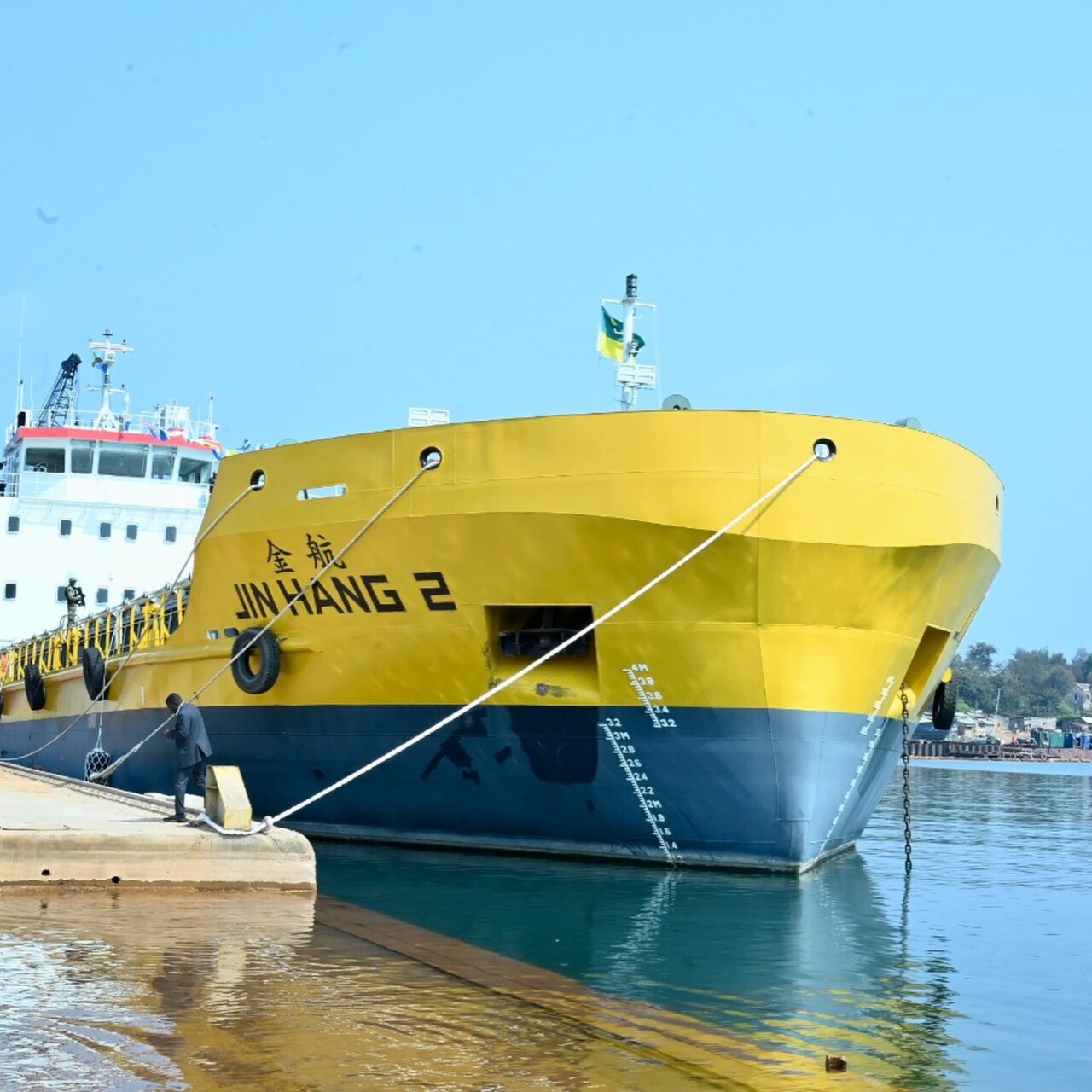
The four ships were built by Chinese firm Shandong Xinneng Shipbuilding at a cost of USD 10 million. The vessels were constructed in China and reassembled on Lake Tanganyika, with Jin Hang 1 (Golden Voyage 1) entering Tanganyika waters on November 11, 2025, and Jin Hang 2 hitting the water on December 23, 2025. Jin Hang 4 and Jin Hang 3 were also successfully launched on March 16 and March 17, 2026.
Speaking at the inauguration ceremony on July 20, 2026, in Kigoma, the Vice President of Zijin Mining, Qiu Guozhu, said the company is undertaking a comprehensive modernization of Kigoma Port and the Malindi Wharf in line with the concession agreement with Tanzania.
“This project will unlock the trade artery connecting Central, East Asia and Africa. Minerals will be transported from Kalemie port in the DRC across the lake to Kigoma, and then overland to the Malindi Wharf, and finally onwards to the global shipping route,” Qiu explained.
“This multimodal water-land corridor will dramatically enhance regional logistics efficiency and inject powerful momentum into the economic development of Tanzania and its neighboring countries,” he added.
The ships, which are 70 metres long and 15 metres wide, are managed by Zijin subsidiary, Golden Voyage Logistics Company. According to the Director General of the Tanzania Ports Authority (TPA), Plasduce Mkeli Mbossa, the company is expected to supply two more ships.
READ: DRC Emerges as Largest Transit Cargo Market for Tanzania Ports
“These ships will be of great benefit, because on Lake Tanganyika there have been only four large ships. Three have a capacity of carrying 2,000 tonnes, and one carries 3,000 tonnes. This means that with the addition of four ships, we will have eight large ships on Lake Tanganyika, and that will help to transport cargo from Congo to us and onward to our other ports,” Mbossa said during the ceremony in Kigoma.
“So we are part of a large project for transporting mineral cargo. We had asked them to carry out the shipping, because they are building the port of Kalemie, but also to build this port of Kigoma, and they are also constructing a 500-kilometre road from Manono in the middle of the DRC, where their mines are located, up to the port of Kalemie,” Mbossa explained further.
The inauguration comes days after Zijin Mining reportedly made its first shipment of lithium through Lake Tanganyika, from the Manono North East Lithium Project, one of the world’s largest underdeveloped hard-rock lithium deposits. The Manono project, which is a joint venture between Zijin Mining (54.9%) and the DRC government, is expected to be one of the major beneficiaries of the Lake Tanganyika logistics initiative.
Strategic positioning
This development places Tanzania at the center of the global competition for critical minerals, as nations seek to secure their supply routes, particularly to reach resources in the mineral-rich DRC. Speaking at the inauguration, the Tanzanian President acknowledged the role Tanzania plays geographically.
“Geographically, our country is a gateway to trade for the neighboring countries that surround us. So by nature, God has already created it that way. But policy-wise and legally, it is up to us to now make Tanzania a major and important trade hub within Africa, and we are heading in that direction,” President Samia remarked.
The launch of the four ships comes three days after the groundbreaking ceremony for a new TAZARA Training Centre and a modern Operations Control Centre under the TAZARA Railway Revitalisation Project, led by the China Civil Engineering Construction Corporation (CCECC).
READ: Tanzania, Zambia and China Launch TAZARA Railway Rehabilitation
The training centre is an initial step towards a $1 billion investment in the rehabilitation of the TAZARA railway, following a 30-year concession agreement between China, Tanzania, and Zambia. Among other things, the railway’s strategic value to the Chinese critical mineral supply chain lies in its ability to serve mines in Zambia and in the southwestern part of the Democratic Republic of the Congo.
The reinforcement of the Lake Tanganyika route provides more options via Kalemie, in addition to the current land route through Tunduma in Tanzania. It comes as, on the other hand, the Lobito Corridor, backed by US-EU cooperation, is being strengthened for supply on the Atlantic side.
On July 3, 2026, the Africa Finance Corporation (AFC) confirmed a USD 753 million funding package for the Lobito Corridor railway project in Angola. The funding will finance the rehabilitation and upgrading of the 1,300-kilometre rail corridor, as well as support its long-term operation, linking Angola’s Port of Lobito with the DRC.
On June 10, 2026, Ivanhoe Mines announced that, for the first time, copper anodes from the Kamoa-Kakula mine in the DRC had reached the Aurubis Olen refinery in Europe via the Lobito rail corridor. The company underscored that the new supply chain produces the world’s lowest-carbon-intensity refined copper. The news marked a development in the new route; on the other hand, the first shipment of copper to the U.S. was conducted in August 2024.
The developments along these supply routes point to intensifying competition in critical mineral sourcing, at a time when such resources are becoming ever more critical amid the AI race.



One Response
Good detailed repporting