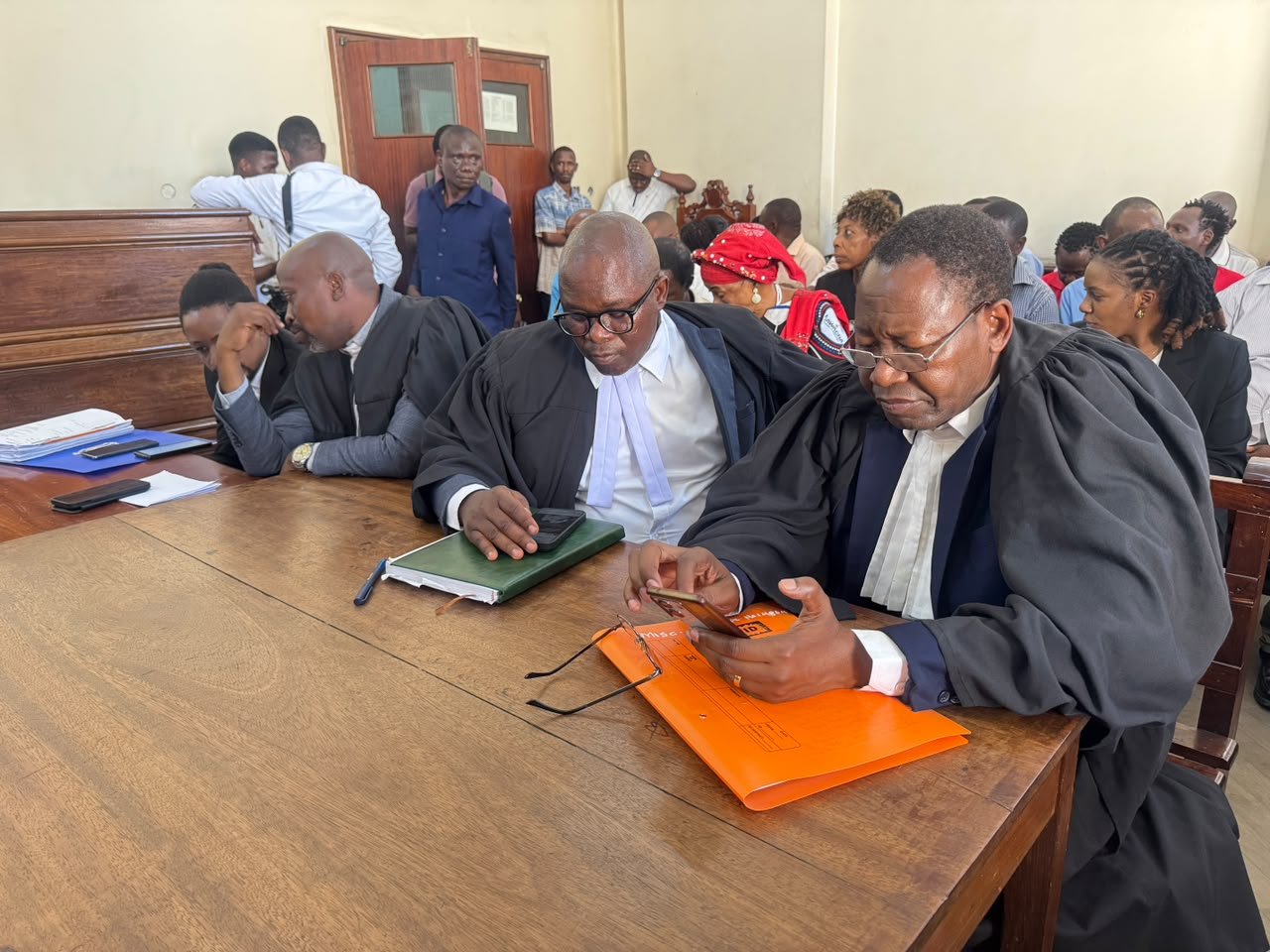

Dar es Salaam — The High Court has given itself a further 14 days to complete Tundu Lissu’s treason trial, after the defence opened the testimony of CHADEMA’s communications and publicity director, Brenda Rupia, on Monday afternoon.
Justice Dunstan Ndunguru announced the extension after Rupia said she, not Lissu, prepared and issued the public notice for the April 3, 2025 meeting from which the disputed speech arose, and invited journalists to attend.
Her evidence goes directly to the prosecution allegation that Lissu convened the meeting and published specified words on Jambo TV with intent to threaten the Government of the United Republic of Tanzania.
The court had been expected to conclude the trial on September 7, the judge said. Instead, it must finish the case within the additional 14 days, with the parties urged to keep evidence focused on matters relevant to the charge.
“Today was to have been the last day of this case,” Justice Ndunguru said. “Fourteen days have been added from today so that we can complete it.”
The hearing was adjourned to Tuesday, September 8, at 9 a.m., with Rupia’s examination-in-chief still incomplete.
Defence witness completes cross-examination
Monday began with the prosecution completing its cross-examination of Amani Golugwa, CHADEMA’s deputy secretary general for Mainland Tanzania and the third defence witness. State Attorney Nassoro Katuga tested Golugwa’s account of the April 3 speech, its dissemination, its alleged meaning and the relationship between CHADEMA’s No Reforms, No Election policy and the 2025 election.
Golugwa maintained that a journalist who takes and broadcasts news content owns the material, although he could not identify a provision of law to support that proposition. He also repeated his view that the word uasi — rebellion — could be political language and was not automatically a criminal expression.
Nassoro Katuga: “You said that mobilising rebellion is not an offence and is political language. Which dictionary of politics does CHADEMA use?”
Amani Golugwa: “We use the Kiswahili language.”
Katuga asked whether Lissu had used the April speech to call judges CCM members, say courts were inaccessible, or allege that police took bags into polling stations. Golugwa said he had not heard the first statement and could not remember the other two. He said his evidence reflected what he heard, but could not say it captured everything Lissu said.
The prosecutor also pressed the witness on kukinukisha, a disputed Kiswahili term in the case, and asked whether a listener could use the absence of a stated method to decide for himself how to “make things smell.” Golugwa rejected a hypothetical involving a person relieving himself at a polling station, saying that was neither a right nor the purpose of the meeting.
Katuga: “Since the method of kukinukisha was not stated, does a person have the right to go and relieve himself at the polling station?”
Golugwa: “That is not a right; it was not even the purpose of that meeting.”
Golugwa agreed that Lissu told people the party would disrupt the election, but denied that the violence which later occurred was connected to Lissu or CHADEMA. He said the party had been barred from political activities and Lissu was in remand custody when the election violence occurred.
READ MORE: Lissu Defence Brings Election-observer Claims and Arrest Accounts Into Treason Trial
When asked what peaceful method could be used to disrupt an election without force, Golugwa said it was to educate citizens. He later accepted that Lissu’s address was intended to press the government to undertake legal and electoral reforms, while maintaining the party did not aim to stop any person from voting.
Katuga: “Was the aim of the speech to press the government to change the electoral system?”
Golugwa: “It was true.”
Katuga: “Did he use strong, persuasive and pressuring words?”
Golugwa: “It was true.”
The prosecution asked Golugwa if he had heard John Heche, CHADEMA’s mainland vice-chairperson, say on East Africa Radio that the 2025 election would not happen, and if he had heard a speech by Judge Chande concerning the October 29 events.
Golugwa said he could not recall the alleged Heche remarks and had not heard Judge Chande say that the events were planned, though he had heard him mention demands for a new constitution.
Re-examination returns to political strategy
Lissu re-examined Golugwa after the state closed its questions. The defence focused first on why CHADEMA did not litigate every local-government and general-election complaint that it says arose in 2020 and 2024.
Golugwa said the party had submitted appeals to district committees over candidates who were allegedly denied or disqualified from nomination forms, but said the appeals were largely dismissed.
READ MORE: Lissu Defence Says CHADEMA’s Election Campaign Grew From Alleged Poll Failures
He said CHADEMA concluded that political action was more appropriate because so many candidates were affected across the country.
Tundu Lissu: “When you said you did not go to court because political means were more appropriate, what did you mean?”
Golugwa: “How many cases could we file, and in which courts would there be enough for all of them? Many of our candidates were disqualified nationwide, so we saw no need to go to court.”
Justice Ndunguru paused the hearing to check the record after a prosecution objection that the answer required no clarification. The judges found that Golugwa had said the party chose political means because it considered them more appropriate, and allowed Lissu to continue.
Golugwa also clarified that CHADEMA’s purpose was to educate people about its reform position, not to physically prevent any individual from voting. He said the party wanted citizens to understand its position so that they could make what it considered an informed decision.
Tundu Lissu: “Did the ‘No Reforms, No Election’ position aim to stop anyone from participating in the election?”
Golugwa: “We aimed to educate people to understand our position; after understanding it, people would make the right decisions.”
On the earlier disagreement over whether Lissu had used the word kukinukisha in meetings with Muslim leaders and retired prime minister Joseph Warioba, Golugwa said the precise word did not have to be repeated in every conversation for the wider reform message to remain the same.
He also said the April 3 speech did not cause the October violence. In his account, CHADEMA had been prohibited from carrying out political activities, and Lissu had been detained before the election, so neither could have participated in what followed.
READ MORE: Mnyika Rejects Bid to Link CHADEMA’s Reform Campaign to Election Violence
The defence then concluded Golugwa’s evidence. Justice Ndunguru thanked him and released him from the witness box.
The morning session took place nine years after Lissu survived an assassination attempt in Dodoma on September 7, 2017. BAVICHA, CHADEMA’s youth wing, had declared the anniversary Heroes’ Day, and many supporters wore white shirts bearing the words: Tundu Lissu — Sixteen Bullets Survivor, 7 September.
Lissu told the court on arrival that prison authorities had not permitted him to receive and wear a shirt that BAVICHA supporters intended to give him for the anniversary. The notes state that he said there was no problem and that he was well.
Rupia enters defence
After the afternoon recess, Rupia took the oath as the fourth defence witness. The 34-year-old said she became CHADEMA’s communications and publicity director on March 12, 2025, having previously served in party and BAWACHA positions in Kinondoni.
Rupia said the party secretariat, under secretary general John Mnyika, organised the April 3 meeting at CHADEMA headquarters in Mikocheni for people who intended to seek party nomination for the 2025 election. Its purpose, she said, was to explain the party’s No Reforms, No Election position.
Tundu Lissu: “Who organised that meeting?”
Brenda Rupia: “The party secretariat, under the secretary general John Mnyika.”
She described the secretariat as the body responsible for CHADEMA’s day-to-day operations, comprising the secretary general, two deputy secretaries general, directors and leaders of the party’s affiliated wings.
READ MORE: Mnyika Tells High Court Lissu’s Speech Carried CHADEMA Policy, Not a Private Plot
Rupia told the court that the secretariat decided to invite aspirants and to inform the public that a meeting would be held. She said she personally drafted the March 27 public notice, posted it on party social-media pages, supplied it to journalists and invited media houses to cover the event.
Tundu Lissu: “What do you say to the allegation that I invited the media?”
Brenda Rupia: “It is not true. Tundu did not invite the media, and he did not organise the meeting.”
Rupia said around 250 people attended, including aspirants, secretariat members, senior party leaders and journalists. She named Jambo TV, The Chanzo, Mwanzo TV, ITV and Mwananchi among the outlets represented.
She said the journalists arrived with cameras or notebooks and were not given instructions by CHADEMA on how to discharge their professional duties. When Lissu asked the question in English, Rupia replied in English: “Honourable Judges, there were no instructions to journalists whatsoever from any one of us on how they should perform their duties in that particular meeting or any other meeting conducted by CHADEMA.”
Broadcasts and alleged publication
Rupia said she could not state directly which outlets broadcast live, explaining that journalists attended with their equipment and recorded the proceedings. She identified Lissu’s role as that of the main invited speaker, who delivered an address as CHADEMA national chairperson on the party’s reform policy.
READ MORE: Court Allows Lissu to Re-examine Himself as Mnyika Opens Defence Case
She said she saw him perform no other role at the event. Rupia then rejected the allegation that Lissu published content on Jambo TV, saying he was neither a Jambo TV employee nor a journalist and did not know in advance whether that outlet would attend.
Tundu Lissu: “The charge says I broadcast those words specifically on Jambo TV. What do you say?”
Brenda Rupia: “That is not a true allegation; it is false. He did not broadcast the programme; he is not a Jambo TV employee, and that is not his responsibility.”
Rupia told the court that material generated by a media house belongs to the organisation that generated it. In particular, she said Jambo TV and its management owned content it captured at the April 3 meeting.
The court rose before Lissu completed examination-in-chief. Justice Ndunguru directed the parties to return at 9 a.m. on Tuesday, September 8, to continue with Rupia’s testimony.