
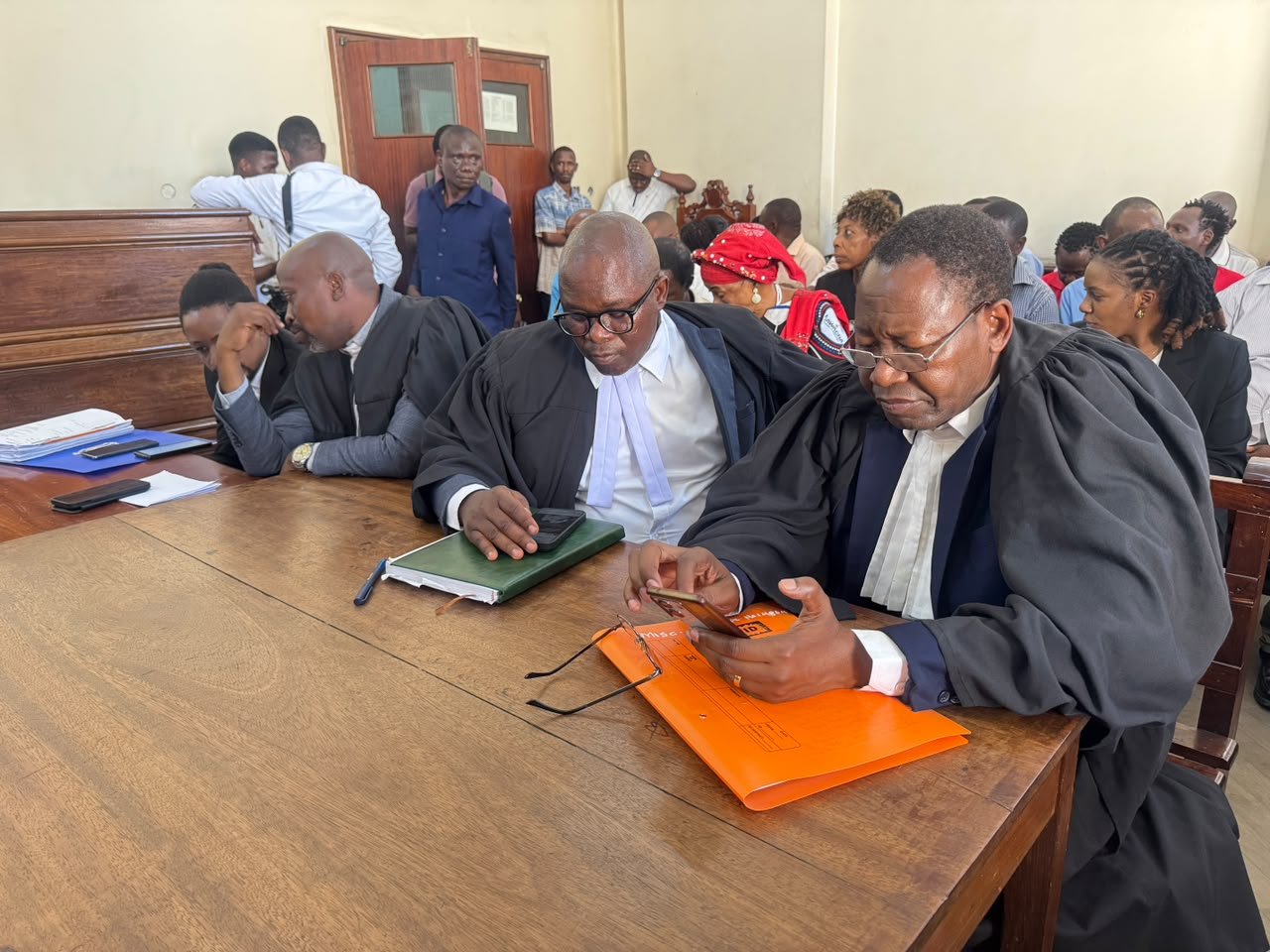
Dar es Salaam — Tundu Lissu’s defence on Thursday broadened its case that the treason charge is political, with CHADEMA deputy secretary general Amani Golugwa telling the High Court that election observers had questioned the credibility of the 2025 election and that the disputed words were extracted from a three-hour speech on electoral reform.
Golugwa, the third defence witness, said the brief words cited in the charge took about 26 seconds to read, while the portion of the April 3, 2025 meeting covered by journalists ran for between 90 minutes and two hours. He said Lissu used the wider address to trace long-standing disputes about electoral laws, institutions and the conduct of past polls.
The witness also gave a detailed account of two arrests in 2025, including an aborted trip to Belgium in May. He said the encounters were part of a pattern of intimidation against CHADEMA leaders after Lissu’s arrest; the prosecution will have an opportunity to test that account when cross-examination begins.
Observer reports cited in court
Lissu began Thursday’s proceedings by asking Golugwa about reports he said were issued by election-observation groups following the 2025 election.
Golugwa attributed criticisms of the electoral environment, violence, and the process’s transparency to the Southern African Development Community, the European Union, the Commonwealth, and the Thabo Mbeki Foundation.
He said SADC observers found that Tanzania’s election did not meet democratic-election standards, citing what he described as threats and mistreatment of opposition leaders, an uneven contest and a lack of transparency.
READ MORE: Lissu Defence Says CHADEMA’s Election Campaign Grew From Alleged Poll Failures
He said EU observers had expressed concern about violence, killings, abductions and the disappearance of people before the vote, and about what they viewed as conditions favouring CCM.
Tundu Lissu: “What did SADC observers say about that election?”
Amani Golugwa: “They said Tanzania’s election did not meet the standards of democratic elections. There were threats and mistreatment of opposition party leaders, the competition was not level, and there was no transparency in the whole process.”
Golugwa told the judges that he had read a statement from the Commonwealth secretary general expressing sorrow and concern over violence and killings, and that the Commonwealth would follow developments closely.
He said the Thabo Mbeki Foundation concluded that the election fell below standards and guidelines set by SADC and the African Union, that voters could not exercise their democratic freedoms because of violence, and that the announced presidential and parliamentary results did not reflect voters’ will.
Golugwa’s evidence, if accepted, would support the defence’s wider claim that CHADEMA’s electoral-reform campaign was grounded in concerns about the electoral system rather than an intention to threaten the state.
Defence disputes threat to government
Lissu then asked Golugwa to examine the terms attributed to him in the charge sheet. Golugwa said the quoted words did not name the Government of the United Republic of Tanzania, the President, Vice President, Prime Minister, Cabinet, Attorney General, DPP, police, armed forces, prisons service or intelligence services.
Tundu Lissu: “Was the Government of the United Republic of Tanzania mentioned in the words in the charge sheet that I have read to you?”
Amani Golugwa: “The word ‘government’ is not there.”
Lissu: “Was the President mentioned?”
Golugwa: “That word is not there at all.”
Golugwa said he did not see how terms such as “this position signals rebellion,” “we will mobilise rebellion,” “we will disrupt the election” or “we will stop the election” could threaten the government.
READ MORE: Mnyika Rejects Bid to Link CHADEMA’s Reform Campaign to Election Violence
He told the court that, in his understanding, opposing a government or institution is not inherently a crime, and that mere spoken words do not themselves establish treason.
He described kukinukisha, a Kiswahili term used in the alleged statement, as making something emit a smell, whether a pleasant fragrance or a bad odour. That answer drew laughter in court when he illustrated the meaning with the word unyunyu, which refers to perfume or scent.
Tundu Lissu: “How can a statement that we are going to make something emit a scent threaten the Government of the United Republic?”
Amani Golugwa: “Words about producing a good smell or a bad odour cannot threaten it. I do not see at all where the government could be frightened.”
The prosecution case has also referred to violence that occurred around October 29, 2025, including reports of burned polling stations and Bus Rapid Transit infrastructure. Golugwa said such acts were not included in the words as read from the charge sheet.
The missing broader context
Golugwa repeated evidence given earlier by John Mnyika that journalists from several outlets, including Jambo TV and The Chanzo, attended the April 3 meeting. He said Jambo TV and The Chanzo broadcast part of the meeting live, but not its entire three-hour duration.
He said the party did not impose conditions on media organisations and that neither Lissu nor other party leaders directed journalists on how to perform their work. In Golugwa’s account, the choice to publish belonged to each media organisation, not to the chairperson who gave the address.
Tundu Lissu: “I am charged with publishing these words on Jambo TV. What do you say?”
Amani Golugwa: “That is false in broad daylight. How could Lissu publish on Jambo TV when he is not a journalist and does not work for Jambo TV?”
Justice Ndunguru interrupted to note that the witness had added a question of his own to the answer, prompting laughter. Golugwa continued that, to his ordinary understanding, material broadcast by a news organisation belongs to that outlet and decisions about its content rest with the owner.
READ MORE: Mnyika Tells High Court Lissu’s Speech Carried CHADEMA Policy, Not a Private Plot
He said he had not seen or heard of action being taken against Jambo TV, The Chanzo or their journalists for allegedly facilitating treason through their reporting of the April 3 event. He added that, in his view, the evidence did not show Lissu had a role in publishing the material on Jambo TV.
Golugwa estimated that the specific words in the charge took about 26 seconds to read. By contrast, he said, the meeting dealt for hours with the electoral system, past commissions, domestic and international election observers, prior local and general elections, and CHADEMA’s experience of candidate disqualifications.
Amani Golugwa: “If someone brings you a few words from the charge sheet after all that speech, I see it as something manufactured with bad intent against you — to oppress you and our party so that we cannot conduct politics permitted by law.”
He said Lissu had made the same reform arguments on earlier occasions, including meetings with editors, Muslim religious leaders, the Legal and Human Rights Centre and retired prime minister Joseph Warioba.
Golugwa said those engagements were intended to explain the party’s position and gain support for reforms, not to spread treason.
Account of arrests
The hearing took a procedural turn when Golugwa began describing events that he said followed Lissu’s April 9, 2025 arrest. State Attorney Nassoro Katuga objected, arguing that a personal account of a witness’s travel or arrest could be unrelated to the treason charge and did not fall within the proper scope of evidence-in-chief.
Lissu replied that his defence and Mnyika’s evidence concerned what he called a campaign of repression against him and CHADEMA, and that Golugwa’s accounts of police action were relevant to his argument that the case was politically motivated.
Tundu Lissu: “My evidence and Mnyika’s evidence concern a campaign of government oppression against us and our party. This case is oppressive, false and political.”
Nassoro Katuga: “What Lissu is saying is the meaning of ‘kukinukisha.’”
After a lengthy consultation, Justice Ndunguru said the parties should remain focused. He observed that the prosecution bears the burden of proving its case and that, unlike the prosecution, the defence does not normally submit advance witness statements to guide the scope of its evidence.
READ MORE: Court Allows Lissu to Re-examine Himself as Mnyika Opens Defence Case
The judge added that the prosecution retained the right to cross-examine defence witnesses, describing that opportunity as part of a fair trial. The court did not exclude Golugwa’s evidence at that stage, and Lissu continued his examination.
Aborted Belgium trip
Golugwa said that on May 13, 2025, he was due to fly to Belgium to represent CHADEMA at a meeting of the International Democracy Union. He testified that, after receiving a boarding pass and reaching an immigration officer at the airport, two people asked him to accompany them to an office.
He said one person was in civilian clothes and did not show identification, and told him he was under arrest. Golugwa said his phones were taken and, within minutes, more than five people entered the room, including one carrying a gun, searched his bag and seized two pages containing the speech he intended to deliver abroad.
Amani Golugwa: “I asked why I was being arrested and searched, and what my offence was. Nobody answered me. One of the people with a gun put it to my right ear and said: ‘You fools are the ones planning trips to go and smear the country abroad. Today you will understand.’”
Golugwa said he was taken around the airport and then to Stakishari Police Station, where he was told he was suspected of cybercrime and money laundering. He said he was later taken to Central Police Station in Dar es Salaam, asked about previous trips to Mombasa and instructed to provide documents relating to those trips.
He told the court that he supplied passport copies and other material, was released on bail by party leaders and told to go home. He said the Belgium trip did not take place, and he denied the allegations made against him.
Broader defence claim
Golugwa said he was arrested again at his parents’ home in Arusha on November 8, 2025. He testified that police mentioned allegations of terrorism, conspiracy to damage public infrastructure and property, and conspiracy to assault security officers.
READ MORE: Lissu Tells Treason Court He Has No Faith in Judges on Election Disputes
He said he was taken first to Central Police Station in Arusha and later to Oysterbay Police Station in Dar es Salaam. Golugwa told the court he declined to make a statement, was placed in a cell, and was subsequently released after an official he identified as Zonal Crime Officer Mafwele and an advocate, Hekima, spoke with him.
Tundu Lissu: “What did this repeated arrest mean to you?”
Amani Golugwa: “Its purpose was to intimidate me and my fellow leaders so that we would not do our party work.”
Golugwa also recalled earlier occasions on which he said Lissu had been arrested, including events in Arusha and Mbeya, but said he knew of no case in which Lissu had been convicted over those incidents.
Asked whether, having known Lissu for 20 years, he considered it possible that the defendant was a traitor, Golugwa said he did not. Justice Ndunguru then noted that Lissu had already given the court an account of his background, before the defence closed its examination of the witness.
Amani Golugwa: “From the way I have known Lissu for those 20 years, he is a very good person, and I do not see the possibility of Tundu Lissu being a traitor.”
The prosecution asked for an adjournment at 5 p.m. to begin cross-examining Golugwa. Justice Ndunguru granted the request, and the case was set to resume on Friday, September 4, at 9 a.m.

One Response
How do you say treason in Kiswahili ? aa Mama Samia wa raisi wa Jamhirya wa Zanzibar