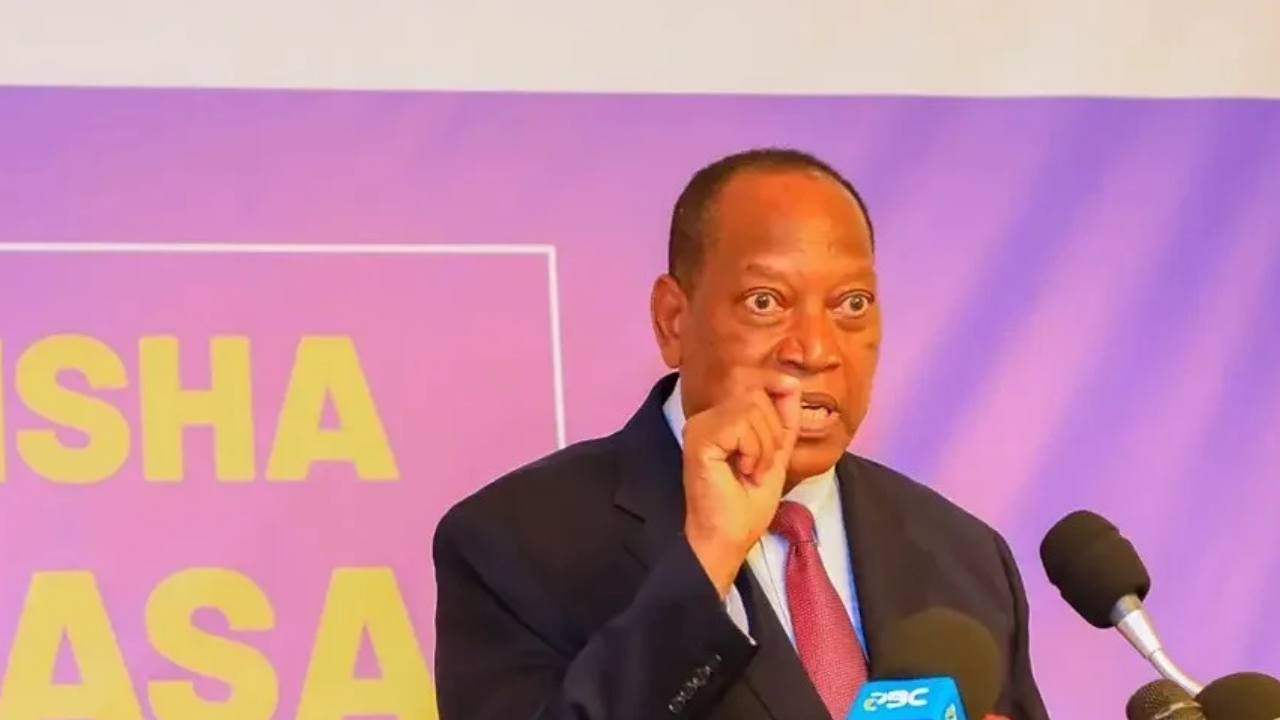

Dar es Salaam – The Court of Appeal has confirmed that a five-year renewable term imposed on Tanzania’s Controller and Auditor General was unconstitutional and that Professor Mussa Juma Assad was unlawfully removed under it in 2019, in a ruling that strengthens the security of tenure of the office responsible for auditing public money.
The five-judge court dismissed both an appeal by then-ACT-Wazalendo leader Zitto Kabwe, who sought further relief for Assad, and a government cross-appeal against the High Court’s constitutional findings.
It nevertheless held that Charles Kichere’s appointment as CAG remained valid, refusing to reinstate Assad or grant compensation.
In Zitto Zuberi Kabwe v President of the United Republic of Tanzania and Others, delivered on October 6, the Court of Appeal considered section 6(1) of the Public Audit Act, which gave a CAG a fixed five-year term, renewable once.
The provision operated alongside section 6(2), which said the office-holder would vacate office at 65 unless a removal question was under investigation.
The court found that Parliament could set a retirement age under Article 144(1) of the Constitution, but not create a separate fixed-term regime.
“The key criterion in the constitutional provision is age,” the judges said, adding that Parliament was “empowered only to prescribe age, not to introduce an entirely new regime of fixed terms.”
READ MORE: Court Rules Magufuli’s Dismissal of Assad as CAG ‘Unconstitutional’
Article 144 allows removal before retirement only for inability, misbehaviour or breach of public-leader ethics, following a special tribunal process.
The Constitution also says the CAG must not be obliged to follow directions from another person or government department when carrying out constitutional audit functions.
The decision upheld the High Court’s 2022 ruling that the fixed term conflicted with those safeguards. Assad, appointed in 2014, was removed on November 3, 2019, before he reached the statutory retirement age of 65, and Kichere was appointed the following day.
The appellate court said the fixed-term provision was adopted with legitimate institutional and international considerations in mind, but its use to end Assad’s tenure did not fit any of the constitutionally prescribed removal criteria.
It noted that the constitutional protection was intended to secure the CAG’s ability to perform duties without fear of arbitrary dismissal or political interference.
The ruling rejected the government’s argument that the removal should stand because the law had not yet been declared invalid at the time.
READ MORE: Former CAG Assad Weighs In On DP World Deal: ‘Long Overdue’
Although the court accepted that acts under a law presumed valid may sometimes be left undisturbed, it held that doing so here would legitimise unconstitutional interference with the tenure of a constitutional office-holder.
Declaration without restoration
Mr Kabwe’s appeal centred on the consequence of that conclusion. He argued that, if Assad’s removal was unlawful, the appointment of Kichere should also fall and Assad should be restored to the office he would otherwise have held until retirement.
The Court of Appeal disagreed. It held that the legality of Kichere’s appointment under section 4 of the Public Audit Act had to be assessed separately from the unconstitutional fixed-term provision, and said the invalidity of Assad’s removal did not itself invalidate the later appointment.
“Reinstatement is legally impracticable where another person has already been validly appointed under a subsisting law,” the judgment said.
The court found that restoring Assad would create “dual incumbency” in a single constitutional office and undermine continuity in public-finance oversight.
It also declined compensation. The court said constitutional litigation is ordinarily intended to vindicate the Constitution and deter future violations, rather than compensate an individual for loss of office, because a constitutional breach harms society as a whole.
READ MORE: CAG: We’re Investigating Plea Bargaining, Report Out In March 2023
That reasoning led the court to dismiss Kabwe’s appeal while also rejecting the government cross-appeal. It made no order as to costs, describing the matter as public-interest litigation.
In a statement he shared with The Chanzo on October 7, Mr Kabwe welcomed the court’s constitutional findings but criticised its refusal to give Assad a remedy.
“The judgment protects future holders of the office but leaves Professor Assad’s harm without an effective remedy,” he said, adding that he had instructed his lawyers to consider other available remedies.
Kabwe said the decision establishes that a president cannot remove a CAG simply because a five-year term has expired. The Court of Appeal’s judgment itself does not order Assad’s return to office, annul Kichere’s appointment or award Assad damages.
The court separately rejected Kabwe’s complaint about remarks attributed to former President John Magufuli at Kichere’s swearing-in.
It said Kabwe had not supplied cogent evidence that Magufuli made statements undermining the CAG’s constitutional independence, and that newspaper cuttings were insufficient proof.
Institutional independence
The CAG is constitutionally charged with authorising and auditing public expenditure and reporting on government accounts.
Audit reports are submitted to the President and must then reach the National Assembly under the constitutional timetable, with a route to the Speaker if that does not happen.
READ MORE: Audit Reports Put Follow-Through at Centre of Tanzania’s Accountability Debate
Assad’s removal followed a period of public controversy over his audits, including his 2018 reporting of a Sh1.5 trillion difference between revenue collected and funds released by the Treasury for government expenditure.
The previous High Court ruling in 2022 had already declared his removal unconstitutional but declined to invalidate Kichere’s appointment, prompting the appeals resolved this week.
In a 2023 interview with The Chanzo, Assad described the office’s independence in similar terms, saying: “In that position, I was not anyone’s employee.”
He added that the Constitution barred a CAG from taking orders or directives from any public official or government department.
The Court of Appeal’s decision does not change the current office-holder, but it gives an appellate interpretation of the constitutional limits on a CAG’s tenure.
Its practical effect is to remove the five-year renewable-term basis that had been used in Assad’s removal and to confine any future early removal to the constitutional grounds and tribunal procedure.