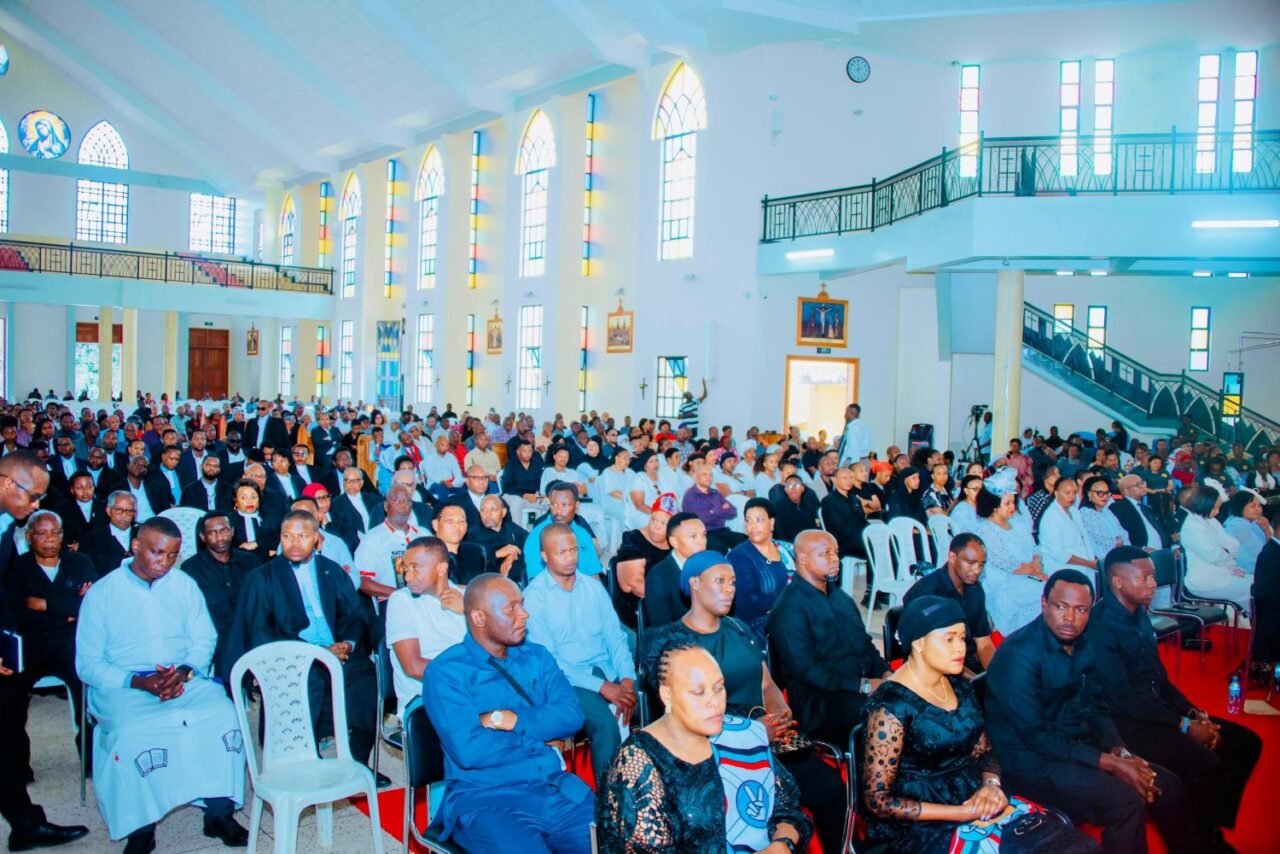

Dar es Salaam– As the judges read their ruling in the treason case against Tanzanian opposition figure Tundu Lissu on November 6, 2026, he sat relaxed, at times tapping his papers as if playing a piano. As usual, whenever he made eye contact with members of the public in the gallery, he would smize or nod to acknowledge their presence. When the judges concluded that he was not guilty of treason, Lissu leaned back in his chair and listened to the “but” that followed: the court found him guilty of incitement.
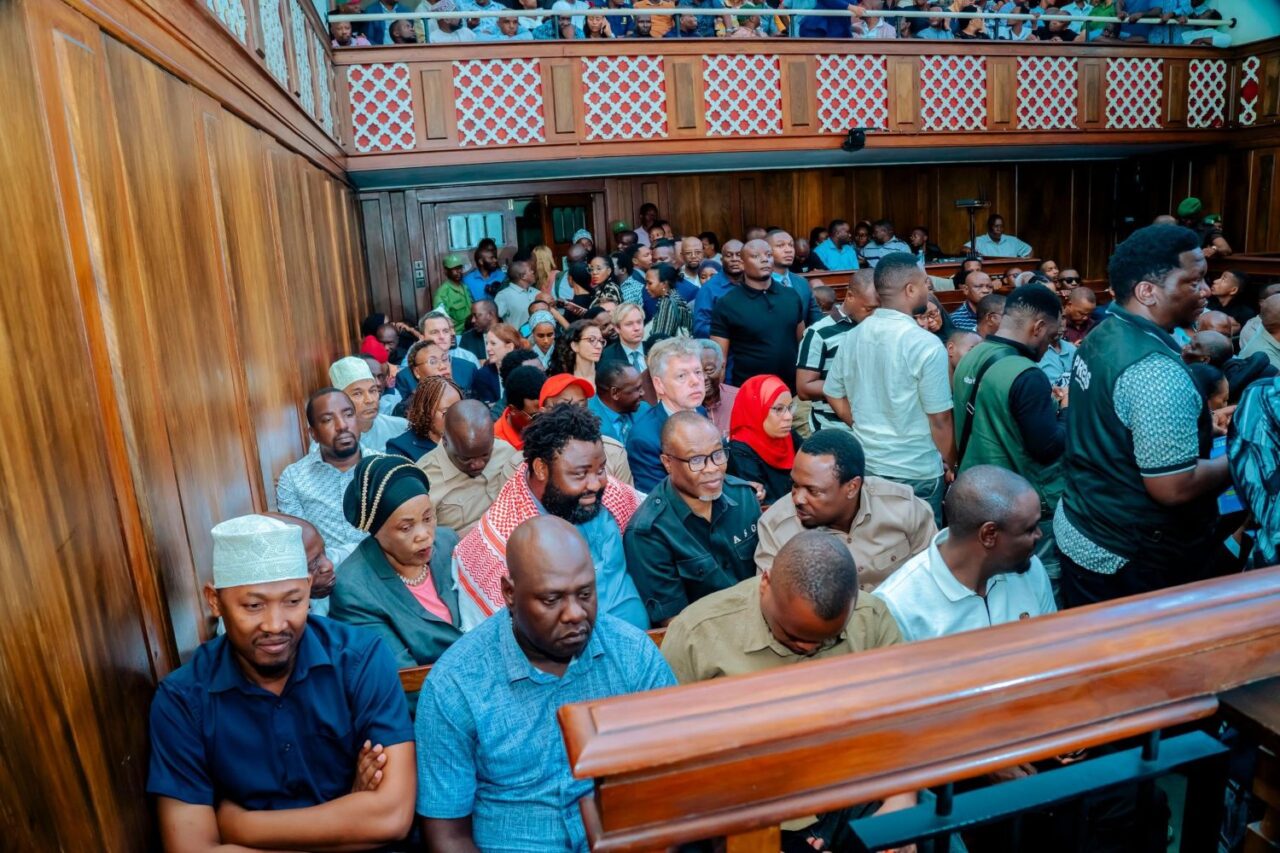
As Judge Dunstan Ndunguru read the ruling, notes passed back and forth between Lissu and his lawyers, some of whom had to stand because the small High Court venue, which holds fewer than 150 people, was packed beyond capacity. When Judge Ndunguru finished reading the guilty verdict, and before sentencing, both the prosecution and the defence were allowed to address the court. The prosecution, led by State Attorney Nassoro Katuga, asked for a severe sentence and spent time linking Lissu to the crisis surrounding Tanzania’s 2025 election, in which at least 518 people were killed.
When it was Lissu’s turn, he asked the judges to allow him to consult his lawyers, who gathered around the dock, engaging with him and handing him notes.
“After seeing that he had been convicted in the incitement case: because he was in the dock, he had no means of accessing TanzLII to look up cases, so he couldn’t offer any guidance from there. So we wrote him a little note asking him to request a break from the judges so he could consult with his lawyers,” Jebra Kambole, one of Lissu’s lawyers, told The Chanzo. “When he wrote back to us, he replied that fine, he would ask. And when he asked, all of us lawyers passed on to him what we thought he ought to say.”
The consultation lasted less than ten minutes. It was noted that the strategy behind his mitigation was both technical and political. The political element had been settled before the consultation: Lissu had already confided to his lawyers that even if he were sentenced to death, he would face it defiantly.
“I visited him on the Monday before Friday’s ruling, and he said, ‘Even if they sentence me to hang, it won’t be easy. I have to speak.’ He had already prepared himself so that, in case they found him guilty, he would say what he believed to be right,” Kambole said, explaining the thinking behind Lissu’s nearly hour-long speech after the verdict.
During the consultation, Lissu told his lawyers he would speak his mind and set the record straight on the political dimension of the trial, while his lawyers insisted that he also put all key mitigating factors on the record for the appeal process.
“He listened to everyone’s ideas, with one person putting forward the mitigating factors that the court usually takes into account. But because he is a politician, he knew that if he presented those mitigating factors without speaking the truth that was in his heart, he would not be at peace, so he said, Let me speak my mind,” Kambole explained.
Legal analysts note that Lissu’s mitigation speech had two distinct parts: the first political and the second technical. He delivered it pacing from one side of the dock to the other, much as he does at campaign rallies. This was a departure from his past submissions, in which he focused on making eye contact with the judges and tried to stay as still as possible. This time, it was as if the courtroom audience mattered as much as the judges on the bench in what he wanted to communicate. For most of the speech, the three judges were writing and hardly made eye contact with him as he addressed them.
Speaking to The Chanzo, his lawyers explained why they had insisted on the technical part of the speech.
“We, however, kept insisting that he had to put these mitigating factors on record, because when the case goes to the Court of Appeal and you say the judges didn’t consider this or that, they’ll ask us, ‘Did you tell them?’ That’s why he said everything he said, and then stated that what he was about to say should not be taken as an admission of guilt,” Kambole told The Chanzo.
Tundu Lissu was sentenced to four years in prison, with the court noting that he has the right to appeal. According to the party’s lawyers, Lissu has authorised them to proceed with an appeal, which will be led by Dr. Rugemeleza Nshala. Lissu has received copies of the notice of appeal and the court’s judgment.
Read Tundu Lissu’s full mitigation speech below, taken from our reporter’s notes:
Honorable Judges, thank you for the opportunity to speak. I ask that you listen to me as carefully as you have listened to me for more than a year, and that you record this well, just as you have recorded the proceedings of this Court.
Honorable Judges, today is my 577th day in prison. 577 days in prison for being called a traitor. Called a traitor, for an offence that under our country’s Constitution is the gravest offence in the United Republic. It is the only offence named in the Constitution: treason.
For 577 days I have been called a traitor, for an offence which, under the section I was charged with, Section 39(2)(d) of the Penal Code, can carry the death penalty.
After 577 days of that dark cloud of the death penalty hanging over my head, today, Honorable Judges, you have called me an inciter, an offence that does not even carry a prescribed punishment.
You have called me an inciter, and the Principal State Attorney is scrambling to work out what the punishment for it should be. What does that mean, Honorable Judges? The offence I was charged with was not an offence, and today you yourselves have said so. It was not an offence, and today, Honorable Judges, you have said it yourselves: it is not an offence.
So I spent 577 days [in remand] without having committed any offence. Honorable Judges, your statement that it was not an offence agrees with my position and my evidence that there was no offence at all. You have agreed with me.
There is one thing you have not said, and I will say it for the record, Honorable Judges. I have said all along, and my evidence has proven this, that this was nothing but a political case. Turning the court into a political battleground, turning a criminal court into a political battleground: your judgment has proven this. It is political persecution.
Because it is political persecution, petty reasons have to be manufactured to lock up this political adversary of ours. Petty reasons, excuses, have to be found to lock up this political opponent. And those petty reasons, Honorable Judges, are the offence of incitement, which you, Honorable Judges, have manufactured. I was never charged with it at all. I was not charged with incitement. Apart from treason, I was charged with spreading false information, and that has been forgotten. Honorable Judges, you went looking for an offence that did not exist at all.
And Honorable Judges, with all due respect, you have done this for political reasons. Because of political instructions: ‘He is not guilty, but he must not simply be released and walk away thinking he has won. The government will be embarrassed. The one who appointed us as judges will be embarrassed. So find some petty reasons.’ That is what you have done today, Honorable Judges. And I know you already have a sentence. You have already agreed on the sentence, I know it, I feel it in my heart. So, very unfortunately, Honorable Judges, you have done what the High Court of Kenya did in 1954 in the case of Mzee Jomo Kenyatta and his six co-accused, the Kapenguria Six. In 1954, the High Court of Kenya, in the case of Mzee Jomo Kenyatta and the Kapenguria Six, convicted Mzee Kenyatta even though it was known, and history has confirmed, that he was not guilty of anything. It was a way of crushing this great opponent of the colonial government. That is what you have done today, Honorable Judges.
History has not been very kind to judges who have turned their courts into places for punishing the innocent in order to please those in power. History has never been kind to those judges, because I believe I am someone you know is innocent, and the world knows is innocent. Now, Honorable Judges, the innocent, like me, do not ask for forgiveness. You ask for forgiveness if you are guilty, if you have done wrong. You don’t beg for mercy when you are innocent; you don’t ask for forgiveness when you know you are not guilty.
So, Honorable Judges, I want to be very clear: what I am about to say must not be taken in any way as asking for forgiveness. I am not asking for forgiveness, because I am completely innocent. But since the Principal State Attorney has said what he has said, allow me to respond to him, and then you can judge whether that is mitigation or not.
First of all, the Principal State Attorney has said that under Section 35, for which he has asked for a severe sentence, the maximum punishment is five years’ imprisonment, or a fine, or both.
Now, Honorable Judges, when the law provides a punishment of that kind, imprisonment or a fine or both together, what is the court required to do? The case of Salum Shabani v. Republic, [1985] Tanzania Law Reports 71. In that case, Honorable Judges, this Court said that where Parliament has provided the option of a fine or imprisonment, the sentencing court must first impose a fine. It must impose a fine first. So as you consider the severe sentence requested by the Principal State Attorney, Honorable Judges, do not forget that the legal position says you should impose a fine first.
Other cases affirming that position, Honorable Judges, are Alice Nyawira Nungu v. Republic, Criminal Appeal No. 40 of 2022, reported in TanzLII 2022, 11653. And the second case, Honorable Judges, Elias Ndikumana v. Republic, Criminal Appeal No. 39 of 2022, reported in 2020 TanzLII 11656, and many other cases, Honorable Judges, which I am sure you are familiar with. So the first issue is that the option of a fine must be taken first.
Now, Honorable Judges, there are things the Principal State Attorney has said in which he has turned himself into a witness rather than the Principal State Attorney. He spoke of incitement offences having become very numerous in this country, according to police reports and according to a speech by retired Chief Justice Mohamed Chande Othman. And if I have understood the Principal State Attorney correctly, he is essentially saying that the violence of October 2025 resulted from my statements, if I have understood him correctly.
Honorable Judges, in this case I am not sure you were presented with any evidence of retired Chief Justice Mohamed Chande Othman’s speech. It is not in the evidence in this case. Retired Chief Justice Mohamed Chande Othman did not come here to testify and establish which politicians’ statements caused that violence. You are being told, Honorable Judges, to give me a severe sentence for an offence which, if it exists, took place some six-odd months after I was arrested. It took place more than six months after I was already in remand.
You are being told to punish me for what happened six and a half months later. If you accept that invitation, Honorable Judges, it will be further proof that this is a decision made on instructions. Many cases, many incidents of incitement: how many, where did they happen, who committed them? The Principal State Attorney wants you to believe social media gossip. If you accept it, Honorable Judges, it will be further proof that these are orders.
Now, Honorable Judges, the Principal State Attorney also told you that at present they have no information on whether this is my first offence or not. That implies I may have other previous convictions. Honorable Judges, since he is not certain, I will tell you something certain. I have never ever been convicted of a criminal offence, ever in my life. I have never been found guilty of anything in my life. Never.
As I said in my evidence, they have charged me, Honorable Judges. They have charged me for 24 years, since 2002, and they have never once secured a conviction against me. So when you consider what sentence to give for this thing you call an offence, as you deliberate on the sentence, do not forget that you are sentencing a person who has never been convicted. Ever.
Honorable Judges, I trust you know that I am in deep mourning. I am in deep mourning for the person who made me a lawyer, the person who made me the person I am, the person who raised me. I was hoping that, since I did not get the chance to nurse him in his illness, the Court would see the truth that there is nothing in this case and let me go and bury Mzee Alute. That is what I was hoping. To go and bury my brother. I was hoping that.
It appears, Honorable Judges, that this is not part of your calculations. I ask that when you consider this severe sentence, you consider that too. Family obligation is a factor in sentencing. This man has suffered a bereavement. Actually, the whole world knows it; the newspapers write about it every day. I was hoping, and I hope you will consider it, that I need to go and fulfil the duty of burying the one I was unable to nurse, the one who raised me.
So today it has been a year and seven months, 577 days, that I have been in prison. When you consider the severe sentence to impose, do not forget that I have already spent a year and seven months in prison for an offence you yourselves have said is not an offence. And do not forget, Honorable Judges, what a panel of three of your fellow judges said: Justice Mruma, Justice Dr. Longopa and Justice Dr. Rumisha, regarding what was done to me in prison. For a year and seven months I have been denied the opportunity to communicate with my lawyers. I have been denied the opportunity to communicate with members and fellow leaders of the party called CHADEMA. I have been denied the opportunity even to pray to God, even to worship. For a period I was held together with death-row inmate while I was a remand prisoner. And those judges said that what was done in prison denied me the right to prepare properly to fight these lies brought by the government to court. They said I was denied the opportunity to defend myself, the constitutional right to defend myself. Do not forget that when you consider the severe sentence you are being asked to impose.
Honorable Judges, I am a good citizen of this country, a patriot of this country. I have served this country as a Member of Parliament elected by the people twice. I have served this nation. I went to the army. I have been President of this country’s bar association. I am not a noise maker like the one these State Attorneys describe. I am not a noise maker, a petty agitator. I am a solid patriot. That is why you see the ambassadors here today, and they have been here every day, and the whole world out there is saying that what is happening is a travesty of justice. The entire world is saying that, because they know I am a true patriot; they have seen it in this country. And that, Honorable Judges, when you consider the sentence requested, which is severe, do not forget.
Honorable Judges, prison is not a very nice place, and I can say so because I have lived in prison for the past 577 days. I stay in a room six by six, six metres by six, like this dock. That is where I have lived for a year and seven months. It is not the Sheraton. You can say ‘lock him up’ if you don’t know what prison is. Now, Honorable Judges, I say this because I am not in very good health. In this body of mine, Honorable Judges, I have had 25 operations, surgeons’ knives. I walk around with a bullet in my body. Of the 16 that entered my body, they were unable to remove one, so I walk around with a bullet in my body.
I am supposed to be going to hospital in Belgium, the University of Leuven hospital where I was treated after what happened to me nine years ago. I am supposed to go every six months, and I have already missed four appointments because of this case. On top of all that, Honorable Judges, I have diabetes; this is the sixth year. So when you deliberate on the severe sentence requested, do not forget that too: my health is not very good.
Honorable Judges, the offence of incitement, the last time I checked, is a bailable offence. It is bailable. If it pleases you, Honorable Judges, grant me bail so that I can appeal this decision of yours while out on bail, but more importantly, so that I can bury the one who lies [awaiting burial]. That I ask of you. I said I had no intention of asking for anything, [but] bail I do ask of you.
Honorable Judges, this decision to convict me of an offence I was not charged with, that I did not defend myself against, an offence manufactured “to strike a balance”: its effect, and perhaps this is exactly what is being sought, is to provide a kind of political cover for people who have committed mass killings of Tanzanians. You have given them a reason to go out and say, ‘Ah, those who incited it have already been found guilty.’ You are covering mass murderers.
The government of this country has never killed as many people as Samia’s government killed last year. The last time there was a mass murder was 120 years ago, during Maji Maji. These mass murderers, not one of whom has been held accountable, will celebrate this decision greatly, because you have given them standing to say that the culprit who caused the events of October has been found guilty. That will not cover it up. These mass murderers will be held accountable someday. If you think it will help them, it will not. Mwalimu Nyerere’s government killed 37 people in 1976. Mwinyi was Minister for Home Affairs and he resigned. Peter Syovelwa was Minister for State Security and he resigned. Elango Shahidi was IGP and he resigned. Peter Kisumo was Regional Commissioner of Shinyanga and he resigned. And Jacob Kasubi was Regional Commissioner of Mwanza and he resigned. They resigned; the government had killed 37 people.
Today the government has killed at the very least 518 people, and not a single person has been held accountable. Your decision will not hide that scandal.
Let me remind you, Honorable Judges, that under the Court’s sentencing guidelines, for an offence with the option of a fine, item 1.3.1 of the guidelines requires a fine to be imposed unless the offence is serious, a grave offence. Incitement, which I am charged with, is not a grave offence. The offence itself does not even have a punishment.
So, Honorable Judges, I close by saying this: deliver the sentence you already have, the one you have been instructed to deliver. Thank you very much.