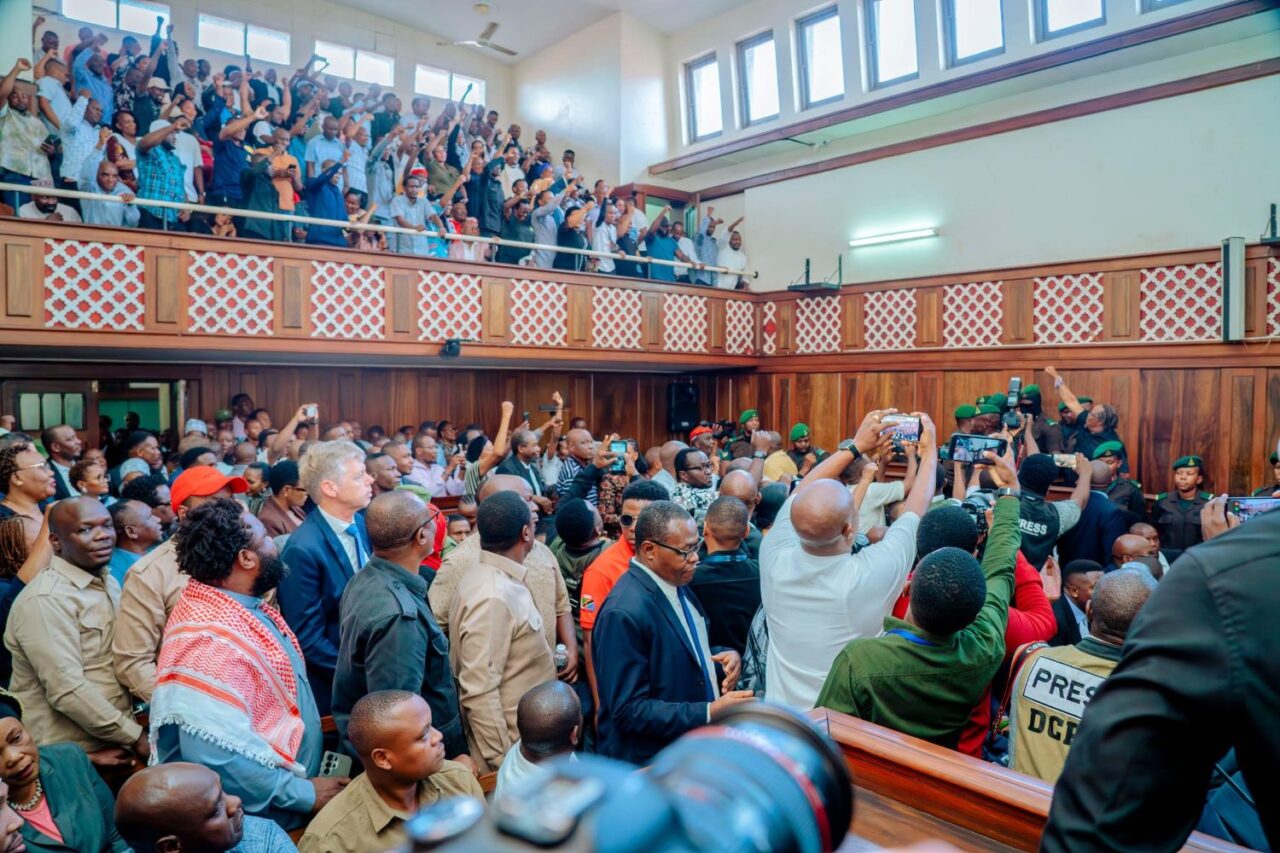

Dar es Salaam – CHADEMA national chairperson Tundu Lissu has filed a notice of appeal challenging his incitement conviction and four-year prison sentence, beginning his challenge to the High Court’s decision after prosecutors failed to prove treason.
The filing coincided with a farewell Mass for his elder brother, Alute Mughwai Lissu, at St Theresa’s Catholic Church in Arusha on November 9. Relatives read a tribute Lissu wrote from prison, remembering Alute as a brother, mentor, and legal adviser who kept helping with his defence despite deteriorating health.
The notice, dated November 7, bears a Court of Appeal registry stamp showing it was filed on November 9. Its second page records lodging at the High Court’s Dar es Salaam Sub-Registry on the same day, alongside a National Prosecutions Service receipt stamp.
“The appeal is against the conviction and sentence,” the notice states. It also says Lissu intends to attend the appeal hearing.
Advocate Rugemeleza Nshala signed the document, which specifies that he was retained only to prepare the notice. It identifies the High Court judgment delivered on November 6 in Criminal Session Case No. 000019605 of 2025 as the decision being challenged.
READ MORE: The Road to November 6: Tundu Lissu’s Treason Trial in Dates
The notice does not set out a full memorandum of appeal or an appeal hearing date. It is not an order overturning the conviction, suspending the sentence or releasing Lissu.
Disputed conviction
The notice’s account highlights the High Court’s replacement of treason with incitement. It says the trial court made that finding on its own initiative and asserted that Lissu had received sufficient notice of the altered charge while presenting his defence.
The prosecution arose from an April 3, 2025 address in Dar es Salaam during CHADEMA’s No Reforms, No Election campaign. Lissu maintained that his remarks sought constitutional and electoral reforms, rather than intimidation of the government.
The three-judge panel led by Judge Dunstan Ndunguru found that prosecutors had not established the intention required for treason. It nevertheless convicted him under section 390 of the Penal Code, invoking the Criminal Procedure Act’s power to convict for a lesser, related offence even where it was not separately charged.
The judges held that the original charge and trial evidence had given Lissu an opportunity to answer the incitement allegations. Lissu disputed that conclusion at sentencing, saying he had not been charged with incitement and maintaining his innocence.
READ MORE: Tundu Lissu Cleared of Treason But Jailed for Four Years for Incitement
The written judgment acknowledges that he was a first offender, had diabetes and had spent 577 days on remand. The court considered a fine but chose imprisonment, reasoning that his statements encouraged disruption of the election and infringed other people’s right to participate and vote.
At sentencing, Lissu also requested bail pending appeal, including to attend Alute’s funeral. The proceedings ended without an announced grant of bail.
“Because I could not nurse him, I had hoped that I would get an opportunity to bury Mzee Alute,” Lissu told the judges.
Brother’s farewell
Alute died on November 1 after a long illness. The family tribute says he had turned 72 two days earlier and leaves five children and five grandchildren.
His burial was scheduled for November 10 in Mahambe village, Singida. The November 9 service in Arusha brought relatives together at the church that, according to the tribute, had been central to his family life for decades.
READ MORE: Tanzania Defends Secrecy on Election Violence Report at UN Rights Review
Vincent Lissu began reading the tribute, titled A Brother to Be Proud Of, an Exceptional Human Being, before other relatives continued. Its words traced a relationship extending beyond kinship into professional guidance and political discussion.
Lissu recalled moving to Arusha to attend Ilboru Secondary School in 1984, when Alute was beginning work in the Attorney General’s office. He described the period as the start of a lifelong friendship and mentorship, with the elder brother already a childhood role model.
“He never made a promise that he did not intend to keep,” Lissu wrote in the tribute, describing Alute’s personal and professional integrity.
Alute’s contribution to the treason defence continued even when illness prevented him from travelling from Arusha to Dar es Salaam. According to the letter, he prepared a ten-page analysis called Rough Notes on Tundu Lissu’s Final Submission.
Lissu quoted Alute’s assessment: “This case was conceived with ill intent. Its investigation was conducted poorly, and the prosecution was pursued with great force but poor quality.”
READ MORE: Foreign MPs Demand Lissu Fair-trial Guarantee as Police Warn of Disorder Ahead of Friday’s Verdict
That, however, remains Alute’s criticism of the prosecution, as recalled in his brother’s tribute. The High Court’s finding was that treason had not been proved, but that the evidence established incitement, the conviction Lissu now challenges.
Last exchange
The tribute also recalled the brothers’ final communication on October 27, when Lissu says he began a hunger strike to secure implementation of an order allowing confidential meetings with legal advisers.
The October 16 High Court ruling required Ukonga Prison to permit consultations within officers’ sight but beyond their hearing. It found that officers had unlawfully listened to meetings between Lissu and two advisers.
Alute responded to the hunger strike with an unusually stern message, delivered through their brother Ikoti. “Go and tell him that the struggle for the rule of law needs him alive, not dead,” Lissu recalled him saying.
Alute threatened to hold a press conference opposing the strike if Lissu persisted, not because he opposed his cause, but because he would not remain silent while his younger brother risked his life without certainty of success.
READ MORE: Kenya Police Chief Denies Holding Mwaipaya, But Court Still Has No Answer on Where He Is
According to the tribute, prison authorities had agreed to Lissu’s demands by the time the message reached him. He replied jokingly that matters had been resolved, but asked Alute to apologise for his stern warning.
“Those turned out to be our last communications,” Lissu wrote.
The remembrance also portrayed Alute as an avid reader, poet, skilled footballer and committed Catholic, whose Arusha home offered younger relatives a place to stay and whose support helped pay for their education. Lissu described his generosity through the Kiswahili saying that giving comes from the heart, not wealth.
“He gave because his heart was full of generosity, not because he was rich in possessions,” he wrote.