
For a considerable period, Gross Domestic Product (GDP) has been treated as the definitive measure of economic performance. Yet a growing number of economists question whether it truly reflects what is happening in the real economy—or in the lives of ordinary citizens.
This debate was recently revived by Zitto Kabwe in an article published on this platform. Kabwe argues that Tanzania should look beyond GDP and track indicators of real economic activity to better understand how the economy is actually performing.
To address this gap, he proposes what he calls a “Real Economy Index” (REI). The idea draws inspiration from an approach attributed to former Chinese Premier Li Keqiang, who reportedly suggested that provincial economic performance could be assessed using three indicators: electricity production, railway freight, and bank lending.
According to this view, official statistics such as GDP growth were considered “man-made” and useful only “for reference.”
Premier Li Keqiang’s assertion was reported by The Economist in 2010 and later became known as the Li Keqiang Index. Since then, several economists and analysts tracking China’s economy have used variations of this model.
Kabwe argues that Tanzania should track a similar Real Economy Index alongside GDP to better understand what is actually happening in the economy. Applying Li Keqiang’s indicators, he suggests that Tanzania should focus on three key drivers of economic activity: electricity, logistics, and productive credit.
READ MORE: Electricity, Freight and Credit: The Real Deal
Need for careful examination
However, Kabwe’s proposal requires careful examination before concluding that it can effectively diagnose the real challenges facing Tanzania’s economy or guide policy priorities.
To explore this question, I examined official statistics using Li’s three indicators: electricity, freight, and credit. For freight, I used transport and storage activity as a proxy, since railway cargo alone is too small to adequately capture the movement of goods in Tanzania.
I analysed data from 2009 to 2024, assigning weights of 40 per cent to electricity, 40 per cent to freight, and 20 per cent to private-sector credit. The results are shown in the chart below:
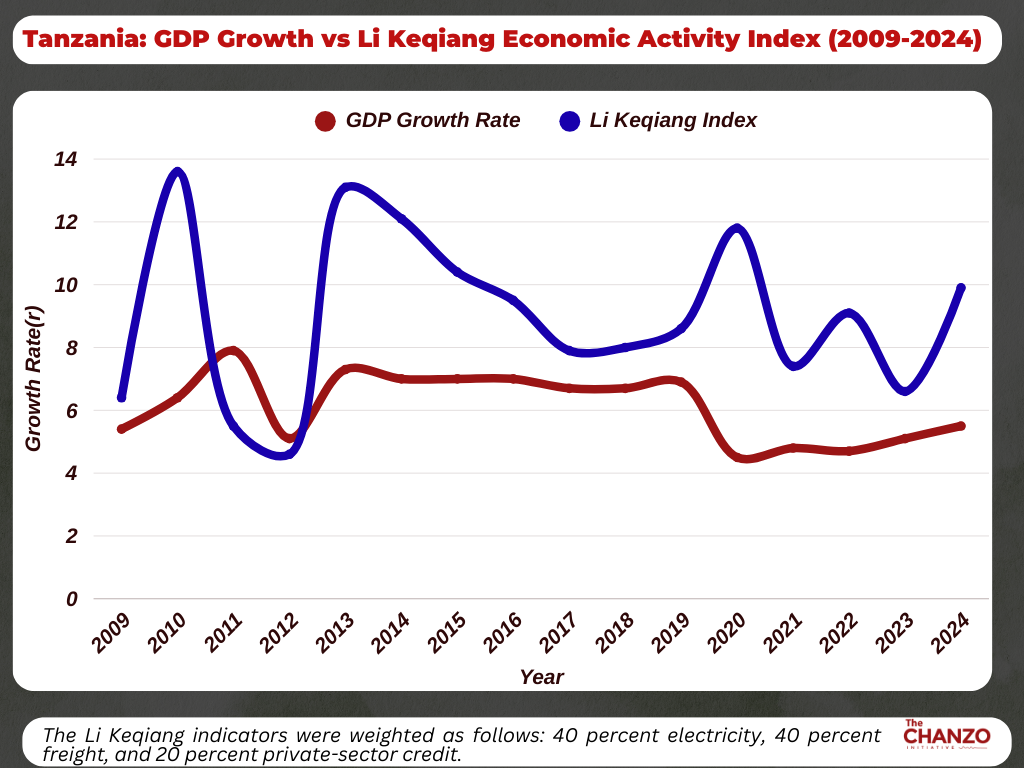
The analysis suggests that the Li Keqiang Index—or, in this context, the Real Economy Index—and Tanzania’s GDP growth generally move in the same direction, although the relationship is not particularly strong. GDP growth appears smoother, while the Real Economy Index fluctuates more.
This finding leads to an important conclusion: the Real Economy Index may suffer from limitations similar to those of GDP when it comes to capturing the deeper dynamics of the economy.
READ MORE: Why Tanzania’s Location Is Its Untapped Goldmine
This is not surprising, since both indicators rely heavily on measures of economic output. As a result, they may fail to reveal structural weaknesses within the economy. An economy may appear to be growing while underlying problems persist, preventing the country from achieving its broader development goals.
Two fundamental conditions
To be clear, material production and output growth remain essential components of the real economy. However, for economic growth to meaningfully improve people’s lives, the structure of the economy must ensure two fundamental conditions.
First, the economy must increase the productivity of the main forces involved in material production. Second, the structure and direction of development should be driven largely by internal productive forces rather than external factors.
These two aspects deserve careful attention when tracking economic performance. Measuring them would help us understand the economy’s ability to generate income from its inputs—primarily labour supplied by its people and capital in the form of land, machinery, and infrastructure.
Furthermore, when productivity growth is driven by domestic productive forces, it increases the likelihood that economic gains will be broadly distributed across the population. Under such conditions, both GDP growth and the Real Economy Index would more accurately reflect improvements in the real economy.
Consider Tanzania’s recent economic performance from 2000 to 2023. Real GDP has grown at an impressive average of around 6 per cent annually, although still below the country’s long-term targets. This growth has been accompanied by a significant rise in gross fixed capital formation, whose share of GDP increased from roughly 19 per cent to about 43 per cent.
However, when we examine productivity, the picture becomes more concerning. Recent studies indicate that Total Factor Productivity (TFP)—a key measure of economic efficiency—has declined significantly.
Its contribution to real GDP growth fell from 1.6 percentage points in the early 2000s to –0.1 percentage points in the 2010s, and further to around –2 percentage points in the 2020s.
Some challenges
This suggests that economic growth has increasingly relied on adding more inputs rather than using existing inputs more efficiently. Such a pattern can create challenges for income distribution if productivity improvements remain weak.
The situation is particularly evident in the agricultural sector, which employs about 65 per cent of Tanzania’s labour force, with the majority being smallholders. Approximately 70 per cent of the food that feeds Tanzania’s population of 60 million, as well as a significant amount of food exports, comes from smallholder farmers, who often operate under conditions of low productivity and low income.
READ MORE: Africa’s Gas Giant Sleeps While the World Burns
This suggests that agricultural output is sustained more by the sheer volume of labour and land used than by improvements in productivity.
If productivity among smallholder farmers were significantly improved, the benefits would directly reach the majority of the population. Such improvements would not only raise incomes but also generate stronger output growth—reflected both in GDP statistics and in indicators such as the Li Keqiang Index.
Ultimately, the challenge for Tanzania is not simply measuring economic activity more creatively, but transforming the underlying productive structure of the economy.
Only then will the indicators we use—whether GDP or a Real Economy Index—accurately reflect genuine economic progress.
Joel Ntile is a writer and co-founder of The Chanzo. He can be reached at joel@thechanzo.com or @JoelNtile on X. These are the writer’s opinions and do not necessarily reflect the viewpoint of The Chanzo. Want to publish in this space? Contact our editors at editor@thechanzo.com.


One Response
Thank you Joel. Your alternative is view is Real Economy.