
Dar es Salaam-The High Court of Tanzania, Dar es Salaam Sub-Registry, remained the venue for argument over the limits of the rights of advocates William Maduhu, Nashon Nkung and Paul Kisabo, and over the conditions under which they communicate with their client, Tundu Lissu, as the three lawyers gave evidence in a constitutional petition alleging that they are denied privacy when they visit him in prison.
On the second day of the hearing, on July 21, 2026, a panel of three judges, Amir Mruma, Dr. Angelo Rumisha and Dr. Evaristo Longopa, continued to hear evidence from the applicants. Lissu, who is among the respondents in the case, was one of those cross-examining the witnesses.
The first day of the hearing, on July 20, 2026, saw advocate William Maduhu give his evidence and face cross-examination from Lissu and from the State Attorney. On Tuesday, July 21, 2026, two further witnesses, Nashon Nkung and Paul Kisabo, described the conditions they say they encountered while visiting Lissu at Ukonga Prison.
In his evidence on the first day, Maduhu broke down in tears after describing how he was denied the chance to speak to Lissu because of his skin condition, albinism. He said that of Lissu’s three lawyers, he had been granted the fewest opportunities to see their client, and that there were occasions when he arrived alongside colleagues who were allowed in to see Lissu while he was turned away.
Tuesday’s evidence turned on the situation in which the lawyers communicate with Lissu inside the prison. The witnesses described prison officers stationed within earshot of their consultations and CCTV cameras installed in the room where they met their client, circumstances they said compromised the confidentiality of lawyer-client communication.
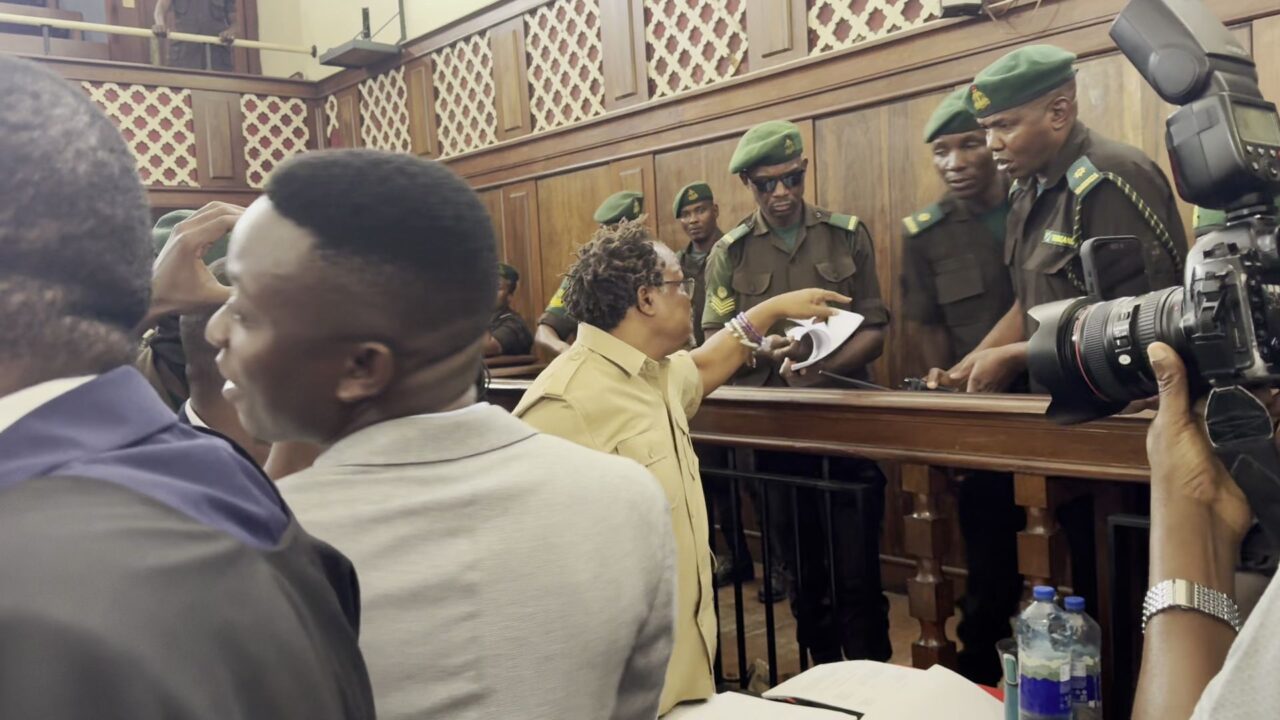
Lissu appeared in court in good spirits, his hair now growing out into what looked like the beginnings of dreadlocks. He went on into a lengthy exchange with his lawyer, Paul Kisabo.
Lissu: I will ask you about the period from June 16, 2025 to November 15. On June 16, at Kisutu, did I complain about my communication with my lawyers?
Kisabo: That is correct, and you said you were dismissing us from the case.
Lissu: After that, did the communication arrangements change?
Kisabo: That is correct.
Lissu: The arrangements changed and we began meeting at the admission office.
Kisabo: Yes, and they were listening to us.
Lissu: In the chair where the lawyer sits at the admission office, there is an officer taking notes. And many others are writing in that room, one from the legal section and one from security.
Kisabo: That is absolutely correct.
Lissu: And in that first room, where we speak by telephone, is it true that they supervise you and hear what you are saying on that phone?
Kisabo: That is correct.
Lissu: Is there a CCTV camera in that small room? When you speak with your client, is there any confidentiality at all?
Kisabo: There is no confidentiality, because they listen and monitor everything we do.
Lissu went on to question Kisabo about the application to him of the rules governing prisoners sentenced to death, referring to Regulation 33(1)(a) of the Prisons (Prison Management) Regulation, 1968. The regulation requires that a condemned prisoner be under the supervision of two officers at all times, day and night, and be given a special facilities to correspond with relatives, friends and legal advisers. It further requires that whenever a condemned prisoner receives a visit, two officers must be present to hear everything that is said.
Lissu: After November 15, 2025, the arrangement changed from the admission office to the office of the Deputy Officer-in-Charge of the prison, an office where the prison security officer is also present?
Kisabo: That is how it was.
Lissu: How many times have we met in the office of the Officer-in-Charge and spoken?
Kisabo: More than three times.
Lissu: When we met in the Officer-in-Charge’s office, were we alone?
Kisabo: The Officer-in-Charge was there, your guards were there, and other officers filled the room.
Lissu: It is true that you have never measured the size of the Officer-in-Charge’s office?
Kisabo: I have never measured it.
Lissu: So is it possible for them to hear, or not to hear, what we are saying?
Kisabo: They must hear us. They have heard us every time.
Lissu: Why do you say they hear us?
Kisabo: First, they are close to us and the room is small. There are moments when we laugh and they laugh, and moments when we are sad and they are sad too. That means they are following what we say.
Lissu: Let us turn to the exchange of documents. Is it true that you have brought me various documents concerning the case I am facing in the High Court?
Kisabo: That is true, but before we hand them to you they take them and read them.
Lissu: And by the time you leave, are they still holding them?
Kisabo: That is correct.
Lissu: Is it true that I have often complained to you that there are times I do not receive those documents?
Kisabo: You have complained very often. Even Justice Chande’s address on the report of the inquiry into the events of October 29, you have not received it to this day.
Lissu: Are you aware that the State Attorneys told the court they wish to introduce additional evidence linking me to the events of October 29?
Kisabo: That is true, and I brought you that document so that you could prepare your defence.
Lissu: Is it true that last month you brought me a document from the United Nations saying I should be released in this case?
Kisabo: That is correct. I brought it to you, but the admission officer took it, read it and passed it to others, after which they said they could not allow you to be given the document.
The United Nations document referred to is Human Rights Council Working Group on Arbitrary Detention-Opinion No. 74/2025, formally adopted at a session held from November 10 to 14, 2025, in which they stated that Lissu’s detention was arbitrary. The document expressed concern at the claim that Lissu’s right to meet his lawyers in private was not being observed.
“The source’s allegations that Mr. Lissu’s meetings with his lawyers take place in the presence of multiple prison officials, through an intercom that can be assumed to be monitored, and that all documents are read by prison officers, are serious violations of the right to confidential communication with counsel,” UN Working Group document noted.
“The Government’s general assertion that monitoring is “strictly limited to safeguarding security” does not address the fundamental requirement that lawyer-client communications be confidential,” it continued.
Speaking in court, Kisabo said other documents that have been withheld from Lissu included material concerning the Commonwealth, among them a statement associated with a call for Lissu’s release within 30 days.
Advocate Nkung, one of the applicants, said that during their consultations with Lissu there were more than four officers present in the room. He also said they had received instructions from some of the prison authorities as to what could and could not be discussed during their meetings, specifically, that they were not to discuss political matters, and in particular the case before the courts concerning the division of the party’s resources.
Constitutional Cause No. 7300/2026 was filed by advocates William Maduhu, Nashon Nkung and Paul Kisabo, who contend that the measures taken by the Ukonga Prison authorities have impaired both the discharge of their professional duties and their right to communicate in confidence with their client.
The respondents in the case include the Attorney General, the Commissioner General of Prisons, the Officer-in-Charge of Ukonga Prison, the Tanganyika Law Society, and Tundu Lissu, who has been joined to the proceedings in order to state his position on the allegations being made.
Cross-examining Lissu’s advocate, State Attorney Stanley Kalokola asked whether the complaints brought before the court had ever been raised with the senior prison authorities.
State Attorney Kalokola: Were you shown various recommendations by the Officer-in-Charge?
Kisabo: I saw them.
Kalokola: Ayone who can see can also hear?
Kisabo: That depends on the circumstances.
Kalokola: Have you ever tested the hearing of the prison officers at Ukonga so as to know whether they heard or did not hear?
Kisabo: When I arrive and speak to them, they answer me. If you say they cannot hear, then perhaps the problem is yours.
Kalokola: Now, the telephone communication in the room with the glass partition, you said it is possible for it to be listened to.
Kisabo: It is listened to.
Kalokola: You mentioned a recording device.
Kisabo: I do not know the device, but the telephone itself records. What other device do you want?
Kalokola: Are you aware that at Ukonga and other prisons there is an officer known as the Principal Officer, who is senior to the officers-in-charge?
Kisabo: That is not my concern as an Advocate.
Kalokola: Did you or did you not go and lodge your complaints with the senior prison officers?
Kisabo: I have already answered that question.
Kalokola: Does this court have the power to enforce the decisions of the UN working group? And the ruling of Justice Mkwizu, can it enforce that?
Kisabo: Why would it not be able to? If the matter is a legal one, it must be enforced.
Lissu has been held on remand at Ukonga Prison since April 10, 2025, facing treason charges. At various stages of the case he has told the court that he and his lawyers have faced obstacles in securing conditions for confidential communication.
The court is expected to continue hearing the petition on July 22, 2026, when a witness for the State, representing the first, second and third respondents, is expected to give evidence.