
Dar es Salaam-The constitutional case filed by Tundu Lissu’s lawyers over the denial of their client’s right to confidential consultation continued on July 22, 2026, its third day of hearing. Lissu cross-examined the Officer-in-Charge of Ukonga Prison, Andrew Shabani Ntamamiro. Much of the questioning centred on the procedures Ntamamiro administers, including his decisions on who is and is not allowed to visit Lissu.
Constitutional Case No. 7300/2026 was filed by advocates William Maduhu, Nashon Nkungu and Paul Kisabo, and is being heard before a three-judge panel chaired by Judge Amir Mruma and comprising Justice Dr. Angelo Rumisha and Justice Dr. Evaristo Longopa. The respondents are the Attorney General (first), the Commissioner General of Prisons (second), the Officer-in-Charge of Ukonga Prison (third), Tundu Lissu (fourth) and the Tanganyika Law Society, TLS (fifth).
Lissu opened his cross-examination by probing the legal basis of prison officers’ conduct. Citing section 105 of the Prisons Act, he established that the power to make regulations rests with the Minister, and, citing section 5 of the same Act, that the Commissioner of Prisons may set various procedures within the framework of the regulations made by the Minister.
Having established that prison procedure is grounded in regulations, Lissu turned to specific incidents and his own direct experience.
Lissu: Under those regulations, prisoners are divided into three categories, correct? Or would you like me to name them?
Ntamamiro: Name them.
Lissu: There are young prisoner, there are what are called star prisoners, and the third group is ordinary prisoners.
Ntamamiro: That is entirely correct.
Lissu: Those referred to as young prisoners are those under 21.
Ntamamiro: Correct.
Lissu: And star prisoners are first offenders, those who have committed an offence for the first time?
Ntamamiro: Correct.
Lissu: And ordinary prisoners are all the rest, those who fall outside the first and second categories?
Ntamamiro: Correct.
Lissu: Yesterday you heard State Attorney Kalokola speak of prisoners of political importance, or he said Prisoners of Security Importance. Does such a category exist under those regulations?
Lissu went on to ask the witness whether any Officer-in-Charge or the Commissioner of Prisons had the power to alter the regulations, including the classification of prisoners. Ntamamiro replied that no one has such authority.
Much of Lissu’s questioning was directed at showing how the regulations are not followed, based on his own experience in prison, while the State attorneys sought to show that they are. He began by expanding on the evidence given by his lawyers, naming various officers and placing them at his meetings with counsel, where he said they sat in and listened.
In their evidence, Lissu’s lawyers stated that the spaces in which they meet him afford no privacy, and that prison officers listen to everything, including taking notes of the conversations.
Lissu: Tell us, Officer-in-Charge of Ukonga Prison, do you have any hearing difficulties?
Ntamamiro: I am fine. I hear well.
Lissu: Assistant Commissioner of Prisons Recha, does he have any difficulty seeing or hearing?
Ntamamiro: I don’t know.
Lissu: What about ACP Mumbii, does he have hearing difficulties?
Ntamamiro: I am not a doctor. I don’t know.
Lissu: And ACP Mohamed?
Ntamamiro: I also don’t know whether he has hearing difficulties.
Lissu: What about Sgt. Hamisi, can he hear or not?
Ntamamiro: I don’t know.
Lissu: And Inspector Stima, the legal officer, can he hear?
Ntamamiro: I don’t know that either.
Lissu: And the three women who work in the admissions office, do they have difficulty hearing or seeing?
Ntamamiro: I don’t know.
Lissu: What about Corporal Dani, the one who keep the money, does he have hearing difficulties? Because he too is always in the admissions office.
Ntamamiro: I don’t know.
Lissu: And the officers who escort me from where I sleep and bring me to your office, Insp. Kaisi and Mwingia, do they also have hearing difficulties?
Ntamamiro: I don’t know.
Lissu: In your experience, can the Prisons Service employ an officer who cannot see or hear?
Ntamamiro: It cannot. But one may fall ill while in service.
Lissu: If an officer is employed and then goes blind, does he remain a prison officer?
Ntamamiro: I am not a doctor.
Lissu: And if he loses his hearing, does he remain a prison officer?
Ntamamiro: I have no answer.
Lissu: Even having no answer is an answer.
In the course of his testimony, Ntamamiro stated that he began working at Ukonga Prison in September 2025, following a transfer. A tense exchange arose between him and Lissu when he denied that his officers had been present during various conversations between Lissu and his lawyers, prompting Lissu to take him through a series of documents in an attempt to expose gaps in his account.
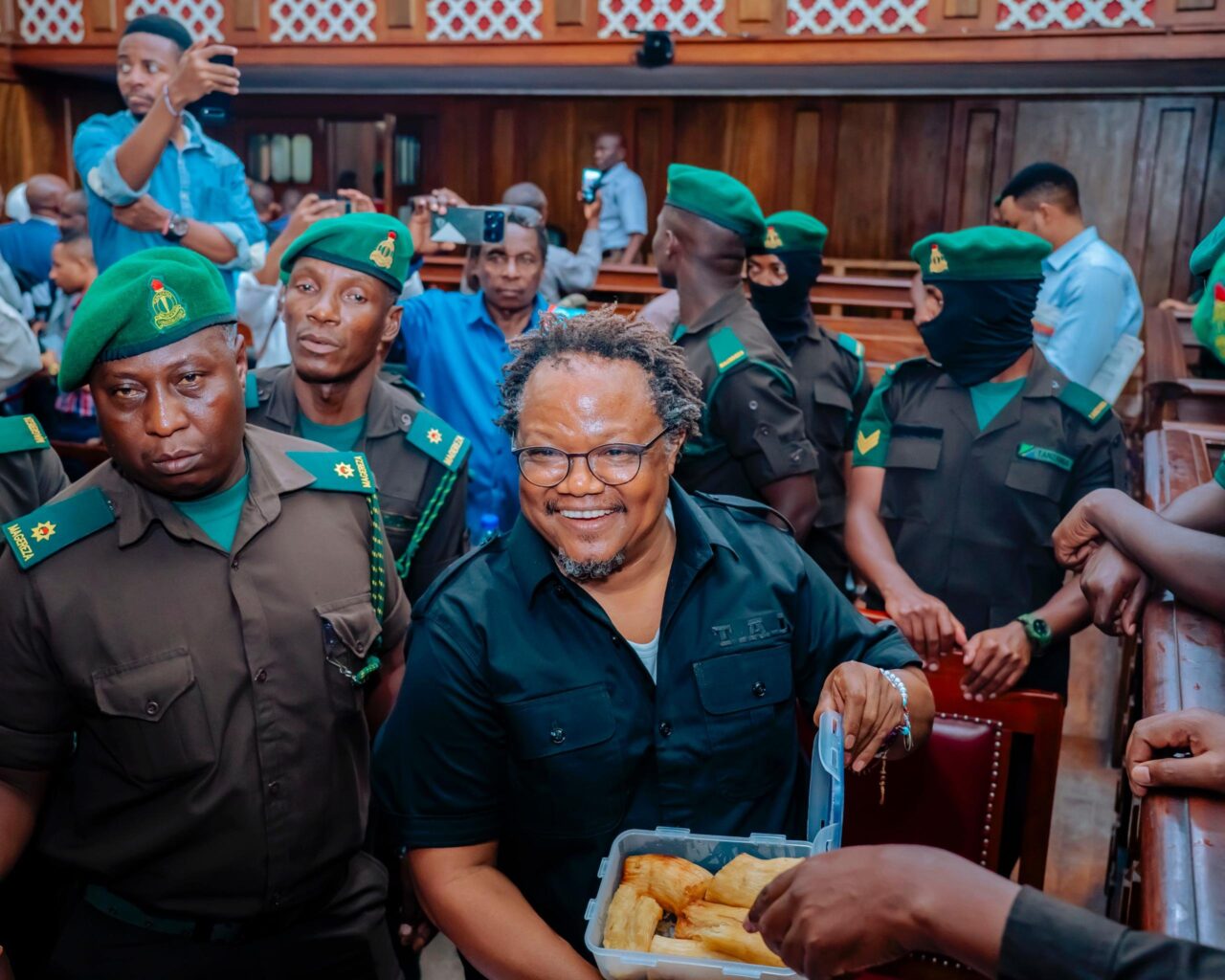
Lissu: Tell the judges whether there is any legal requirement that a prisoner who has a lawyer or lawyers must submit a list of them to the prison authorities.
Ntamamiro: There is no such legal requirement. But a prisoner has the right to choose who visits him.
Lissu: I chose Kulwa William Maduhu, and you turned him away.
Ntamamiro: He was not on the list.
Lissu: Andrea Chima came to see me. Which list was he on?
Ntamamiro: He was not on one.
Lissu: Let us turn to SUPP 5, the entry for 24/12/2025, do you see Nashon Nkungu and Paul Kisabo there?
Lissu: For the meeting with Nashon, you directed that it be supervised by the Deputy Officer-in-Charge and required four of your assistants to oversee it. And for the meeting with Kisabo, you also directed that it be held under supervision in the office of the Acting Officer-in-Charge.
Ntamamiro: Yes.
Lissu: And we agree that all those people, Mumbii, the legal officer Stima, Corporal Dani and the three women. Were they present in the room?
Ntamamiro: That is not correct. They step out. They leave to allow the conversations to take place.
Judge: Lissu, are you satisfied with the witness’s answers?
Lissu: Bear with me, I want to catch people out in a lie.
Lissu: So all the officers in that room step outside. Now read your own affidavit. Let me read it to you. Your affidavit states that they were present.
Ntamamiro: Some were present and some stepped out.
Lissu: Who were the ones who stayed?
Ntamamiro: The one who escorted you
Lissu: Which ones?
Ntamamiro: I don’t recall.
In his testimony, Ntamamiro disputed several of the claims made by Lissu and his lawyers, including the existence of CCTV in the room housing the telephone Lissu used to speak with his lawyers through the glass partition. He also denied that officers listen in on those calls from the control room.
Lissu spent time questioning the barring of CHADEMA leaders from visiting and speaking with him, a line of questioning that led the chair of the panel to intervene and question the practice, with the Officer-in-Charge ultimately apologising to the court.
Lissu: Is it true that after the events of October 29 you summoned me to your office?
Ntamamiro: That is not true.
Lissu: And when you summoned me, you told me that from that point on CHADEMA leaders and members were barred from visiting me.
Ntamamiro: That is not true.
Lissu: And you said conversations with your lawyers should be confined to legal matters only?
Ntamamiro: That is not true.
Lissu: Advocate Gaston Garubindi used to visit me in prison before 14/11/2025.
Ntamamiro: True.
Lissu: From that date, he has never been allowed in?
Ntamamiro: I don’t dictate his schedule.
Lissu: Since I entered prison, you have never allowed advocates Dickson Matata and Deogratias Mahinyila in. Matata is the [CHADEMA’S] Western Zone Chairman and Mahinyila is the National Youth Chairman. They have never been permitted?
Ntamamiro: I don’t force them to come or not to come.
Lissu: Is that so? Very well, Mahinyila and Matata, come to Ukonga tomorrow.
Ntamamiro: The case is before the court; I will not allow them in.
Lissu: John Heche, Amani Golugwa and Secretary General Mnyika are appearing as my witnesses in the treason case, were they barred from entering?
Ntamamiro: They cannot enter.
Judge: Where does this position that you cannot allow them come from? Is there any court order?
Ntamamiro: I cannot allow them.
Judge Mruma: So this is where we are. You are telling this court that you cannot allow them and that you have no court order to that effect? Are you serious, or have you misunderstood the question, because we will have to make a ruling of our own here.
Ntamamiro: I apologise.
In his cross-examination, Lissu also sought to show the difference in treatment between State attorneys and private advocates visiting the prison, arguing that private advocates are searched and closely monitored while State attorneys are not, a claim the Officer-in-Charge denied.
Lissu accused the Officer-in-Charge of being remote-controlled by politicians and by the Commissioner of Prisons, citing as examples such as the visit of the Commonwealth envoy, President Lazarus Chakwera. Lissu said he was taken into the city to meet him.
He said the same happened during the visit of the Secretary General of the Inter-Parliamentary Union, Martin Chungong, when he was again taken into the city for the meeting. The Officer-in-Charge denied that Lissu had been taken to meet the two delegations. In official statements, both the Commonwealth and the Inter-Parliamentary Union have confirmed meeting Lissu.
The case continues on July 23, 2026, when the Republic and the other respondents will have the opportunity to question the witness, the only witness for the Republic.