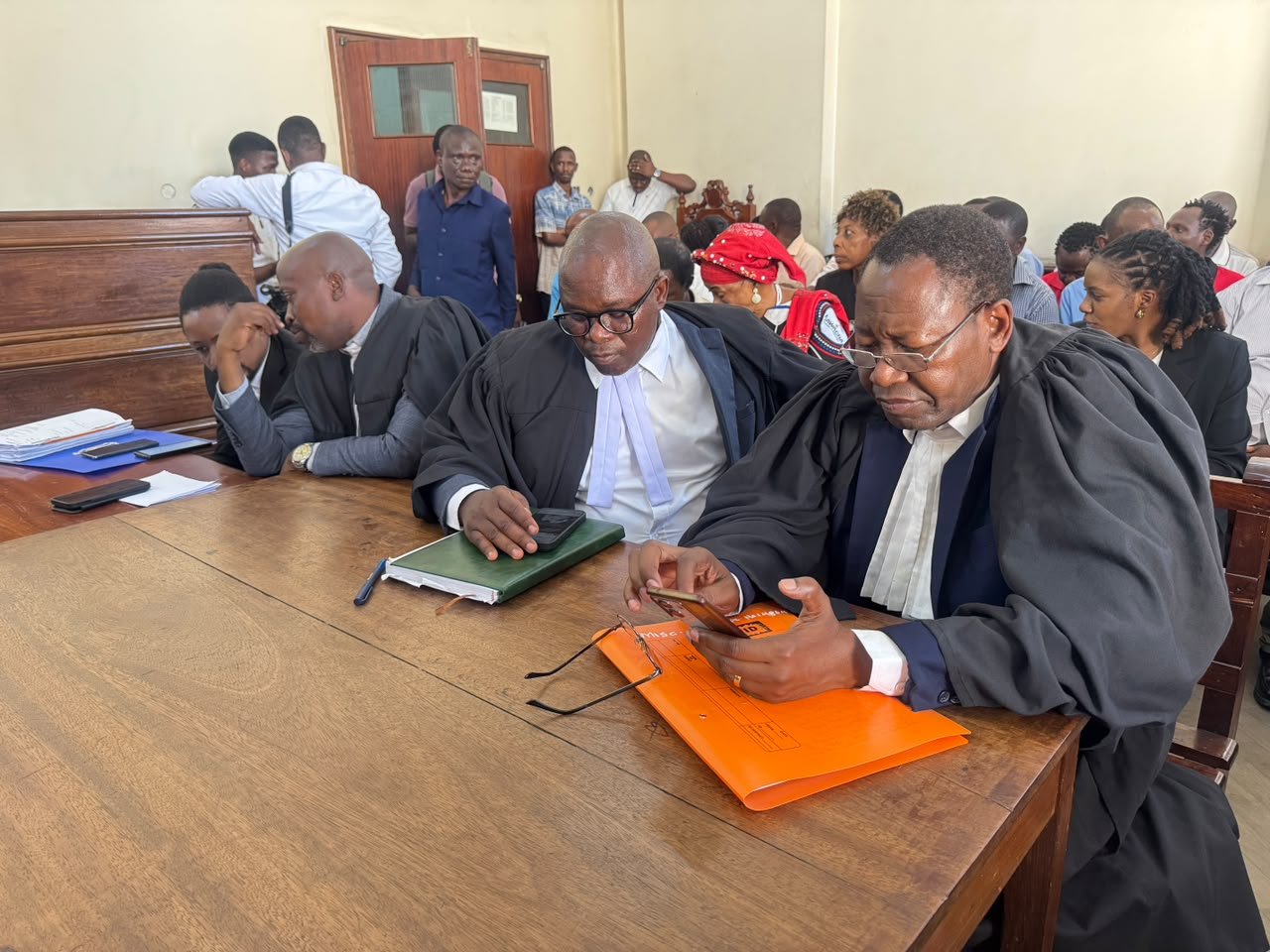

Dar es Salaam — Tundu Lissu spent Monday, August 24, 2026, delivering an extended account of his political career and his version of the speech at the centre of his treason trial, telling the three-judge High Court panel that the case against him is “political persecution” arising from decades of activism rather than any plot against the state.
Lissu, CHADEMA’s national chairperson, resumed testimony in his own defence after Justice Dunstan Ndunguru offered to remind him where he had stopped. He asked to be reminded, and the judge noted he had left off describing research he had conducted into Tanzania’s electoral history since 2020.
Government advocates Nassoro Katuga, Job Mrema, Ignas Mwinuka, Thawabu Issa and Winiwa Kasawa appeared for the prosecution, alongside lead State Attorney Ajuaye Zengeli, who told the court the prosecution was ready to proceed.
Lissu opened by returning to a point he said he had raised on his first day of testimony: that his prosecution has drawn condemnation from an unusually wide range of bodies, not only Western governments and institutions.
He listed a series of organisations he said had publicly denounced the charge as unjust, including the East Africa Law Society, the Southern African Development Community Lawyers’ Association, the Pan African Lawyers Union, the Law Association of Zambia, the Law Society of Kenya and the Tanganyika Law Society, of which he said he was briefly president in 2017.
READ MORE: High Court Finds Lissu Has a Case to Answer as He Seeks Summons for President Samia
He also named the Kenyan chapter of the International Commission of Jurists, Amnesty International’s regional office for Eastern and Southern Africa, and the Uganda Law Society.
Lissu said condemnation had also come from continental political groupings, including what he described as the Democratic Union of Africa, a pan-African grouping of parties aligned with CHADEMA’s own political tendency, and the Platform of African Democracy, which he said brought together democratic parties from 17 African countries.
He placed particular emphasis on a resolution he said the African Commission on Human and Peoples’ Rights adopted on July 30, 2025, following an emergency session at its headquarters in Arusha.
Lissu told the court the resolution, which he cited as ACHPR/RES.640 (LXXXIV), expressed serious concern over his arrest and prosecution and stated that Tanzania was obliged to honour the human rights instruments it ratified in 1984.
“I wanted to add this about who I am, and why this case has been brought,” Lissu said, telling the judges he intended to use the day’s testimony to set out his record as a human-rights and democracy activist, which he said would demonstrate that the case stemmed from his long-standing political positions rather than from any act of treason.
“This is political persecution because of my position on justice and good governance,” he said. “Not because I am a traitor, but because of the work I have done and will continue to do.”
Four decades of activism
Lissu told the court he began his activism as a secondary school student in 1988, when he nearly faced expulsion for defending Form Four students despite being in Form Six himself.
He said he later continued the theme while doing national service in 1989 and 1990, at a time when debate over the return of multi-party politics was beginning nationally.
He said the armed forces and police at the time were solidly aligned with the ruling Chama cha Mapinduzi (CCM), a position he said had not fundamentally changed.
Lissu said he clashed with senior officers over their opposition to multi-partyism, telling one, retired police chief Omary Mahita, that Julius Nyerere himself had said those who resisted change were being foolish.
READ MORE: Tundu Lissu Treason Trial: High Court Explains Its Reasoning Behind Case-to-Answer Ruling
He told the court that when President Ali Hassan Mwinyi appointed a commission in February 1991 to consult citizens on whether Tanzania should return to multi-party politics, he appeared before it to argue in favour of the change.
He said the panel, chaired by Professor Haroub Othman, sat under the overall commission led by the late Justice Francis Lucas Nyalali, whose secretary was January Msofe, later himself a Justice of the Court of Appeal.
Lissu said he returned from studies in the United Kingdom to contest in Tanzania’s first multi-party general election, and that he has continued campaigning for democracy, a New Constitution and electoral reform “without pause” ever since.
Land and mining rights record
Turning to what he described as his record defending ordinary citizens, Lissu told the court that in 1997 the government of President Benjamin Mkapa allocated roughly 120 hectares of the Rufiji Delta’s mangrove forest to an Irish investor for industrial prawn farming, a project he said would have destroyed the forest and harmed an estimated 120,000 people living in the Rufiji basin.
He said he and colleagues at the Lawyers’ Environmental Action Team, including Dr Rugemeleza Nshala, opposed the project and were labelled “environmental jihadists” by Mkapa and his minister at the time. He said the campaign succeeded, and the investor left the country.
Lissu said his advocacy extended to land rights for pastoralist communities affected by evictions from the Ngorongoro Conservation Area and relocations to areas including Handeni, Loliondo, Tarime, Meatu, Maswa and Bariadi, and that he was arrested in 2023 to prevent him travelling to Ngorongoro to meet Maasai residents he said he had supported since 1996.
He also said he had campaigned against what he described as killings of fishing communities along Lake Tanganyika, in Kigoma’s coastal areas, and along Lake Victoria near the borders with Uganda and Kenya, which he attributed to state security forces.
On mining, Lissu told the court he had campaigned since 1999 against what he called the government’s mistreatment of communities near major mine sites, including the Geita Gold Mine, and Bulyanhulu, where he said killings of small-scale miners in July and August 1996 — during a military operation he said Mkapa ordered to hand the site to a Canadian company — produced his and Dr Nshala’s first criminal case, in 2002, after they campaigned for an independent investigation.
He said similar campaigns followed at the Golden Pride mine near Nzega, where he said thousands were evicted for the benefit of an Australian company, and in Tarime, where he said he secured the release of 466 people jailed on what he described as fabricated charges over three years, including the late Member of Parliament Chacha Wangwe. He said the Tarime campaign also produced a criminal case against him under President Jakaya Kikwete.
Lissu said his advocacy continued at Buhemba, in present-day Butiama District, and at the Mererani tanzanite mines in Simanjiro District and in his own constituency of Singida East, which he said have long suffered mining-related harm.
“My motto has been that opposing oppression is glory to God,” Lissu told the court, summarising what he described as the throughline of his public life.
Lissu told the judges that treason, as defined under the Penal Code, is the most serious offence recognised under Article 28(4) of the Constitution, carrying a mandatory death sentence if the court is satisfied of guilt.
“This is the greatest offence of them all in the United Republic of Tanzania… It doesn’t get more serious than this,” he said, adding that the present charge was, in his account, one instalment in a long series of criminal cases he said had been brought against him by the police and state prosecutors.
He said that within CHADEMA, he had personally faced more prosecutions than any other leader of the party.
Mkapa-era prosecution
Lissu told the court that on December 23, 2002, he was arrested — two days before Christmas — and charged with incitement after leading a campaign demanding investigation into the deaths of more than 60 people at Bulyanhulu, which he said were not accidental.
He said he spent two days in the Central Police Station cell known as Shimoni before being brought before a magistrate on Christmas Day.
He said the case, in which his co-accused included Augustine Mrema and Dr Nshala, dragged on for six years without the prosecution producing witnesses, before the Kisutu court dismissed it for want of prosecution.
Kikwete-era prosecutions
Lissu told the court that in July 2011, while serving as a Member of Parliament, he travelled to Tarime after police killings near the Nyamongo mine, joining residents who were trying to prevent police from removing bodies from the mortuary.
He said he and others were beaten and detained, then charged with criminal trespass and held for four days in Tarime prison, before the case was later dismissed for lack of witnesses.
He said that in 2012, after police killed demonstrators during a lawful protest in Arusha, he and CHADEMA’s then-Secretary-General, Dr Willibrod Slaa, were arrested and charged with unlawful assembly; that case, too, was later dropped.
He described a further arrest and similar charge in 2013, after an attack using hand grenades on a party meeting addressed by then-CHADEMA chairperson Freeman Mbowe left several people dead and triggered fresh protests.
Magufuli-era prosecutions
Lissu told the court that in 2015, after Zanzibar’s election was annulled by the then chairperson of the Zanzibar Electoral Commission, Jecha Salim Jecha, he was asked by journalists for his reaction and said publicly that annulling the result risked disaster.
He said he was arrested on June 29, 2016, and charged with incitement, in an operation he said was led by an officer, Ramadhani Kingai, who today serves as Director of Criminal Investigations.
Lissu said that, unusually, the prosecution in that case did produce a witness — Kingai himself — and that after Lissu cross-examined him, no further witness was brought.
He said that days later, on July 1, 2016, he was arrested again in Singida for calling President John Magufuli a “petty dictator,” and that he was arrested twice more before the end of 2016, accumulating four cases that year alone.
He said a further arrest followed in early 2017 after he stood, and won, an election for the presidency of the Tanganyika Law Society, and that he was arrested twice more between April and August 2017, once over remarks linking Magufuli, in his earlier role as a minister, to Bombardier’s difficulties in Canada.
Lissu told the court he was arrested eight times and charged in six separate cases at the Kisutu Resident Magistrate’s Court between June 2016 and August 2017.
He then turned to the events of September 7, 2017, telling the court he was shot 16 times outside the government housing where he lived alongside MPs including Tulia Ackson, in an attack in which he said the compound’s usual armed guards were absent and the gate had been left open.
He said one bullet remains lodged near his spine, which doctors have told him is too dangerous to remove.
“God is not Athuman, I did not die,” Lissu told the court, saying that instead, Magufuli himself later died, and that the six pending cases against Lissu were withdrawn roughly six months afterwards. He said no one has ever been arrested, charged, or questioned him about the shooting.
Samia-era arrests
Lissu described what he said was the first of several arrests by authorities under President Samia Suluhu Hassan.
He said that on August 11, 2024, while travelling to Mbeya for a CHADEMA youth event that police had banned, he was confronted at the party’s local office by officers led by Awadhi Juma, described by Lissu as the police force’s head of operations, beaten alongside other party leaders, and driven overnight to Vwawa in Songwe region before being returned to Dar es Salaam without charge.
He said that the following month, on September 7, 2024, CHADEMA’s head of mobilisation, Mohamed Ally Kibao, was abducted from a bus in Tegeta by armed men travelling in vehicles with tinted windows, and was found dead the next day on the Ununio shoreline, having reportedly been doused in acid.
Lissu said the killing formed part of a wider pattern of abductions of CHADEMA officials that year, prompting the party to organise protests, during which he said he was again arrested on September 23, 2024, and held briefly at the Mbweni police station before being released.
He said he was arrested again around March 2023 near Karatu, to prevent him from travelling to Ngorongoro, and held at Monduli.
Lissu told the court that his arrest on April 9, 2025 — the arrest that produced the present charge — was his fourth under President Samia. He said the treason charge was filed the following day, April 10, and that, at the time of testifying, he had been in remand custody for roughly 16 months, which he described as the longest period he has ever spent in detention, and the longest, he believes, of any CHADEMA leader or opposition figure in the country’s history.
“It is the longest I have stayed in prison in my entire life,” he told the court, adding that several colleagues he had worked alongside had died since 2015 and others remain missing.
Prosecution objects
At this point in Lissu’s testimony, referring directly to the report of the presidential commission chaired by retired Chief Justice Mohamed Chande Othman, which recommended reform of the police force, State Attorney Nassoro Katuga rose to object.
Katuga argued that Lissu’s evidence had strayed from matters properly before the court, invoking Section 156(2) of the Evidence Act, which he said requires evidence-in-chief to relate to relevant facts.
He said the prosecution had allowed Lissu latitude when his testimony touched on his good character, but argued that the proceedings could not extend for weeks while unrelated matters were introduced.
“We are now nine cases in,” Katuga told the panel, arguing that if the court allowed every tangential matter, it would receive a great deal more of the same.
Lissu responded that his defence rests on the argument that the case against him is political and fabricated, and that the pattern of prosecutions he had described was itself evidence supporting that argument. He questioned the prosecution’s professed concern for time, noting the case had already run for more than a year.
Justice Ndunguru asked both sides to proceed, guided by what evidence was properly before the court. Separately, State Attorney Job Mrema referred the witness to Section 177 of the Evidence Act regarding the use of documents while testifying; Lissu said he was not reading from a document and the exchange drew laughter in the courtroom.
Lissu then addressed directly the words attributed to him at CHADEMA’s April 3, 2025, meeting with parliamentary and civic aspirants at the party’s Mikocheni headquarters, which forms the basis of the treason charge.
He told the court that although witnesses for the prosecution, including the confidential witness referred to in the earlier ruling as PW17, described a recording of between two and five hours, the actual words the prosecution tendered in evidence took less than a minute to read.
He said the remaining span of time was devoted, in his account, to a lengthy explanation of the historical and structural problems in Tanzania’s electoral system, which he then set out to the court in detail — the same explanation, he said, he had given to the aspirants that day.
A history lesson
Lissu told the court that Tanzania has held general elections roughly every five years since 1957, and that the second of the country’s earliest elections, in August 1960, produced the government that led to independence a year later.
He noted that early elections under the one-party system offered voters a single candidate’s portrait alongside a blank box.
He said the country’s shift to multi-party politics after 1992 followed the Nyalali Commission’s work, and that the commission had recommended a New Constitution and an independent electoral commission, concluding that the then-constitution, designed for one-party rule, was unsuited to multi-party competition. He said the commission also recommended allowing independent candidates.
Lissu told the court that the government of President Mwinyi rejected the recommendations for a New Constitution, an independent commission and independent candidates.
He cited a memoir he said the late President Mwinyi wrote before his death, in which Mwinyi said the recommendations were rejected to prevent an exodus of members from CCM, a decision Lissu said caused friction with Nyerere.
He said the 1992 constitutional amendments that followed made the electoral commission’s members presidential appointees, replaced the Speaker of Parliament with a judge as its chairperson, and made the position of Electoral Director a presidential appointment as well — with returning officers at the district level also appointed through structures under presidential control.
He referred to research by a commission chaired by Justice Joseph Warioba as supporting his account of how the system had developed.
Turning to more recent history, Lissu told the court that unresolved complaints about the electoral system have repeatedly preceded violence, citing disputed elections in Zanzibar in 1995 and 2000, a 1998 commission led by Justice Robert Kisanga that also recommended reform and was rejected, and a subsequent international mediation and commission led by Justice Mac Bomani in Zanzibar.
He said internationally accredited election observers had repeatedly recommended reform of Tanzania’s electoral laws after the 2000, 2005, 2010 and 2015 elections, warnings he said went unheeded through the Mkapa, Kikwete and early Magufuli years.
Disqualifications, etc.
Lissu told the court he explained to the aspirants the scale of candidate disqualifications in past elections, saying 63 of 244 parliamentary candidates were disqualified ahead of the 2020 general election and that 832 councillors were disqualified in the same cycle, alongside what he described as related violence.
He said presidential election results, unlike parliamentary results, have never been gazetted constituency by constituency, and that the law requires the underlying materials to be destroyed after six months.
He also raised what he described as imbalances in the delimitation of constituencies, saying Dar es Salaam, Tanzania’s most populous region, has ten parliamentary seats while Zanzibar has fifty despite a far smaller population, an outcome he attributed to the absence of a population-based quota in the boundary-setting process.
Lissu told the court he had also raised long-standing complaints about voter registration irregularities, describing them as a subject “observers have raised for years,” and about a code of electoral ethics he said had been used selectively against opposition parties, including CHADEMA.
Lissu told the court he explained his view that Tanzania’s media landscape becomes heavily aligned with the ruling party during election periods, citing research by the University of Dar es Salaam’s Research and Education for Democracy in Tanzania programme, led by Professor Rwekaza Mukandala. He said Tanzania needed a media law guaranteeing fair coverage of campaign events.
He said he had also discussed the historical practice of holding elections on a Sunday, and the difficulties, in his account, of challenging disputed results through the courts, saying Tanzania’s election-petition procedures were difficult to use effectively.
‘No Reforms, No Election’
Lissu gave the court a detailed account of the political reconciliation process known as Maridhiano, which he said began after President Samia met him in Belgium on February 17, 2022, on the margins of an African Union–European Union summit, while Lissu remained in exile and Mbowe remained in detention.
He said he told the president that any process should begin with Mbowe’s release and a commitment to discuss a New Constitution and an independent electoral commission, and that Mbowe was subsequently released.
Lissu said the ensuing talks, conducted between CCM’s Abdulrahman Kinana and CHADEMA’s Mbowe, produced written CHADEMA proposals that the government rejected in a written response dated May 31, 2023.
He told the court that after the collapse of Maridhiano, CHADEMA resolved to take its campaign for constitutional and electoral reform directly to citizens, and that officials who did so, in his telling, began to face abductions.
Lissu said the party went on to contest local government elections in November 2024 despite those elections falling under the President’s own ministry, and that following what he described as widespread disqualification of opposition candidates and violence during that poll, CHADEMA’s Central Committee met on December 3, 2024, and adopted the position No Reforms, No Election.
He said the position was formally endorsed by the party’s General Council on January 20, 2025, and confirmed as party policy at its General Assembly the following day, the same assembly at which Lissu was elected national chairperson.
“That is not a slogan of Tundu Lissu. It is the slogan of our chairperson, Freeman Mbowe, and we agreed on it together,” Lissu told the court, insisting that the party’s mobilisation strategy, endorsed at a Central Committee meeting in Bagamoyo, called for peaceful demonstrations and voter mobilisation, not violence.
Outreach to religious figures
Lissu told the court that CHADEMA’s campaign involved outreach to religious bodies, including Muslim organisations, though not the National Muslim Council of Tanzania (BAKWATA), which he said was aligned with CCM, and attempts to meet Catholic and Christian church bodies that he said were unsuccessful.
He said the party did meet the Tanzania Editors’ Forum and the leadership of the Tanganyika Law Society, in a meeting held in Bagamoyo.
He said the party also sought international engagement, meeting former Kenyan Prime Minister Raila Odinga in Nairobi, and consulting former Prime Minister Joseph Warioba domestically, alongside a lecture Lissu delivered in March 2025 at Uganda’s Makerere University on Julius Nyerere’s legacy and Tanzania’s electoral challenges, and further engagements in Angola and Rwanda.
Lissu told the court that CHADEMA’s national tour promoting No Reforms, No Election concluded in Iringa, where, on March 31, 2025, Deputy Secretary-General Amani Golugwa informed him of a planned meeting in Dar es Salaam with prospective party candidates for the coming general election.
He said the meeting, on April 3, 2025, at CHADEMA’s Mikocheni headquarters, was organised by the office of the party’s Secretary-General, not by him personally, and that he addressed it in his capacity as national chairperson.
“You cannot be a general and yet put the captains ahead of you,” he told the court, arguing it would have been procedurally irregular for anyone other than the party’s most senior leader to address such a gathering.
He said none of the 17 prosecution witnesses had reproduced more than a minute’s worth of his remarks, and that he could not himself say how long he had spoken because he has never seen the recording.
He told the court that the confidential witness identified as PW17 admitted to being the person who filmed the meeting on three Sony HXR cameras and distributed the footage, including to Jambo TV, and that another witness said the meeting was attended by journalists after being invited by CHADEMA’s communications officer, Brenda Rupia, through the party’s media director, John Marwa.
“They have known since April 8 who organised and invited people to that meeting. They are prosecuting me for organising a meeting they know was organised by our own information officer,” Lissu said.
He added that police practice was to build a case around a suspect once a decision had been made to charge them, saying: “The police say, ‘give him a head’ — and then he is charged with murder.”
What he actually discussed
Lissu told the court that, having explained the history behind Tanzania’s electoral disputes, he then set out to the aspirants his argument for boycotting the election if necessary, and, separately, a proposal to postpone the October 2025 general election altogether to allow time to fix the identified problems — a position he acknowledged was controversial.
“We were ready for the general election to be postponed so we could get the chance to put electoral arrangements right,” he told the court, saying senior CCM figures, including Stephen Wasira, rejected the idea. “Today we are talking about people who have been murdered. Had we postponed the election, not a single Tanzanian would have died.”
He denied ever telling the meeting how the party would “deal with” the government, insisting that the words attributed to him about inciting rebellion or intimidating the state had been excised from a much longer explanation of electoral grievances.
“Where I allegedly said we would incite rebellion, that we would do something to the government, has just been cut out. I never said how we would deal with the government,” Lissu told the court.
“Our intention was to explain to our aspirants the problems in our electoral system,” he added. “Disrupting or stopping an election is not, in itself, a crime, and if you had asked me what kukinukisha meant, I would have told you.”
“I do not lead a party of conspirators,” Lissu told the court. “I lead a party of people fighting for democracy.”
Adjournment
Toward the close of the day’s proceedings, Lissu told the panel he wished the court, when it reconvened, to take him through the evidence tendered against him to assess whether, in his submission, it was sufficient to support a capital conviction.
He asked that the matter be adjourned to Wednesday.
The judges granted the request. The case was adjourned to Wednesday, August 26, 2026, at 9:00 a.m., when Lissu is expected to continue his testimony.