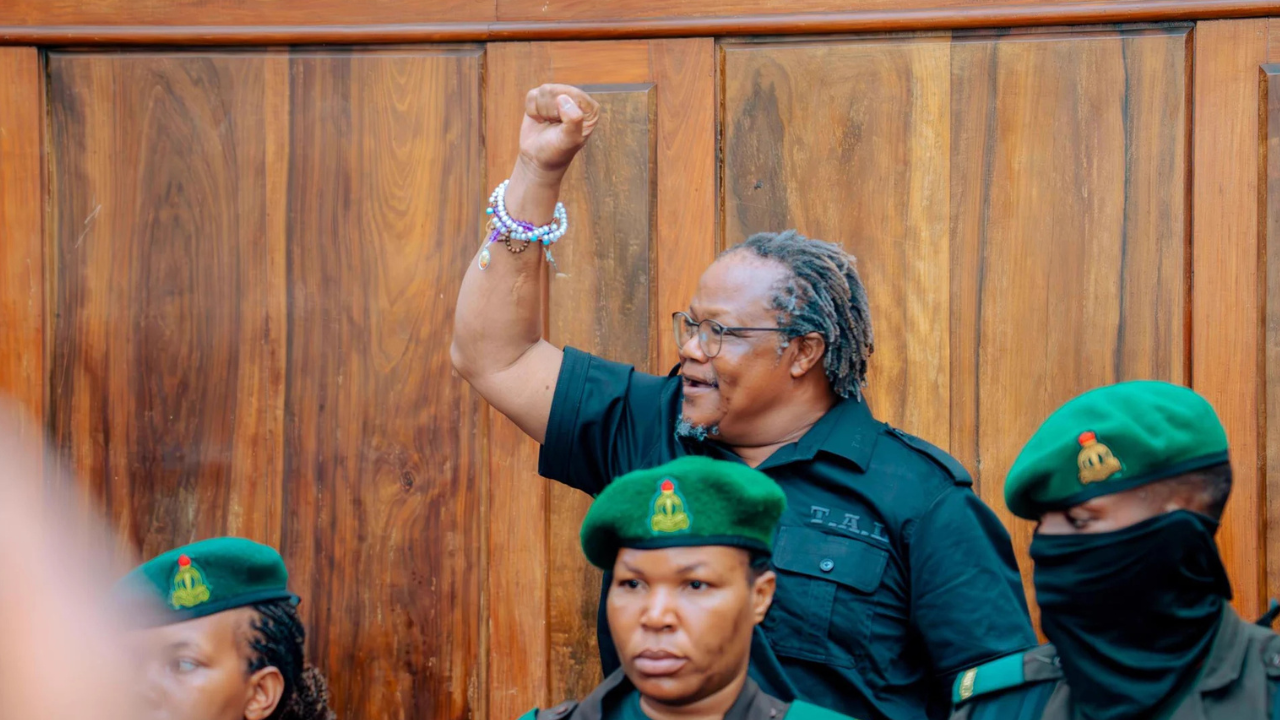

Dar es Salaam – The High Court on Friday, November 6, 2026, found that prosecutors have not proved treason against CHADEMA national chairperson Tundu Lissu, but convicted him of incitement and sentenced him to four years’ imprisonment.
The three-judge panel, led by Justice Dunstan Ndunguru, ruled that his April 2025 election remarks do not establish the intention to intimidate the government required for treason, but encourage non-peaceful obstruction of the election.
The decision removes the threat of a death sentence in this prosecution, but does not free Lissu. He challenges the substitution of incitement for treason and requested bail pending appeal, including to attend his elder brother Alute’s burial; the proceedings ended without an announced grant of bail.
The case has run from Lissu’s arrest after a CHADEMA rally in Mbinga through a lengthy committal process at Kisutu and a High Court trial marked by disputes over anonymous witnesses, courtroom access, police evidence and the meaning of his words.
Alongside it are restrictions on CHADEMA, international demands for his release and a separate judgment protecting confidential consultations with his legal advisers.
What follows is a day-by-day timeline of the principal moments, from the speech at the centre of the prosecution to Friday’s verdict and sentence. Each entry links to the relevant full reports published by The Chanzo, with later reporting dates noted where necessary.
April 3, 2025: During a meeting with CHADEMA aspirants at the party’s Mikocheni offices in Dar es Salaam, Lissu speaks about the party’s No Reforms, No Election campaign. Remarks from this meeting, including statements about stopping the election, mobilising rebellion and kukinukisha, form the basis of the subsequent treason count.
The meaning and context of those expressions become central to the trial. The prosecution treats them as evidence of an intention to intimidate the executive, while Lissu maintains that they express a political campaign for constitutional and electoral reform.
April 9, 2025: Police arrest Lissu in Mbinga, Ruvuma region, after he concludes a CHADEMA rally under the same reform campaign. CHADEMA says he is moved to Dar es Salaam that night, together with other party officials who are also detained.
April 10, 2025: After interrogation at Dar es Salaam’s Central Police Station, Lissu is taken to the Kisutu Resident Magistrate’s Court and charged with treason, a capital offence. He separately faces counts of publishing false information.
The treason investigation is incomplete, so the case remains at the committal stage. Kisutu handles the preliminary process required before a High Court trial, while Lissu remains in custody.
April 24, 2025: Conflict over court access marks the first weeks of the case as people seeking to attend Lissu’s Kisutu hearing are prevented from entering. Reports and eyewitness accounts allege arrests, beatings and the abandonment of some detainees in bush areas.
The allegations concern the treatment of people outside the proceedings, not evidence of treason against Lissu. They add to the wider dispute over how the case is conducted.
May 6 and May 19, 2025: The Kisutu court on May 6 urges prosecutors to expedite their investigation and provide an update on May 19. It also directs the prison service to produce Lissu physically at the next hearing.
By May 19, however, the prosecution still says the investigation is being finalised. The court maintains that proceedings should remain open to the public, but the case is not yet at the High Court trial stage.
June 16, 2025: Lissu tells the court he will represent himself, saying restrictions on confidential consultations with his lawyers have made ordinary preparation through counsel impossible. The court accepts his decision.
The choice sets the pattern for the hearings that follow. Lissu personally conducts legal arguments, cross-examines prosecution witnesses and later gives his own evidence and questions defence witnesses.
July 1, 2025: Still at Kisutu, Lissu asks the court to order the State to withdraw the case or move it to the High Court. He describes repeated delays in completing the investigation as an abuse of the court process, in a hearing reported the following day.
July 15 to August 18, 2025: Witness security becomes a defining issue before the trial begins as prosecutors seek protection for civilian witnesses. The High Court approves measures permitting anonymous testimony.
The prosecution also asks to halt live broadcasting on witness-protection grounds. On August 18, Kisutu orders live transmissions of the proceedings to stop.
September 8, 2025: The treason trial formally begins at the High Court, Dar es Salaam Sub-Registry. Lissu reaffirms that he will defend himself and raises preliminary objections concerning the papers and procedures before the panel.
September 15 to September 22, 2025: The judges dismiss Lissu’s principal preliminary objections and later rule the charge sheet valid. The decisions clear the way for prosecution witnesses without determining guilt or innocence.
October 6 to October 17, 2025: The prosecution begins presenting its evidence, with police witnesses describing the investigation. Lissu cross-examines them about written statements, the alleged publication of the speech and the legal ingredients of treason.
The hearings then turn to digital evidence, including a flash disk and memory card. A police forensic examination of the Jambo TV video becomes the subject of further admissibility arguments.
October 22 and October 23, 2025: In a substantial evidentiary setback for the prosecution, the High Court finds that the police witness called to tender the video material is not qualified to do so. The flash disk and memory card are not admitted through that witness, and the court subsequently rejects the related forensic report.
The decisions do not end the prosecution’s case. Lissu uses the next hearing to challenge the remaining police evidence.
October 24, 2025: The prosecution fails to produce witnesses, and the matter is adjourned to November 3. Lissu remains in remand custody through the October 29 general election, whose associated violence becomes an issue in later testimony and sentencing submissions.
November 10 and November 12, 2025: Proceedings are first postponed when the prison service does not produce Lissu and the prosecution brings no witnesses, with unspecified security concerns cited. Two days later, Lissu challenges the plan to hear a completely concealed prosecution witness, arguing that the arrangement lacks adequate fair-trial safeguards.
The dispute produces another prolonged interruption in the proceedings.
February 9 and February 11, 2026: After the break, the High Court resumes proceedings to hear arguments over the secret-witness arrangement. The immediate issue is how to receive protected testimony while preserving Lissu’s ability to challenge it.
On February 11, the judges order modifications allowing them to see the protected witness. They reject Lissu’s wider challenge to the protection framework and allow the trial to continue.
February 12 to February 20, 2026: The court hears a succession of prosecution witnesses, with Lissu testing differences between their oral accounts and police statements. His questions also concern the basis of alleged election-disruption offences and the reliability of concealed witnesses.
These hearings include concerns over his treatment in custody and judicial intervention over food, alongside further orders concerning witness-protection law. On February 20, the judges refuse a prosecution request to restrict reporting on the proceedings.
February 23, 2026: The United Nations Working Group on Arbitrary Detention issues an opinion finding Lissu’s detention arbitrary and calling for his release and compensation. The opinion does not itself end the domestic prosecution or secure his release, but becomes a reference point in international appeals over his detention and fair-trial rights.
February 23 and February 24, 2026: The legal dispute shifts to a prosecution bid to add evidence through ACP Amini Mahamba, who has already testified. The High Court strikes out its notice, finding that the procedure invoked does not allow a previously heard witness to be recalled in that way.
The Director of Public Prosecutions immediately seeks revision at the Court of Appeal. The High Court stays the trial pending the appellate outcome, beginning another lengthy pause.
April 9, 2026: CHADEMA holds a virtual event marking one year since Lissu’s arrest and demanding his release. The event takes place online because a High Court injunction has suspended the party’s political activities.
Deputy chairperson John Heche alleges that Lissu has missed four scheduled medical check-ups and that the party has rejected conditions involving his release, withdrawal from politics and departure from the country. Prison authorities deny allegations concerning restrictions on private lawyer consultations.
April 15, 2026: The Court of Appeal quashes the injunction barring CHADEMA from political activities and using its assets, ending a restriction lasting 309 days. It cites procedural defects, including proceeding after the withdrawal of the party’s advocate and failing first to determine whether the underlying petition is time-barred.
The appellate court restores the party’s activities and access to assets while sending the matter back for consideration by a different High Court judge. At CHADEMA’s press conference, Heche says securing Lissu’s release is the next priority.
May 18, 2026: At a rally in Kahama, Heche says Lissu suffered severe stomach pain after eating fruit in prison. He says Lissu received an injection, underwent tests and was told he had amoeba; these medical details remain the party’s account.
Heche says CHADEMA will seek a comprehensive medical examination, including poison testing, if Lissu is released. The concerns accompany renewed rallies demanding his release, a new constitution and accountability for the October 2025 killings.
June 11, 2026: The Court of Appeal hearing of the DPP’s revision application, initially scheduled for this date, is postponed to July 6. The registrar’s notice gives no explanation, prompting questions from CHADEMA and prolonging the High Court stay.
June 26, 2026: Home Affairs Minister Patrobas Katambi directs the Inspector General of Police not to issue permits for political rallies by any party. The government presents the temporary measure as a response to security and economic concerns, including the planned July 7 mobilisation, in remarks reported on June 29.
Opposition parties call the directive unconstitutional and an attempt to suppress dissent. It constrains CHADEMA’s public campaign after the party’s return to rallies; Heche has already rejected allegations that it is planning violence and linked its mobilisation to constitutional reform and Lissu’s release.
July 10, 2026: At its 73rd meeting, the Commonwealth Ministerial Action Group recommends resolving Lissu’s detention through a political and legal pathway within 30 days. It also calls for the release of people held solely for peacefully exercising their rights.
The roadmap includes 60-day and 90-day recommendations on digital access, intimidation of media and free-expression advocates, and an inclusive inter-party forum with neutral facilitation. These recommendations do not amount to a domestic release order.
July 16, 2026: Civil-society stakeholders publicly call for implementation of the Commonwealth recommendations. They propose possible mediators including Joseph Warioba, Anna Tibaijuka, Lazarus Chakwera and Naledi Pandor, without announcing an agreed mediation process.
July 22, 2026: Government spokesperson Gerson Msigwa says the government is assessing the Commonwealth statement and will respond, while stressing sovereignty and the country’s constitutional and legal foundations. His comments address the recommendations concerning detention, digital platforms and an inter-party forum.
The same day, Heche says CHADEMA will not enter talks unless Lissu is released and a mediator is involved. A separate constitutional case also concerns the treatment of Lissu’s lawyers during prison visits.
July 29, 2026: Katambi denies that the government is targeting any person or institution after CHADEMA reports that 51 members, including leaders, have been arrested and charged with terrorism across the Victoria, Serengeti and Nyasa zones. Opposition figures and academics criticise the prosecutions in remarks reported alongside his denial on July 30.
Heche alleges that the arrests are meant to force the party into “fake reconciliation” and repeats its conditions for negotiations. The alleged motive remains the party’s claim, and the charges are not findings of guilt.
July 30, 2026: The Court of Appeal dismisses the prosecution’s revision application. It agrees that the notice seeking to add evidence through a witness who has already testified is misconceived.
The decision leaves the High Court’s February ruling intact. It removes the appellate barrier to resuming Lissu’s trial without deciding the treason charge itself.
August 10 to August 13, 2026: The High Court resumes the trial, and chief investigator ACP Amini Mahamba gives evidence about police analysis of the April speech and files from several regions. The August 10 hearing is reported on August 11; the resumption does not reverse the earlier rejection of additional evidence.
During cross-examination, Lissu questions the investigator about responsibility for publishing the Jambo TV video. A confidential Jambo TV journalist later says the outlet’s team livestreamed the meeting and that Lissu did not operate the camera or instruct staff to post the footage, in testimony reported on August 14.
August 17, 2026: The prosecution closes its case after calling 17 witnesses, although it has listed 30. Lissu submits that there is no prima facie case requiring a defence.
He argues that the evidence does not prove an intention to intimidate the institutions specified in the law or show that he published the disputed video. The prosecution maintains that its oral evidence is sufficient to require an answer.
August 21, 2026: The panel led by Justice Ndunguru finds that Lissu has a case to answer under section 39(2)(d) of the Penal Code. The judges stress that this is not a conviction and that the stage does not require a detailed assessment of the evidence’s weight or credibility.
Lissu says he will testify and seeks summonses for 11 witnesses. They include President Samia, former Vice-President Philip Mpango, former Prime Minister Kassim Majaliwa, Inspector General of Police Camillius Wambura, Chief of Defence Forces John Mkunda, the heads of intelligence and criminal investigations, and CHADEMA figures John Mnyika, Amani Golugwa, John Heche and Brenda Rupia.
The prosecution opposes the proposed senior state and security witnesses. The court rules on the specific officials on September 10, not in this decision, requiring a defence.
August 24, 2026: Lissu describes decades of work on constitutional, electoral, land and human-rights issues, alongside earlier arrests and prosecutions. He characterises the case as “political persecution” and says: “What brought us here is a political conflict; it is a political war, not treason.”
He testifies that CHADEMA’s organs adopted No Reforms, No Election and that the party secretariat organised the April 3 meeting. He maintains that the charged phrases are extracts from a much longer explanation of electoral grievances and that he did not control Jambo TV’s publication.
The account forms part of his defence, which the judges must assess alongside the prosecution’s case.
August 26, 2026: Lissu challenges the reliability of police and concealed witnesses, arguing that prosecutors have not proved the required intention or an overt act. He alleges that some protected witnesses were first arrested over planned election-related crimes and released after agreeing to testify.
The prosecution then begins cross-examining him about the speech, its publication and the limits of protest. Lissu accepts making the attributed remarks and wanting the speech to reach the public, but maintains that the journalist identified as PW17, rather than he, caused its publication on Jambo TV.
August 27, 2026: The prosecution continues questioning Lissu about No Reforms, No Election, kukinukisha, mobilising rebellion, journalists’ presence and the absence of the full video. In a testimony, he insists that the words must be understood within the longer speech.
Lissu says his lack of faith concerns courts dealing with election disputes, not the courts generally. He describes his preferred response as a “democratic alternative” and disputes the proposition that he controls media workers’ broadcasts.
August 28, 2026: After cross-examination concludes, the High Court rejects the prosecution’s argument that Lissu cannot re-examine himself without an advocate. It confines clarification to matters raised in cross-examination, after which he reiterates that journalists control publication and that intention does not necessarily manifest itself only through an act.
Mnyika becomes the second defence witness. He says CHADEMA invited journalists to the opening portion of the April meeting but did not direct whether or how they should broadcast, and describes Lissu’s address as an explanation of party reform policy.
August 31, 2026: Mnyika sets out the party’s account of how its governing organs adopted the reform campaign. He says the April speech was not a private plot by Lissu but an explanation of a policy approved before the meeting.
He describes political resistance through democratic means, including pressing for postponement or boycotting an election, and again denies that Lissu controlled journalists. The prosecution questions CHADEMA’s constitutional objectives, Mnyika’s interest as a party office-holder and the use of media coverage, before the court adjourns to September 1 with his evidence continuing.
September 1, 2026: The prosecution tests whether CHADEMA’s campaign can be linked to plans to burn polling stations, damage property or harm voters. Mnyika says he does not know who is responsible for reported fires and killings, and maintains that the policy seeks democratic reform rather than unlawful conduct.
He says the campaign predates April 3 and that its words are directed to citizens. Prosecutors also question him about party finances, administration and the meaning of uasi, but cross-examination remains unfinished when the court adjourns.
September 2, 2026: Mnyika completes his evidence and re-examination, maintaining that the policy belongs to the party and publication decisions belong to journalists. The prosecution’s questions about later violence, party funds and earlier cases do not establish a judicial finding connecting Lissu to those events.
After Mnyika is discharged, Amani Golugwa opens as the third defence witness. He describes alleged nomination and polling irregularities in the 2024 local-government elections and says regional party reports led to No Reforms, No Election.
Golugwa alleges that candidates were obstructed or disqualified and opposition agents kept outside polling stations. His evidence-in-chief continues into the following day, before prosecution cross-examination begins.
September 3, 2026: Golugwa cites criticisms he attributes to regional and international election observers, including SADC, the EU, the Commonwealth and the Thabo Mbeki Foundation. He says the charged words take about 26 seconds to read, whereas the media-covered portion of the April meeting was much longer and concerned electoral reform.
He maintains that the extracts do not name the government, the President or another state organ and that Lissu was not a Jambo TV employee who published the footage. He also gives accounts of alleged arrests and intimidation of CHADEMA officials, which remain testimony subject to challenge.
September 4, 2026: The prosecution begins cross-examining Golugwa on the purpose and public impact of the April address. He accepts that Lissu wanted it public and that it was intended to press the government for electoral changes.
Golugwa nevertheless maintains that journalists independently decided to broadcast it. The State also challenges his reliance on translated observer material and his account of election irregularities, with questioning continuing on September 7.
September 7, 2026: The prosecution completes its questions about uasi, later violence and whether peaceful education can stop an election. Golugwa maintains that CHADEMA seeks to educate citizens and does not advocate unlawful acts, while Lissu’s re-examination returns to the choice of political rather than court action.
Brenda Rupia, CHADEMA’s communications chief, opens as the fourth defence witness. She says the secretariat organised the April meeting and that she drafted and circulated its March 27 notice and invited journalists.
The judge says the trial has been given 14 additional days. The hearing is adjourned with Rupia’s evidence-in-chief incomplete, as reported on September 8.
September 8, 2026: Rupia says Lissu spoke for roughly two to two-and-a-half hours during a meeting lasting about three to three-and-a-half hours. She compares that with charged extracts that take less than two minutes to read.
She says those words do not expressly name the government, the President or security services, or give instructions for violence, and that she saw no intention to threaten the government. She also says Lissu neither organised the meeting nor published its footage on Jambo TV; cross-examination begins and continues the next day.
September 9, 2026: The prosecution questions Rupia about stopping or disrupting an election, possible methods of doing so and CHADEMA’s constitution. She accepts that Lissu wanted the message public and sought to press the government for electoral change, while maintaining that journalists published the footage.
After her discharge, John Heche becomes the fifth defence witness, in a hearing reported on September 10. He describes the Central Committee’s adoption of the reform campaign after the 2024 local-government polls and says the April meeting explained that decision to aspirants.
September 10, 2026: Heche continues his account of alleged electoral violence, arrests and disappearances, and describes CHADEMA’s engagements with stakeholders about reform. He says Lissu’s disputed address repeated the campaign’s wider message rather than introducing a new personal plan.
In a ruling delivered late that day, the court declines to summon President Samia, Philip Mpango and Kassim Majaliwa, but orders summonses for Wambura, Mkunda and DCI Ramadhani Kingai. The panel finds the three security officials’ evidence relevant, while saying the defence does not need to call the political leaders simply to establish whether they felt threatened.
The judges consider the omission of the disputed officials from the committal witness list but also examine relevance under the High Court’s discretion to permit important evidence. “In criminal cases, it is the prosecution that has the duty to prove the offence, not the defence to prove the accused’s innocence,” Ndunguru says.
September 11, 2026: Heche says the April speech carried materially the same message CHADEMA gave stakeholders, religious leaders, editors and the public, although its wording varied. He accepts that Lissu said the party would mobilise citizens to stop an election without reforms and “We will disrupt this election,” but maintains that the objective was reform rather than violence.
He says the secretariat organised the meeting and that he heard no instructions to burn polling stations, attack officials or kill people. His accounts of deaths, arrests, disappearances and October 2025 events rely in part on reports and information from others, and his description of the case as false and politically motivated remains his assessment.
September 14, 2026: The prosecution challenges the foundation of Heche’s claims about killings, disappearances, abductions and election abuses. He accepts that he did not personally witness most incidents or attend relevant post-mortems, and relied on reports, social media or other people.
Questions also concern earlier arrests, Lissu’s shooting and the October 2025 events. Heche maintains that the arrests were intended to intimidate party leaders, but the prosecution challenges his account of motives, and questioning remains incomplete.
September 15, 2026: The prosecution confronts Heche with letters dated December 21, 2025 and January 2026 inviting him and Mnyika to provide information to the Chande commission. He accepts that the documents bear his name or the party address but does not want them admitted as part of his evidence.
The State also plays an East Africa Radio clip after the court rejects Lissu’s objection to using it to refresh Heche’s memory. Heche accepts that phrases including “the election will not take place” and “we are determined” can be heard, although he cannot recall when he made the remarks.
September 16, 2026: Heche completes re-examination after the panel rejects the prosecution’s request to question him about alleged discussions outside court while he remains under oath. Ndunguru says cross-examination must arise from evidence given in court and that an oath does not turn an out-of-court conversation into evidence.
The registrar reports that summonses for Wambura, Mkunda and Kingai cannot be served because the officials are outside the country. Lissu says Kingai is expected back and seeks time to consult him; the court adjourns to September 18.
September 18, 2026: Lissu tells the court that Kingai has complied with the summons but will not testify for the defence. He further says Kingai believes Wambura and Mkunda will take the same position if they return and are served, but neither gives evidence, and the court makes no finding confirming those assertions.
“In these circumstances, I have no more witnesses,” Lissu says. The court declares the defence closed and fixes September 23 for final submissions, leaving a defence record comprising Lissu and four CHADEMA witnesses.
September 23, 2026: Lissu challenges the indictment’s use of “the public” rather than an identified person or group, in a hearing reported on September 24. He argues that stopping an election is not an offence stated in the relevant treason provision and disputes treating the utterance of words as a deed or overt act.
He also says the charge does not adequately identify the alleged target, whether the President, Prime Minister, Vice-President, police or another authority. The court adjourns without ruling on those submissions.
September 24, 2026: Lissu continues arguing that the indictment is defective and that the quoted words do not disclose an offence under section 39(2)(d). He contends that the case on intention rests on police inference rather than adequate evidence.
He says only four prosecution witnesses address the alleged intention: three police officers who were not at the meeting and PW17, the attending journalist. He argues that the journalist’s account supports the defence context and that suspicion cannot sustain a conviction.
September 25, 2026: Lissu argues that PW17 identifies Jambo TV staff as the people who recorded, livestreamed and uploaded the meeting. He says other witnesses cannot establish that he operated the channel, held its password or worked for the broadcaster, adding: “They alleged that I published it myself.”
He also says the prosecution has called no government witness to establish intimidation. During a court break, he separately asks about former Vice-President Emmanuel Nchimbi’s whereabouts and urges religious leaders and the public not to remain silent; no official explanation for Nchimbi’s absence accompanies the account published on September 26.
September 28, 2026: Lissu completes his final submission, arguing that the prosecution has failed to prove the case beyond reasonable doubt. He maintains that the treason charge should end in conviction or acquittal rather than a conviction for a lesser alternative.
He identifies seven alleged failures of proof: that he convened the meeting, invited journalists, intended to intimidate the executive by obstructing the election, used words disclosing an offence, manifested intention through a deed, published on Jambo TV and intimidated the government. He also challenges the concealed witnesses, investigation and absence of the video, and again characterises the prosecution as the use of criminal proceedings to settle a political dispute.
He ends: “I am a patriot. I am not a traitor.”
September 29, 2026: The prosecution asks the court to convict, arguing that 17 witnesses prove an intention to incite the public to intimidate the executive and the publication through Jambo TV. State Attorney Nassoro Katuga frames the issues as allegiance to the United Republic, the alleged intention and its manifestation through uttering and publication, in the hearing reported on September 30.
Katuga argues that “public” clarifies the indictment, that credible oral evidence can establish publication without producing the video, and that actual government fear is immaterial. Lissu says he has nothing to add, and the panel reserves judgment for November 6, 2026.
October 6, 2026: At a Dar es Salaam press conference, Mnyika asks Inter-Parliamentary Union Secretary General Anda Filip to visit the detained chairperson and meet victims of violence following the October 29, 2025 election. He also urges the IPU to hear opposition leaders, civil society and other stakeholders.
CHADEMA asks the organisation to examine Lissu’s 2017 shooting and what the party describes as violations of his parliamentary rights, including the loss of his seat. The request does not confirm a visit, and the party’s claims about electoral fraud, killings and the shooting remain separate from findings in his trial.
October 7, 2026: A three-judge High Court panel temporarily stays National Advocates Committee proceedings against Tanganyika Law Society President Boniface Mwabukusi, in a decision reported on October 12. Advocate Chacha Mwita Nashon’s complaint concerns remarks attributed to Mwabukusi that Lissu is “not a traitor” and should be released.
Nashon alleges that the comments prejudge a live case under Rule 137 of the Advocates (Professional Conduct and Etiquette) Regulations, 2018. The court pauses proceedings pending Nashon’s appearance and sets October 16 for further orders, without deciding the misconduct allegation or Mwabukusi’s constitutional challenge to the discipline framework.
October 8 to October 9, 2026: In an interview with The Chanzo at his Arusha home, conducted late on October 8 and into October 9, veteran advocate Alute Mughwai Lissu discusses his legal career, continuing CCM membership and his younger brother Tundu’s prosecution. The profile is published on October 28, while judgment remains reserved.
Alute says the case rests on words rather than the overt acts, secret meetings and concrete preparations he associates with historical treason prosecutions. He urges a decision based on evidence and law, offering his views as a lawyer and brother rather than the court’s conclusion.
He also recounts an unverified approach by a senior government official in December 2025 concerning a possible humanitarian withdrawal of the case. He says the family did not submit a letter; the account does not lead to a withdrawal or change in Lissu’s remand status.
October 9, 2026: The High Court in Morogoro strikes out a prosecution notice adding witnesses and exhibits in Lucia Simon Shayo v Republic, according to CHADEMA legal and human-rights director Gaston Shundo Garubindi.
The ruling is separate from Lissu’s trial. It is one of three outcomes CHADEMA presents as limited legal gains, not a resolution of the party’s wider criminal cases.
October 15, 2026: Police question the TLS president over allegations of protest financing and travel to Kenya for protest training. His lawyers say he denies the allegations, is treated as a witness and is released after sureties are provided for his return when required.
Police give no public details of the evidence, offence or legal basis for the arrangement. The inquiry is distinct from the professional-discipline complaint about Mwabukusi’s comments on Lissu, and the earlier stay does not decide it.
October 16, 2026: The High Court rules that Ukonga Prison officers unlawfully listened to consultations between Lissu and two legal advisers. Interpreting Regulation 13 of the Prisons (Prison Management) Regulations, 1968, the three-judge bench says officers may observe meetings for security but must remain out of hearing distance.
The court also finds unjustified the exclusion of advocate Kulwa William Maduhu solely over the absence of his name from a visitors’ list. It orders Ukonga to arrange confidential consultations immediately and directs the Commissioner General of Prisons to issue national written guidance within 60 days of service.
The judgment, published on October 22, protects access and confidentiality in preparing a fair hearing. It does not decide the treason charge, order Lissu’s release or uphold every broader complaint about political visits and other restrictions.
In a separate case, the High Court in Musoma quashes George Mapuli Bukingi’s grievous-harm conviction and sentence and orders his release unless otherwise lawfully held. The decision cites material contradictions in the prosecution evidence and is reported alongside CHADEMA’s other legal outcomes on October 18; like the Morogoro matter, it does not decide Lissu’s liability or end the party’s wider terrorism prosecutions.
October 19, 2026: The High Court orders Mwabukusi’s National Advocates Committee case to remain stayed until the constitutional challenge is finally determined, in a ruling reported on October 20. It rejects a recusal request and declines to summon a committee chairperson or member over alleged continuation of proceedings because no properly instituted contempt application has been filed.
The court makes no finding that the committee breached the earlier stay. It also does not determine whether Mwabukusi’s comments about Lissu amount to misconduct or whether the challenged Advocates Act provisions are constitutional.
October 21, 2026: A charge sheet made public on this date accuses John Justine Pambalu, CHADEMA’s director for organisation, training and elections, of treason. It alleges that, between September 1 and October 29, 2025, he intended to persuade the public to obstruct the general election and manifested that intention through “endless protests” intended to intimidate the executive.
The charge invokes section 39(2)(d), the same provision used against Lissu, and CHADEMA denies the allegation. The account published on October 22 places his arrest in Arusha and subsequent transfer to Dar es Salaam, but gives no exact arrest date.
Pambalu’s prosecution remains separate. The forthcoming judgment can decide only Lissu’s liability, not guilt or innocence in Pambalu’s unresolved case.
October 22, 2026: The High Court refuses an interim application to stop CHADEMA using its assets or conducting political activities. The application arises in a dispute about the alleged distribution of resources between the mainland and Zanzibar, and the ruling is reported on October 23.
CHADEMA’s chief legal counsel says the applicants establish only one of the three conditions for interim relief. The ruling keeps the party operational during litigation but does not finally resolve the resource-allocation claims or the criminal cases against its leaders.
October 25, 2026: Amnesty International Kenya says activist Twaha Mwaipaya is reportedly taken by unidentified people in Kamulu, Machakos County, while travelling by taxi. CHADEMA calls for his whereabouts to be established and his safety protected, in remarks reported on October 26.
Mwaipaya’s political work includes involvement with CHADEMA’s BAVICHA youth wing and campaigns for constitutional reform and police accountability. The reported abduction and the identity of those responsible remain unconfirmed independently.
October 26, 2026: The Uganda Law Society issues a statement demanding due process, while the Pan-African Solidarity Network holds a Nairobi press conference urging investigators to locate Mwaipaya. The interventions accompany differing public responses about whether authorities have received reports of his disappearance.
October 30, 2026: Kenya’s High Court directs police authorities to produce Mwaipaya before the Milimani High Court on November 2, with any detention warrant and an explanation of why he should not be released. The habeas corpus direction creates a formal process to account for him, not a finding that Kenyan police or another respondent abducted or detained him.
Further hearings follow on November 2 and November 3, but do not establish his whereabouts.
November 1, 2026: Alute Mughwai Lissu dies early on Sunday after a long illness, his family said. Relatives say the veteran constitutional and administrative lawyer had recently been admitted to Sani Hospital.
They plan to inform Tundu at Ukonga Prison and attend the November 6 judgment before arranging the funeral. Vincent Lissu Mughwai describes Alute as “a father in our family” and a role model, particularly for Tundu.
November 2, 2026: A letter dated November 2, published by British MP Alicia Kearns, urges President Samia’s government to uphold Lissu’s fair-trial rights and ensure he is not subjected to the death penalty. Kearns and 23 fellow parliamentarians from six countries and the European Union signed it.
“No political party should be criminalised for calling for electoral reform and participating in peaceful opposition,” the lawmakers write. They cite the UN Working Group on Arbitrary Detention and the Commonwealth Ministerial Action Group, whose positions do not end the domestic prosecution.
At the habeas corpus hearing brought by Vocal Africa, Justice Alexander Muteti says a police denial of custody does not adequately address allegations that state agents may have unlawfully returned Mwaipaya to the country. He orders Kenya’s police chief to appear personally and explain the authorities’ response, as reported on November 4.
A witness describes Mwaipaya and his companion as political asylum seekers living in Kenya because of their involvement in CHADEMA politics. The court’s concern about a possible forced return does not establish that any transfer occurred.
November 3, 2026: Inspector General of Police Douglas Kanja appears before Justice Muteti and denies that police have arrested or detained Mwaipaya. He says a specialist investigative team is handling the disappearance and that any officer found involved in criminal activity will face the law.
His appearance does not establish Mwaipaya’s location, whether he remains in Kenya or who took him. The denial and confirmation of an investigation do not resolve the allegations about individual officers.
In Dar es Salaam, Special Zone Police Commander Jumanne Muliro says police are monitoring reports of mobilisation to attend Lissu’s judgment, with some people allegedly planning violence or sabotage. The warning gives no names of the alleged groups or evidence of the plans.
“The police recognise that people have a right to be at court,” Muliro says. He cites limited capacity and warns that police will act against criminal conduct.
Family spokesperson Vincent Lissu Mughwai says relatives will attend the judgment before returning for Alute’s funeral programme. The announcement sets an evening service for November 8, a farewell Mass in Arusha for November 9 and burial in Mahambe village, Singida, for November 10.
The timetable reflects the family’s plans while Tundu remains detained. It is not a court order permitting him to attend or confirmation of his release.
A charge sheet dated November 3 accuses Coletha Clavery Ntidyicha, chairperson of CHADEMA’s BAVICHA youth wing in Kigoma Region, of counselling the commission of terrorist acts in a Kisutu prosecution. It alleges conduct on unspecified dates between August 1 and October 23, but does not identify the alleged words, communication method, targeted property or completed attack.
November 4, 2026: CHADEMA says in a statement that Coletha was brought to court without her lawyers being given an opportunity to attend, and alleges that terrorism offences are being used to silence opponents. Her prosecution, reported on November 6, remains legally separate from the treason cases against Lissu and Pambalu; the November 3 date on her charge sheet does not establish her court-appearance date.
November 5, 2026: During the country’s Universal Periodic Review in Geneva, the United Kingdom raises Lissu’s detention and the UN working group’s opinion that it is arbitrary and involves serious fair-trial concerns. UK Human Rights Ambassador Eleanor Sanders recommends an end to prolonged pre-trial detention and review of non-bailable offences used against political opponents, journalists and rights defenders, in proceedings reported on November 6.
Germany separately calls for review of automatic bail denial, including for treason. The government disputes the characterisation of Lissu’s arrest as arbitrary and says courts should determine guilt or innocence through established procedures.
The UPR is a peer review, not a court deciding Lissu’s prosecution. Distribution of the complete report is scheduled for November 20.
November 6, 2026: With relatives, journalists and advocates present, Lissu appears before the three-judge panel for judgment. The trial record includes his own testimony and four further defence witnesses, 17 prosecution witnesses and 16 defence exhibits.
Reading the judgment, Ndunguru emphasises that the prosecution bears the burden of proof, that a conviction cannot rest on weaknesses in the defence and that suspicion cannot replace evidence.
The panel examines whether Lissu owes allegiance to the United Republic, whether he intended to obstruct the 2025 election in order to intimidate the government, and whether he manifested that intention through the disputed statements and dissemination.
The judges first reject his renewed objections to the charge sheet. They hold that the statutory definition of “public” includes a person or group, that “executive” is intelligible and that the indictment gives sufficient information to understand and answer the case, while noting their earlier ruling on its validity.
Allegiance is undisputed: Lissu is a citizen who owes allegiance to the United Republic. The decisive failure lies in proof of the particular intention required for treason under section 39(2)(d).
The court distinguishes political criticism and pressure for reform from an intention to intimidate the government. It finds that prosecution witnesses’ interpretations do not provide sufficient concrete evidence of that intention, and that provocative speech seeking political change does not necessarily constitute a crime.
On publication, the panel accepts that the speech was public and broadcast, but agrees there is no evidence that Lissu personally uploaded the footage to Jambo TV’s YouTube channel. Appearing in a broadcast is not proof that he operated or published it.
The court nevertheless holds that the absence of the video does not automatically defeat oral testimony about what was said. The attending journalist’s account remains relevant, particularly because Lissu does not deny uttering the words.
The result is that the prosecution has not proved treason. That finding removes the capital threat in this prosecution, but the panel then considers whether the same evidence establishes a different offence.
The court turns to section 319(1) and (2) of the Criminal Procedure Act, which it applies to consider a lesser offence despite the failure of the charge tried. Referring to DPP v Zombe, the judges say substitution is not automatic and must respect the accused’s right to be heard and receive notice.
They treat incitement under section 390 of the Penal Code as a minor, “cognate” offence, sufficiently related to the treason allegation to fall within that procedure. They say alleged public incitement to obstruct the election has been at the centre of the evidence and defence, so Lissu has notice and an opportunity to answer it without a separately framed charge.
The panel finds that his public remarks were intended to incite obstruction or disruption of the 2025 election through non-peaceful means. It refers to prosecution witnesses who say they were influenced by the words and joined others intending to disrupt the election, and finds that the statements were communicated.
The court also says the defence has not explained how it intended to stop the election or mobilise rebellion. It convicts Lissu under section 390, not the treason provision.
Lissu disputes both the substitution and the court’s conclusion about a fair opportunity to defend himself. After consulting legal advisers, he tells the judges that he was charged with treason and publishing false information, not incitement, and accuses them of creating a route to imprison him after the original charge fails.
“I am completely innocent,” he says, insisting that his address should not be understood as an apology. He accuses the judges of acting on political instructions, while the panel bases its decision on its assessment of the evidence and its power to convict for a lesser, related offence.
Section 390 does not prescribe a sentence, so the court applies section 35 of the Penal Code. The judges describe that provision as allowing imprisonment of up to five years, a fine or both, where no specific penalty is provided.
Katuga seeks a severe deterrent sentence, arguing that incitement harms peace, property and economic activity. He refers to police information about an increase in incitement but gives no numerical breakdown in his submissions.
He also asks the judges to consider retired Chief Justice Mohamed Chande Othman’s presentation on the October 2025 election violence, arguing that statements by some politicians were identified among its causes. That is a sentencing submission, not a finding against Lissu.
Lissu objects that Chande has not testified and that the presentation is not evidence in his case. He asks how violence occurring months after his detention can justify a harsher sentence, and alleges that the conviction will give political cover to those responsible for the killings.
“That speech is not part of the evidence in this case,” he says. The conviction is for incitement, not murder, and the court makes no announced finding that he is responsible for all the election deaths.
Lissu tells the judges that November 6 is his 577th day in custody under the threat of a possible death sentence. He says he has never previously been convicted of a criminal offence, despite prosecutions dating back to 2002, and asks the court to consider his detention and prison conditions.
He describes 25 operations, a retained bullet from the 2017 shooting, diabetes and four missed medical appointments at the university hospital in Leuven, Belgium. These are his health submissions; the court says it considers his illness and treats him as a first offender.
He also raises restrictions on consultations with lawyers, contact with party colleagues and religious support. The separate October 16 judgment establishes violations of confidential lawyer-client access, but does not uphold every wider complaint he raises about his treatment.
His bereavement is another central part of the address. Lissu describes Alute as the person who raised him and helped make him a lawyer, and says he had hoped to be released to bury his elder brother after being unable to nurse him during the illness.
He requests bail pending appeal, including to attend the burial. “I said I was not asking for forgiveness, but I am asking for bail,” he says.
On punishment, Lissu argues that where Parliament provides a fine as an alternative to imprisonment, the court should consider the fine first. He cites Salum Shaban v Republic and other authorities in support of that position.
Ndunguru says the panel has considered Lissu’s health, first-offender status, the submissions about a fine and the bail request. The judges acknowledge that a fine is ordinarily the first option to consider where both a fine and imprisonment are available.
They nevertheless choose custody, referring to Article 30(1) of the Constitution and holding that obstructing an election infringes other people’s rights. “The court sentences the accused to serve four years’ imprisonment, and you have the right to appeal,” Ndunguru says.
The proceedings end without an announced grant of bail. Although Lissu asks the court to consider his time in custody, the sentencing pronouncement gives no direction specifying how that period counts towards the four-year term.